
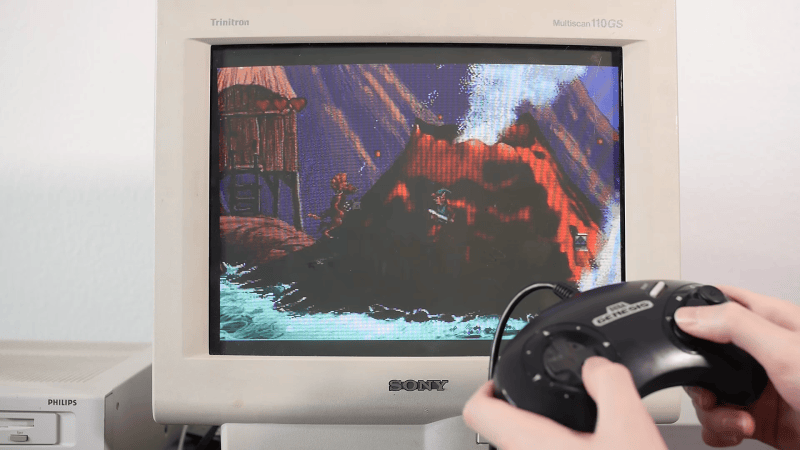
The Philips CD-i was not popular upon its launch in 1991, and is barely acknowledged today. In the opinion of [MattKC], it had a particularly poor selection of controllers, too, and it’s often hard to find used examples anyway. To rectify this situation, he whipped up an adapter to let him use Sega Genesis controllers instead.
The benefit of the Genesis controller is that it uses DB-9 connectors that are readily available, and it’s got a simple pinout that is compatible with the Atari joystick port, too. It makes interfacing the controllers supremely easy. Converting the controllers required using a Arduino Pro Micro to read the Genesis pad and translate it into something suitable for the CD-i.
On the Sega controller side, the microcontroller just has to strobe one pin while reading the state of others to determine what all the buttons are doing. The CD-i, however, expects a serial data stream from the original Philips controllers. Thus, the microcontroller is set up to poll the Genesis controller, and then translate this into the serial commands for the CD-i. It gets a little complicated, because the CD-i wasn’t really built for game controllers, but mouse-like inputs instead. But it’s not too hard to get things working once you understand what the weird Philips console is looking for.
There aren’t really any good games on the CD-i, so this isn’t a project that the retro gaming masses will be flocking to. Still, if you have a CD-i and you want to hook up some controllers on the cheap, this might come in handy. Alternatively, you could also try the BlueRetro project.











The Apprentice is an, um, cute cartoonish platformer game. 😇
Not to be confused with the reality tv series starring a future world leader that shares the same name.
Interesting choice. In my experience, the original Genesis pads are only slightly better than the worst game controller ever made, which is, of course, the Atari 2600 joystick.
Hm. I find the older three button controllers to be nicer than the six button controllers.
The six button controllers are fine for small hands, though.
Maybe they were redesigned to appease the eastern market (smaller people, smaller hands)?
It’s basically same thing as with the original GameBoy.
The old, chubby, heavy one felt nicer somehow. The ergonomics, the haptics etc.
Holding it was a nicer experience than holding the skinny editions (Pocket, Colour, SP).
I developed for CD-i. Nice machine, had some great ideas built into it. I especially liked that it had two SCC66470 display controllers, which were really capable. Each video chip controlled its own ‘plane’, and you could mix planes by making pixels in one plane transparent so that the pixels of the other plane would be visible.
However, with a CD-i you were not allowed to control the display controllers other than through OS system calls. Which basically killed off any advanced usage of the video chips and made it impossible for games to compete with Amiga games. CD-i games had no way of winning against Amiga games, even though imo CD-i’s video hardware was better. Ok, Amiga did have hardware sprites. But both the Agnus and the SCC66470 had a blitter. And basically the CD-i has two blitters, because it has two SCC66470’s.
Basically Philips had as tight a control over the publishing rights of applications as Nintendo had. With the difference that Nintendo wasn’t so completely *nal about complying with some green colored book. And that is what killed the CD-i.
And what did Philips do in the ‘home computer’ market? Sell the most boring computer ever: the P2000. While they had this really capable video chip and could imo have given Commodore and Apple a run for their money.
But like I said. Philips at that time was more about hammering every little detail into documentation and then beating people into compliance with it, rather than that it was about innovation and vision, and allowing people to take a platform to where No Man Has Gone before.