
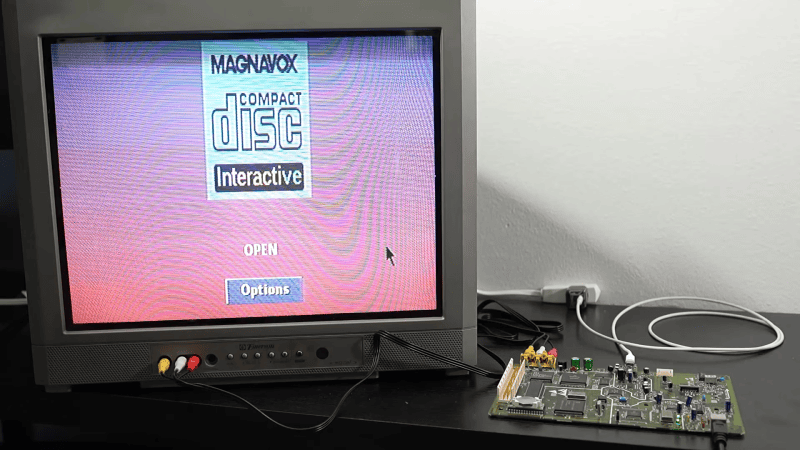
Running A Philips CD-i Off USB-C

The Philips CD-i is a console with many shortcomings, and those include the power supply. For whatever reason, the engineering team decided it should use an 8P8C connector just like Ethernet. Thus, just like your Ethernet cables, it has that annoying problem of the tab snapping off all the time. [MattKC] wondered if the CD-i could benefit from a USB power upgrade instead, and set about making it a reality.

The plan was simple enough—get the CD-i running off of USB-C instead of the ungainly original power supply that shipped with the unit. Given the console runs almost exclusively off of 5 V power, it should have been pretty easy. Only, the original spec adds one little detail that makes things a bit harder. The console is designed to draw up to 3 A from the 5 V line, while also having a -5 V line at 0.2 A. If not for that negative supply, it would have been easy to run the unit off any old 15 W USB-C charger spitting out 5 V. That extra negative line complicates things, because while the negative line could be created with some supporting electronics, it’s hard to find that extra watt from most chargers. While there are plenty of higher-wattage USB-C chargers, the majority tend to use higher voltages to deliver the additional power, capping the 5 V output at 3 amps.

Thus, it was necessary to work a little harder. [MattKC] decided to build a board that would negotiate with a USB-C charger for 9 V operation to get the power budget necessary. This would then be stepped down to 5 V, while there would also be an inversion step to supply the -5 V line, too. A CH221K chip does the job of negotiating a 9 V USB-C power supply, while a TPSM84538 steps the voltage down to 5 V with the capacity to supply up to 5 A. An LT3580 chip then inverts this voltage for the 5 V line. There’s also a power switching circuit on board because the CD-i included some of that functionality in the original power brick.

If you’ve got a CD-i and you’re sick of fussing with the original power supply, this could be a great upgrade. We’ve also explored USB Power Delivery in detail before, if you need a primer.
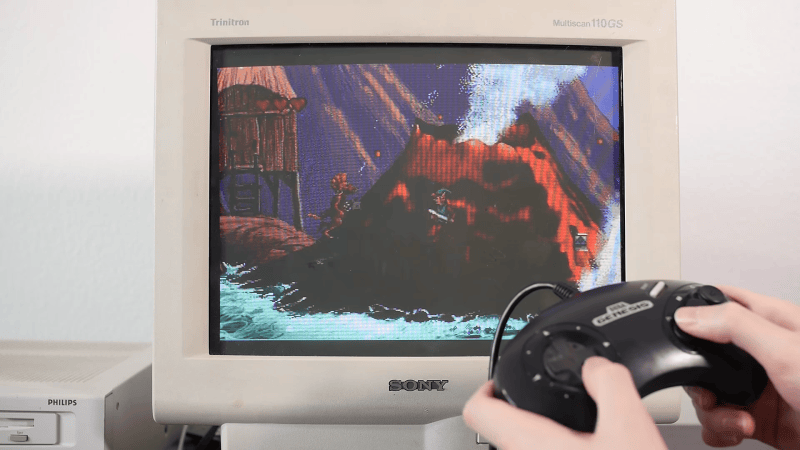
Sega Genesis Controllers On The Philips CD-i

The Philips CD-i was not popular upon its launch in 1991, and is barely acknowledged today. In the opinion of [MattKC], it had a particularly poor selection of controllers, too, and it’s often hard to find used examples anyway. To rectify this situation, he whipped up an adapter to let him use Sega Genesis controllers instead.

The benefit of the Genesis controller is that it uses DB-9 connectors that are readily available, and it’s got a simple pinout that is compatible with the Atari joystick port, too. It makes interfacing the controllers supremely easy. Converting the controllers required using a Arduino Pro Micro to read the Genesis pad and translate it into something suitable for the CD-i.

On the Sega controller side, the microcontroller just has to strobe one pin while reading the state of others to determine what all the buttons are doing. The CD-i, however, expects a serial data stream from the original Philips controllers. Thus, the microcontroller is set up to poll the Genesis controller, and then translate this into the serial commands for the CD-i. It gets a little complicated, because the CD-i wasn’t really built for game controllers, but mouse-like inputs instead. But it’s not too hard to get things working once you understand what the weird Philips console is looking for.

There aren’t really any good games on the CD-i, so this isn’t a project that the retro gaming masses will be flocking to. Still, if you have a CD-i and you want to hook up some controllers on the cheap, this might come in handy. Alternatively, you could also try the BlueRetro project.

Continue reading “Sega Genesis Controllers On The Philips CD-i” →

Fixing Sony And Philips’ Doomed CD-i Console

Although not intended to be a game console, the CD-i would see a a couple of games released for it that would cement its position in gaming history as the butt of countless jokes, some of which still make Nintendo upset to this day. That aside, it’s still a fascinating glimpse at the CD-based multimedia future envisioned in the early 90s, starting with its release in 1990. Recently [MattKC] decided to purchase another CD-i in a fit of nostalgic rage, and repair it to show the world what the future could have been like.

Although Sony and Philips co-developed the device, Sony would go on to release the PlayStation a few years later, which made the CD-i’s life and expectations for it that much harder, leading to it slowly fading into history. The Magnavox one that [MattKC] got is one of the later models, based on the CD-i 450 that was introduced in 1994 as one of the more gaming-oriented models.

As is typical with older devices that use optical media, it would not read discs. It also would sometimes boot up with a ‘Memory Full’ error. This is a common fault due to the built-in battery having run out, erasing RAM-stored values and causing random glitches like this when garbage values were read in on boot.

Continue reading “Fixing Sony And Philips’ Doomed CD-i Console” →








