
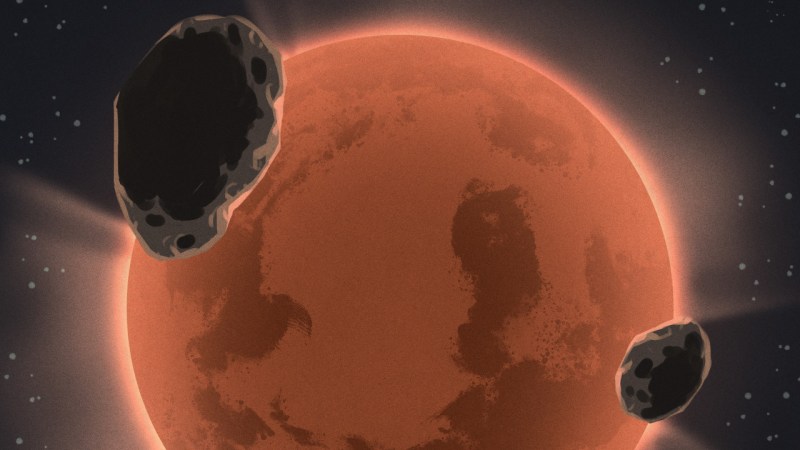
Humanity has been sending robotic explorers to Mars since the 1970s, and for our efforts we’ve been rewarded with not only incredible imagery of the Red Planet’s magnificent desolation, but a wealth of information about the alien world and how it’s changed over the last several billion years. But comparatively, we know almost nothing about the planet’s two moons, Phobos and Deimos. In fact, as recently as the 1960s, there were some scientists that believed the unusual shape, mass, and orbit of Phobos hinted at the possibility that it was no moon at all, and was in actuality a derelict spacecraft of some type.
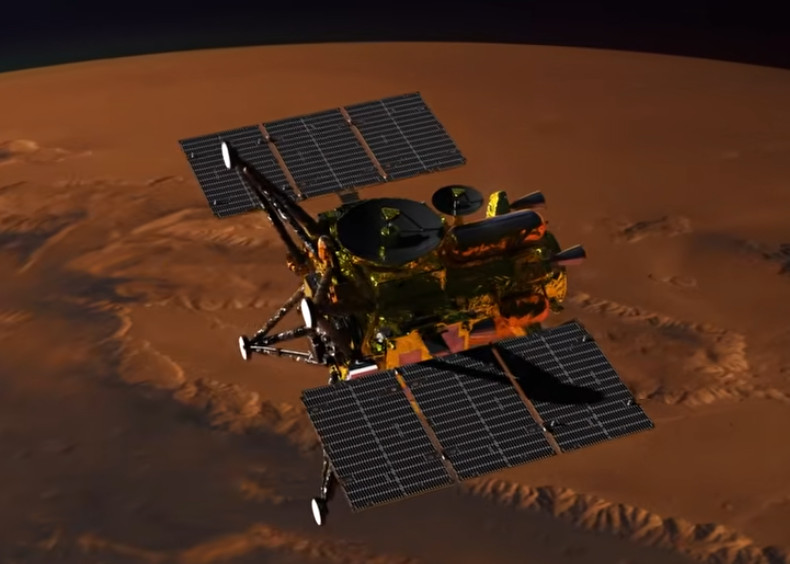
Once the first Viking probes arrived at Mars, we had the photographic evidence and up-close measurements to prove that Phobos wasn’t artificial. But even today, we still don’t know exactly what it is. The data suggests that it’s not solid rock, and that large voids may be hiding under its surface. While we can be fairly sure there won’t be any mummified remains of Martian astronauts to be found within Phobos, vast deposits of ice are a tantalizing possibility.
With the launch of the Martian Moons eXploration (MMX) mission earlier this week, the Japan Aerospace Exploration Agency (JAXA) hopes to bring us one step closer to understanding the formation and structure of Phobos. Should everything go to plan, MMX will deploy a small rover to its tenuous surface in 2029, and by 2031, a sample return capsule will bring pieces of the mysterious moon back to Earth for further study.
A Delicate Operation
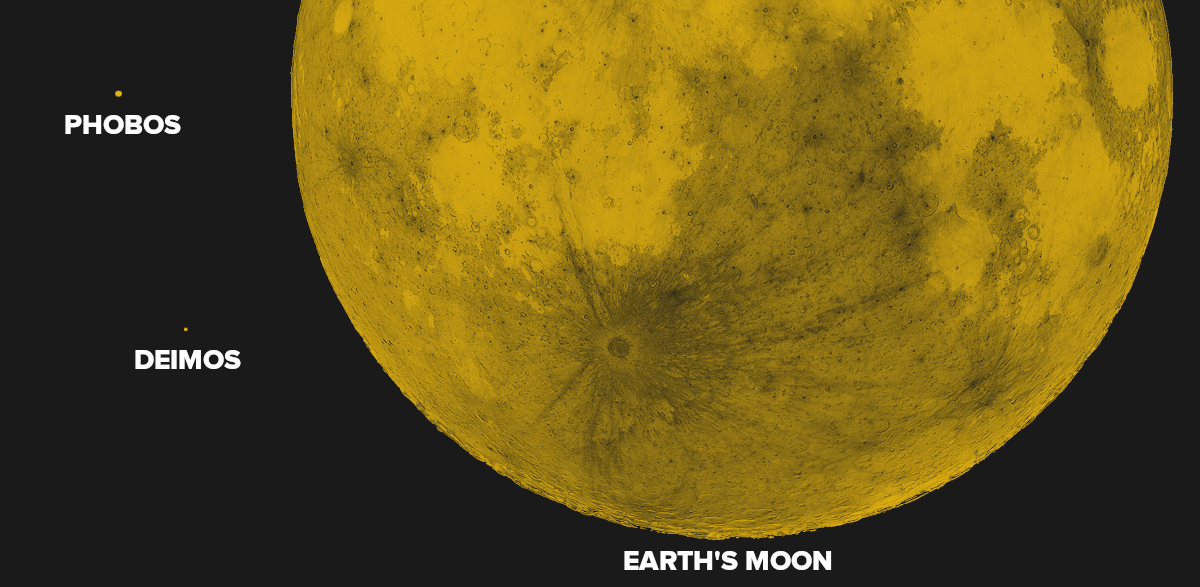
It’s only natural that we’d imagine Phobos and Deimos to be similar to Earth’s moon, but the reality of the situation is very different. For one thing, the Martian moons are absolutely dwarfed by our nearest celestial neighbor. Phobos has a diameter of just 22.2 kilometers (13.8 miles), and Deimos is even smaller at roughly 12.6 km (7.8 miles). For reference, Luna is approximately 3,474 km (2,159 miles) across.
Due to their low mass, putting a spacecraft into a stable orbit around either of the Martian moons isn’t really an option. Some clever maneuvering will put the MMX mission within range of both Phobos and Deimos at different points during the mission, but it won’t be able to stay around for long.
As such, final approach to Phobos will look more like a slow-motion “crash” than a traditional landing. A close comparison would be the OSIRIS-REx mission, where the spacecraft effectively “bumped” into the asteroid Bennu while collecting its samples. The impact velocity will need to be very low to prevent the spacecraft from bouncing off, and even then, some reports indicate that JAXA expects the craft to make at couple of hops before finally settling down.
The situation is compounded by the fact that we still don’t know what the surface conditions are like on Phobos. Based on previous observations, it’s expected that the moon is covered with a layer of fine regolith that could make traversal difficult for the mission’s Idefix rover. Indeed, one of the rover’s primary mission goals is to determine if wheeled motion in such an environment is even viable.
Tiny Moon, Huge Potential
Landing a crewed vehicle on Mars and successfully bringing it back home afterwards is perhaps the most daunting engineering challenge ever conceived. There’s even a solid argument to be made that it’s currently beyond our technological capabilities. The energy requirements of making a propulsive landing on the planet and then lifting off and getting back into orbit are enormous, and will very likely require in situ propellant production to refuel the craft between the two phases of the mission.
Landing on Phobos or Deimos however would require a small fraction of that energy. Moreover, due to their low orbital altitude, the moons would make ideal outposts from which to make detailed observations of Mars. This close proximity to the planet also means human operators on Phobos could directly command robotic vehicles on the Martian surface without the transmission delays that make real-time telerobotics from Earth impossible. While such a mission might not have quite the same symbolic impact of actually putting boots on Mars, it could be a valuable stepping stone towards that eventual goal.
The viability of such a landing may well depend on the findings of Japan’s Martian Moons eXploration mission. Not only in terms of the actual mechanics of rendezvousing with Phobos and touching down on it, but should the mission succeed in returning surface samples, we may be able to confirm whether or not the moon is made from ejected Martian material. Should that be the case, there will likely be even greater interest in studying the planet’s strange little moons up close.












I hope they don’t find any artifacts or some kind of teleportation device…
A “Phobos anomaly” if you will…
…I hope they do lol
But no giant alien spiders though right? Right?
“Landing on Phobos or Deimos however would require a small fraction of that energy.”
Deimos is actually easier to get to (energetically, and in best case alignment) from LEO than the surface of the Moon is!
Escape velocity of Deimos is so low that it’s slower than a fast human runner. Phobos is about twice as much. This leads to comical possibilities like a spring-powered launch or throwing the rover off the moon.
So, throw a baseball and it will hit you in the back of the head an hour later?
No the said escape velocity. So more like throw a ball and it’s lost in space.
If you think about it, it’s downright terrifying, to the umpteenth degree to consider there are places which have escape velocity that can be overcome by running or jumping.
But that fear stems from the actual primal fear, to die in space
It would make a simple game of catch with your beloved canine quite tragic.
The Adventures of Reg O’Lith – Interplanetary Dog Rescuer!
Well if there’s ever an OSHA on the Martian moons, I think they will require a personal RCS system at all times. It’s easy to trip and fly into a sub-orbital trajectory, but it’s equally easy to expel a puff of computer-assisted gas that neutralizes it. If you do it early enough… If you actually build up speed, it doesn’t matter if the gravity is insignificant. Plowing into a rock at hundreds of meters per second is always going to hurt.
On the flip side of fluffy Deimos, is this:
https://en.wikipedia.org/wiki/33_Polyhymnia
If this thing does have some degenerate matter in it…. maybe it could have a shell around it in layers for a space station with different gravity conditions per floor
Other thoughts
https://www.reddit.com/r/IsaacArthur/comments/17k6biu/what_to_think_about_the_strange_claims_about/
https://www.reddit.com/r/xkcd/comments/2gkel2/error_in_the_book_on_the_neutron_star_matter/
Yep! It’s an interesting quirk of the solar system… If you’re willing to wait. The tyranny of propellant mass fraction is good motivation to be a bit patient.
Probably like landing on Moho vs. Minmus (KSP)?
A small human outpost on the trabants of Mars! That would be so cool! 😎
Design-wise, like a meteological station here on earth, if you will.
Say, built like a polar station on Earth (thinking of Von Neumayer-Station, or more the former, more humble Georg-Forster-Station).
With a small crew, maybe. Or being automated by default, but with crew quarters, a ham shack, a data centre,
a planetarium (astrometrics lab like in ST:VOY) and supplies of all kinds.
Like a garage or garden shack for Mars mission..
Saljut 7 (Салют-7 aka Salyut 7) and Skylab already were a bit like this..
Such an outpost could also be a powerful relay station for communication between Mars and Earth/Luna and space vessels in general.
There’s enough space to install antennas of all kinds, for a laser link and for a big array of solar pannels.
A dozen thermo electrical generators could be installed, too.
A natural satellite like this is basically like a big platform in space to install stuff on.
Rockets could deposit stuff up there months or years before human missions to Mars start.
Say, modules with tires that could be arranged remotely?
Hm. Maybe there could be two out outposts that keep a communication link witch each others? Or for redundancy?
In an emergency, a Mars mission could travel to the nearest outpost then.
It could also serve as a small space port, maybe.
For space propes or for traveling between both ouposts.
So yeah, trying to land on these natural satellites is worth a try for sure!
I hope that little Lander of the land of the rising sun is an success
and helps the all of us to get more stuff savely on these celestial bodies.
Learning how to navigate in low-G environments surely needs some practicing! 🙂
The design of the station would be interesting… Or perhaps mundane. It would be little different than a free-space station. It would be the ISS with an ensuite boulder. Managing water and dust would be slightly easier, it would go to the floor… barely.
Or I suppose it would be wisest to put it deep inside the rock. No magnetic field, so no Van Allen belts but also no safe zones either.
Thank you for your reply! That sounds interesting!
There are for sure many different concepts to choose from.
Personally, for example, I remember that Von Neumayer-Station II was underground (under snow), unlike the current Von Neumayer-Station III.
NS II was built using metal tubes, basically.
With a tower and a ladder to climb down (another big entrance for vehicles existed, too).
Btw, I made a mistake in my original comment.
I was thinking in 20th century terms again.
That an united humanity would explore the space together, like it used to in the days of MIR/ISS.
In these recent days we’re living in(to), there might be many rivaling nations that would do their own things.
So maybe multiple outpost will be built on same moons? Who knows.
Thanks for the search terms… do you have any links to information about these bases? The English Wikipedia does not have much detail.
And the moment it touches down, the DOOM music starts…
;)
Don’t be so Phobic, Bey!
I was lucky enough to get to watch the launch in person last week. It was spectacular and from my location the H3 rocket passed very close to Mars.