
When [Matt Williams] found an old enterprise firewall in the trash, he knew he had to do something with it. After cracking it open, he found that this 2000s-era Fortinet FortiGate 60 hardware firewall has some very hackable hardware in the form of a VIA C3 mainboard. This is an x86-compatible CPU that was very popular in small form-factor and industrial solutions around 2000s, meaning that it should be able to run just about anything that’s happy to run on its 400 MHz single core.
Unfortunately it wasn’t a standard Mini-ITX C3 board like the one that [Matt] also has kicking around, as that one features standard DIMMs for the memory modules. For this firewall the 128 MB of SDRAM was soldered to the board, with the only clue as to how to initialize it in the original firmware. Ergo this firmware had to be reverse-engineered to figure out just how this was supposed to happen.
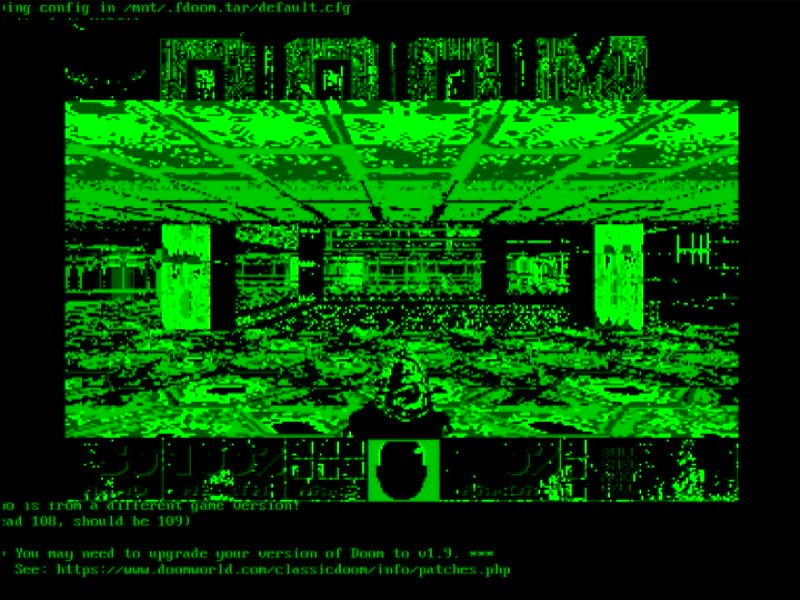
With that done, Linux 2.4 was happy enough to boot on it with a bit more tweaking. Using the framebuffer driver applications like DOOM happily ran, as the above graphic shows. That it’s very much green is due to only the green pin on the VGA connector being probed. Since it’s a firewall Fortinet only added a physical DE-9 port in addition to the internal IDE interface and CF card slot.
If one were to wire up these pads on the mainboard to physical connectors, it would actually make for a pretty decent little system for what the kids call retro gaming these days.











Righteous hack! :-)
Just like Thatcher.
With all that green, it almost looks like doom on an apple II! Even if I was young and didn’t use them much, those green and amber phosphor screens will always give me the warm fuzzies…at least a little bit, whenever I see them.
Memory serves, the amber ones were supposed to be better for the eyes. Vaguely recall a white (ish?) flavour as well. I’ll still take a modern flatscreen (and my bifocals!) any day, but as you say, fond memories, good times.
The green and amber CRTs usually had used phosphor with a longer persistent time.
Green was best in terms of afterglow, followed by amber.
Amber was more eye-friendly if there was no flickering.
“Paper white” CRTs were popular by late 80s but required a higher refresh rate to avoid flickering.
So that’s why all those IBM MDA compatible CRTs (aka Hercules monitors) were mainly green (or sometimes amber).
They were basically little radar screens on the desktop. ;)
At 50 Hz refresh and a bright text on dark background, the green monitors of office PC had an advantage.
Normal monochrome video monitors (15 KHz, 50/60 Hz) had existed, too, of course.
Great work!
Your VIA C3 cpu is i586, so other than just using an older distro you can build your own tiny linux with buildroot – try it out, you’ll love it.
Ah, brings back memories of the the VIA Epia series of motherboards!
They used to be popular in Car PC scene, I vaguely remember!
The VIA C7D was capable of running Windows XP SP2 just fine, btw.
https://en.wikipedia.org/wiki/EPIA
PS: Speaking of Windows XP, it can still run on plain i586 systems, btw!
Even on i486 systems thanks to that recent patch..
But honestly, a Pentium MMX with 64 MB of RAM, a PCI VGA card and a 2 GB SCSI HDD is the lower minimum for Windows XP SP0.
Otherwise, it’s not really fun. Windows 2000 or an older Windows Workstation/Server release is better for i486/i586.
About Linux.. I vaguely remember that Knoppix used to be popular on VIA C3 based Car PCs in early 2000s.
Where I live, at very least.
That’s useful to ham radio fans, btw!
A DE-9 connector is useful for using a radio “modem” (TNC, PTC etc), CAT connection (to transceiver), antenna rotator control or for triggering the transmit pin of the transceiver (simple PTT interface).
Some DOS applications also did audio via serial pin using PWM method (HamComm modems etc).
It was an alternative to tapping the PC speaker on motherboard.
Sound Blaster support came later in some programs.
About the green pin. In analogue video environment, there’s also “sync on green”.
So green has a bit of a special role, historically. It’s more than being Matrix movie sort of retro cool.
In the old frame-sequential SSTV (Slow Scan TV), the first Colour SSTV system, individual Red/Green/Blue frames were sent one after another.
And the green image frame was often viewed best by users of monochrome equipment (today b/w SSTB often is refered to as Robot-8, though strictly speaking Robot was 4:3 ratio and not 1:1 ratio like original 7s/8s SSTV).
Likewise, the frame buffer for green was often used to transmit a monochrome image from colour systems.
Because green was closest to the brightness levels of a real monochrome image.