
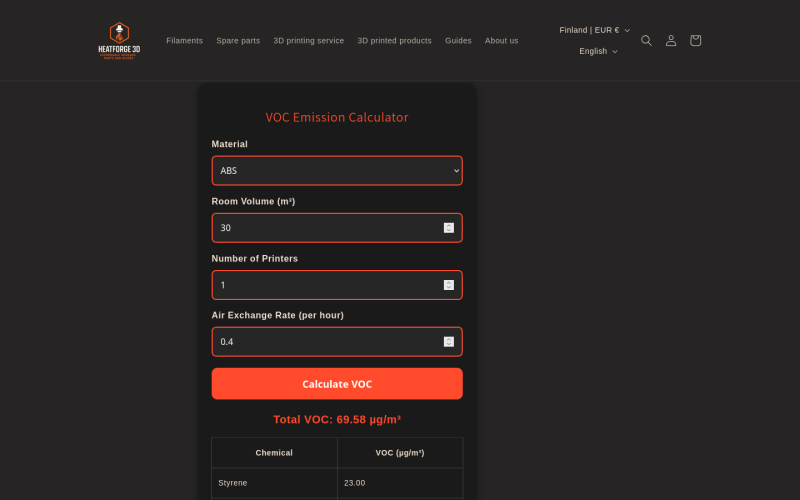
We love 3D printing here, but we also love clean air, which produces a certain tension. There’s no way around the fact that printing produces various volatile organic compounds (VOCs), and that we don’t want to breathe those any more than necessary. Which VOCs, and how much? Well, [Jere Saikkonen] has created a handy-dandy calculator to help you guesstimate your exposure, or size your ventilation system, at least for FDM printing.
The emissions of most common FDM filaments are well-known by this point, so [Jere] was able to go through the literature and pull out values for different VOCs of concern like styrene and formaldehyde for ABS, PLA, Nylon, HIPS and PVA. We’re a bit disappointed not to see PETG or TPU on there, as those are common hobbyist materials, but this is still a great resource.
If you don’t like the numbers the calculator is spitting out, you can play with the air exchange rate setting to find out just how much extra ventilation you need. The one limitation here is that this assumes equilibrium conditions, which won’t be met save for very large prints. That’s arguably a good thing, since it errs on the side of over- rather than underestimating your exposure.
If you want to ground-truth this calculator, we’ve featured VOC-sensing projects before. If you’re convinced the solution to pollution is dilution, check out some ventilated enclosures. If you don’t want to share chemistry with the neighborhood, perhaps filtration is in order.
Thanks to [Jere] for the tip!












“If you’re convinced the solution to pollution is dilution,”
“If you don’t want to share chemistry with the neighborhood”
Well, I don’t know if dilution is a solution per se.
I would love to see a study on just what happens to particles from 3d printing after they are exhausted outside. Does the UV or microbes break them down? Do they end up falling into the soil and if so are they inert or do they actively cause problems? Or do they just float in the air until something or someone inhales them?
Perhaps the answers will show that once we exhaust them from the house they no longer really matter. Or maybe it would show the opposite. I’d love to have real answers and not just assumptions though!
This is reasonable place to start on the evidence…
https://www.epa.gov/chemical-research/3d-printing-research-epa
From the papers referenced, PLA is better than ABS, but both produce large amounts of ultrafine (respirable) particles.
What I took from the ecidence is that it’s best to always use a filter and an extractor…
As far as particles in the environment, PLA should break down relatively quickly, but best not to breath in anything under pm20…
Also didn’t find much on the plasticisers/additives in PLA… But those may be of concern too.
P.s. looks like there are manufacturers which claim to sell pure PLA (without additives). These should have very low VOC, but particulates are still an issue.
https://maxxeshop3d.com/index.php?route=product/product&product_id=64
https://www.dasfilament.de/filament-spulen/pla-1-75-mm/5/pla-filament-1-75-mm-natur-800-g?c=11
Apparently it’s stiffer than filament with additives (but I’m not experienced in 3d printing… So take all opinions with a grain of salt!)