
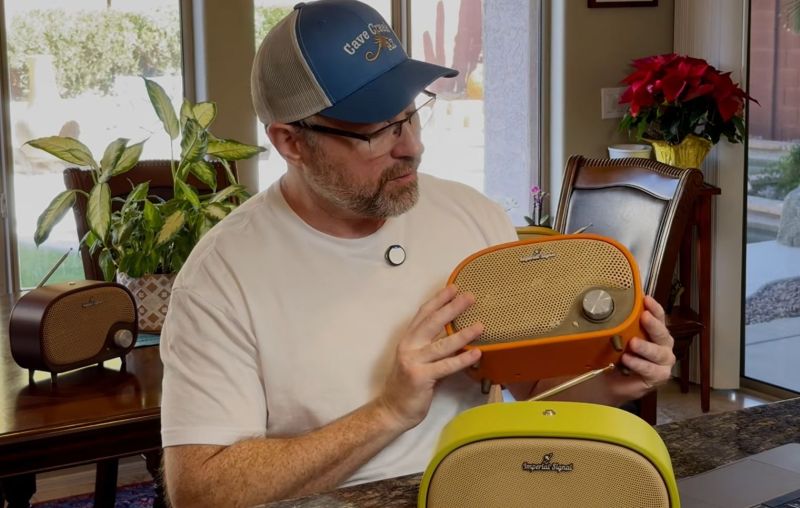
Although hobbyists these days most often seem to use thermoplastics as a print-and-done material in FDM printers, there’s absolutely nothing stopping you from taking things further with thermoforming. Much like forming acrylic using a hot wire or hot air, thermoplastics like PLA can be further tweaked with a similar method. This can be much less complex than 3D printing the design with supports, as demonstrated by [Zion Brock].
For this classically styled radio project the front grille was previously 3D printed with the curved shape, but to avoid an ugly edge it had to be printed with most of the grille off the print bed, requiring countless supports and hours of printing time. To get around this, [Zion] opted to print the grille flat and then thermoform its curved shape. Of course, due to the unusual shape of the grille, this required a bit more effort than e.g. a spherical form.
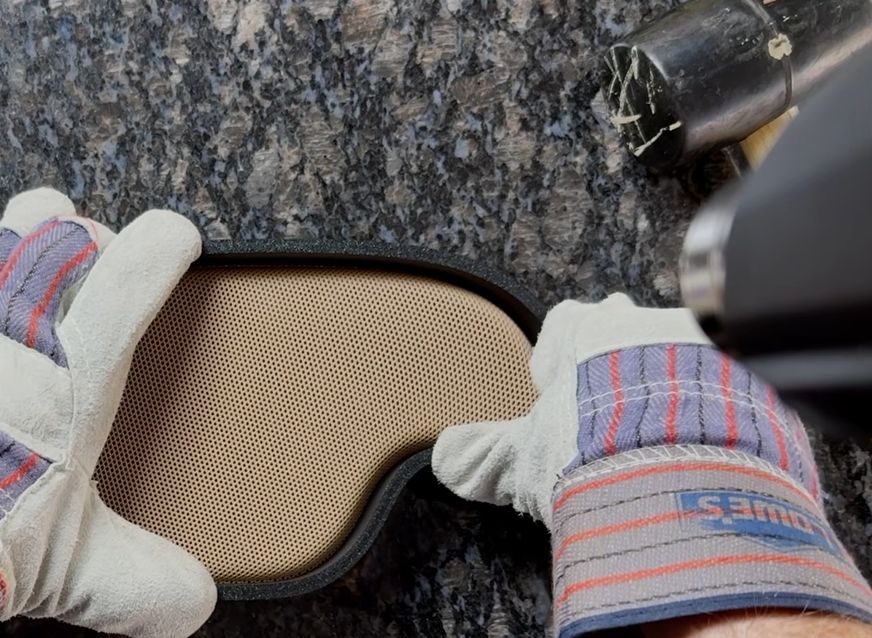
This is similar to what is used with sheet metal to get detailed shaped, also requiring a mold and a way to stretch the flat shape over the mold. With the flat form designed to have all the material in the right places, it was able to be printed in less than an hour in PLA and then formed with a heatgun aimed at the part while the two-section mold is slid together to create the final form.
You can find the design files and full instructions on the website for the radio project.












To think, back in the old days we had to buy speaker grill cloth or perforated metal, and stretch it over a form to get that look.
This is totally out of reach nowadays…
I don’t know that there’s any point in doing this, but it would be interesting to use a multi material printer using a couple different grays to print implied shadows and make a moderate amount of curve look like lots more curve: trompe l’oeil but instead it’s trompe l’PLA.
The reasoning is that getting the curve just printing took way longer and results in wasted materials in the form of supports.
Whatever happened to gradient infill, here it would allow to offset the deformation around the edge, resulting in a more even hole density.
Or, using Z-AA, the outer 2-3cm could be thickened to redistribute the stretch, but I suppose at that point cooling dynamics are better influenced by controlling contact to the pattern, as well as preheating it.
I would interested in knowing how these relatively-thick plastic grilles compare to grille cloth in sound transmission. I’ve always been suspicious about the cloth, and I’m even more dubious about this.
Project specifically declares “slightly distorted characteristics that define the AM radio”, so I’m pretty sure high fidelity is NOT included.
Very honored you guys featured my design! Surprised and honored. thanks guys!
Why not cloth?
Props to him for owning the verbal typo.
Super extra props for the very subtle whisper correction! Just enough to know its there but not too much to be distracting. And hilarious.