
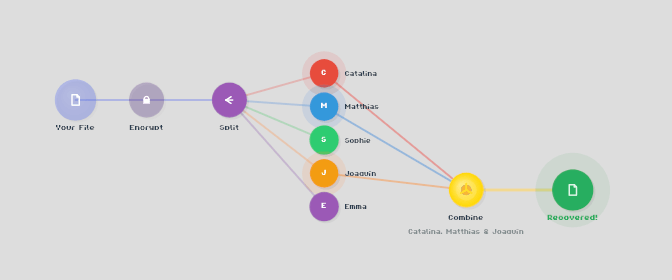
What would happen if you lost your memory, even partially? With so much of our lives being digital, forgetting your passwords (or the master key to your password manager) could be disastrous. Haunted by that specter after a concussion, [eljojo] created ReMemory, a tool based on Shamir’s Secret Sharing to help your friends help you.
Shamir’s Secret Sharing, for the uninitiated, is a way to split up important data between parties so that the full picture is only available when a quorum comes together. The classic example is giving everyone a couple of digits out of the combination to the bank vault, but no one the full combination. Together, they can open the vault.
ReMemory works the same way. Rather than the combination to a bank vault, the locally-hosted, browser-based interface splits the encryption key to your sensitive data. If you’re old fashioned that might be a plaintext list of passwords, or for the more modern the recovery codes to your password manager. It could be literally anything, like your Aunt Edna’s famous cupcake recipe, which surely should not be lost to time.
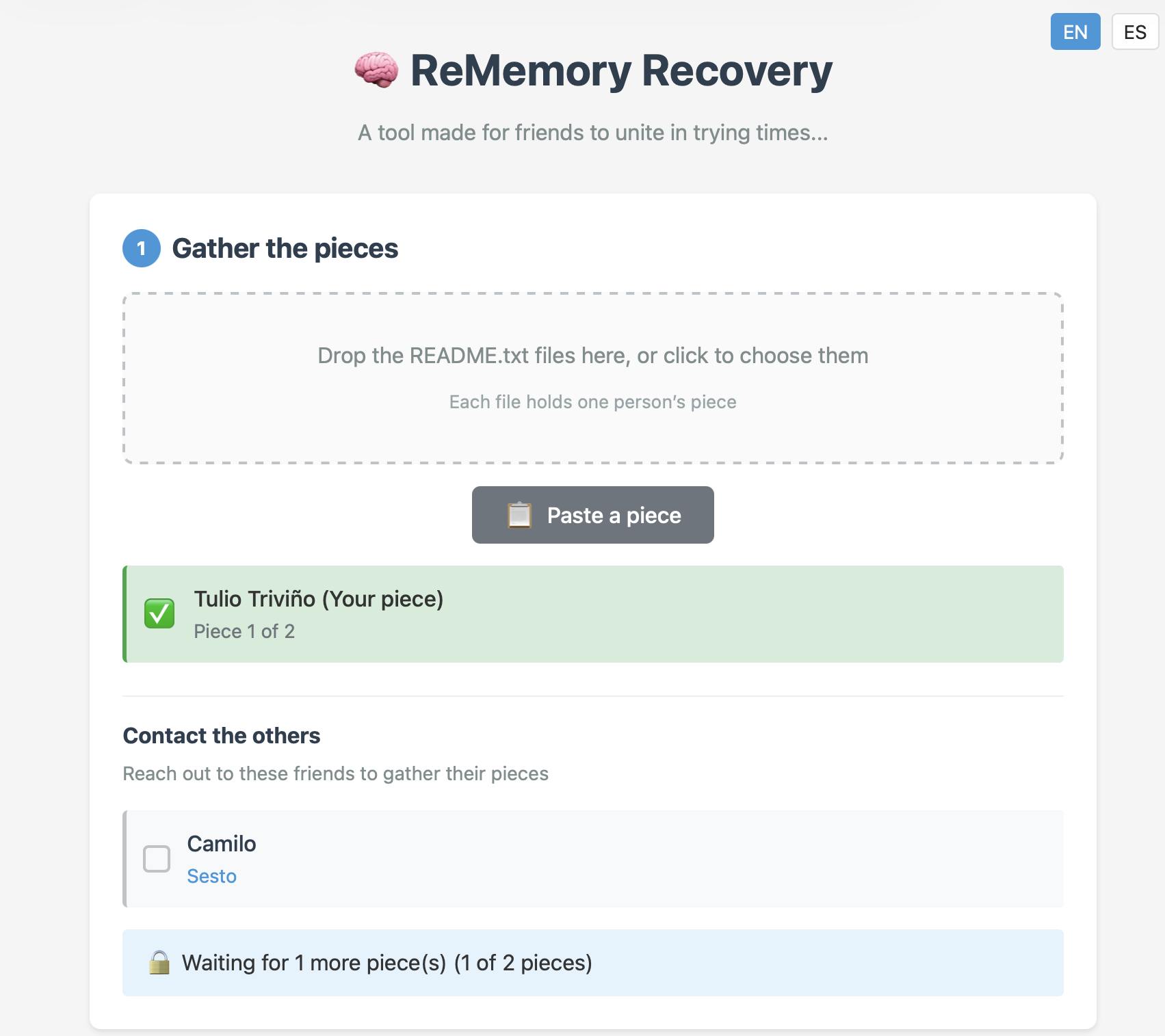
You can chose how many friends to split your data betwixt, and how many will be required to meet quorum– the minimum, of course, being two, but the suggested default is to split the data five ways, and allow decryption from any three parties. Each bundle includes the complete recovery tool, so anyone in your circle of trust can start the process of decrypting your data if they get the others on board. Since it’s self-hosted and browser based, those friends don’t have to be particularly tech-savvy, as long as they can be trusted to hold onto the files. Everything is explained in the readme included in each bundle.
This does have the downside of requiring you to have multiple close friends, at least some of whom you trust to come through in a crunch, and all of whom you trust not to collude behind your back. Still, if you’re the social type, this seems like it might be a useful tool. The code is available under an Apache 2.0 license, so you can audit it for yourself — a must for any tool you plan on entrusting your secrets to.
The best part of the sharing algorithm is that it’s not vulnerable to quantum computing. While [eljojo] was thinking of amnesia when he put the tool together, we can’t help but think this also solves the postmortem password problem.












Just hope you remember which tool you used for this, and which friends you picked to hold the secret :)
And hope your not ghosted by your /friends/.
And that your friends themselves did not forget or lost the piece of information they should retain
easy: just use rememory.
oh, uh….
the ZIP file that you send your friends comes with the tool included in it. the idea is for you to tell them to reach out back to you in case you have a health issue/accident. The ZIP file contains a PDF with contact details for your other friends.
But where will they store that zip file so they can find it in good state after all those years?
“This does have the downside of requiring you to have multiple close friends”
LOL
KISS: i have a piece of paper for secrets :)
and location stored in head? :)
don’t jinx it
…and a desire to have your secrets stolen by any single person who gets their hands on that piece of paper.
don’t mistake dgaf for desire :)
(hanlon’s razor)
Physical security is a pretty solved problem. I can count on one hand the number of friends who’ve had a burglary. And even then, they’re usually after stuff they can sell for crack, not passwords.
Yes, targeted attacks for secrets happen, but they’re vanishing rare.
On the other hand, I’ve lost count of the number of friends who’ve had accounts hacked through poor passwords, or lost the passwords to their accounts.
I’ve thought about this problem a bit for personal use, but have not yet found the solution. At the moment, I wouldn’t know what to encrypt with this tool and who to give access. I would need to plan for it, and to refresh the file regularly without bothering every holder of a piece. But it’d be a good reason to call your friends on a regular basis.
With the risk of making it a scavenger hunt, it would ideally have several components. Electrical, physical, and time. You can share a password to physical media with your friends with this or a similar tool, including a list of whom to contact. Alternatively, the password could be to a Keepass archive with a seven-day delay, or something. If the decryption is started maliciously or by mistake, you still have plenty of time to change the password. This doesn’t help if you need the secret right away, though.
Friends have joked for a long time to set up a cronjob, which shares the secrets when you didn’t log in for a week. But whatever you do, think it through, and you are likely to find a better solution than just trusting a random vibe coded project.
This sounds like an ideal solution for my needs, with some modification.
I have stashed in multiple digital locations copies of an encrypted packet. Inside this packet are documents listing my final wishes and letters to be sent to various people in case of my death. Things I never had the courage to say, secrets I’ve kept, reminders of how I felt and words of encouragement, etc. I already have an arrangement with one friend to retrieve and deliver the letters to their intended recipients, but I worry what would happen if he can’t make it, or someone else obtains those letters first.
I am thinking I can divide the secret into 4 pieces, and give each of 6 trusted friends/relatives a unique combination of 2 pieces. This way they only require a quorum instead of all of them.
Update: I am dumb and missed a whole paragraph in the article and instead dove into source code before reading all the features. It already does that. Duh.