
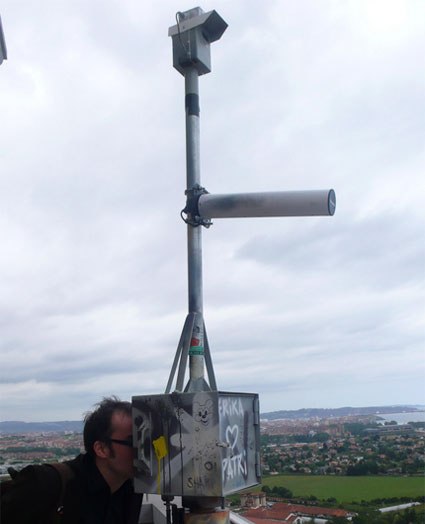
We Make Money Not Art recently visited the LABoral Art and Industrial Creation Centre in Gijón, Spain. The installation that left the strongest impression on [Regine] was the WiFi sightseeing telescope built by Clara Boj and Diego Diaz. Spain is in a situation similar to the USA: A few years ago many municipal WiFi projects launched only to be squashed because of theoretical unfair competition with local utilities. Now commercial projects like WeFi, Whisher, and FON encourage people to “share” their WiFi. Observatorio (Observatory) is designed to provide insight into the current state of local WiFi. It uses a highly directional Yagi antenna to collect wireless access data from the local area. The antenna has a 30deg aperture which is matched to a camera with an identical field of view. The observer sees the camera’s viewpoint with the WiFi data overlaid showing where accesspoints are and whether the AP is open. WMMNA also recommends you check out the WiFi Camera which photographs electromagnetic space.
antenna254 Articles
Creeping Wave Antenna
Monitoring medical patients remotely 24 hours a day has always proven to be a difficult proposition due the size of the wireless sensors attached to the patient’s body to relay vital signs. A team from Queen’s University Belfast has come up with a solution that utilizes the creeping wave effect. The effect applies to electromagnetic waves as they come into contact with solid objects. While the majority of the waves are absorbed by the object, a small amount move along the surface of the object before they continue their path.
Since most of the signal sent by conventional biosensors is absorbed by the patient’s body, the signal must be strong enough to compensate. The antennas designed by the Queen’s University team, though, focus their broadcast laterally instead of inward and outward, maximizing the amount of waves that will travel along patients’ bodies via the creeping wave effect and minimizing the amount that are absorbed. These antennas are up to 50 times as efficient as conventional antennas of the same size, broadcasting a stronger signal with less power.
The applications to the wireless body area networking, attaching multiple biosensors to patients’ bodies, field are obvious, but this technology could be used in other ways. Since the creeping wave antenna is small and wearable, it could conceivably be used to boost low power communication to PDAs, cellphones, or any other portable wireless product.
[via Medgadget]









