

Once upon a time, cars were merely designed for performance, comfort, and usability, with little regard to how safe they may or may not be in the event of a collision. In this era, it turned out that most cars were horrific deathtraps, but eventually outside pressure led the industry to try and make cars safer. It was realized that making crashes more survivable with less injuries was generally a good thing.
Ever since, there has been a general push towards making cars ever safer as time goes on. To that end, researchers have been exploring whether the use of metal foams could aid in further crash safety improvements.
Metal Foams
When it comes to automobile collisions, safety for vehicle occupants largely comes down to absorbing energy in a controlled manner. Vehicles moving at high speed have a great deal of kinetic energy, and that needs to be dissipated and controlled in such a way that the people inside a car are harmed as little as possible. The concept of crumple zones is key, here—wherein parts of the vehicle are designed to crumple and deform in such a way to absorb the energy of an impact while preserving the integrity of the passenger compartment of the vehicle as much as possible.
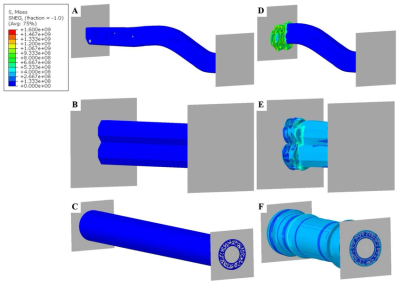
Researchers at NC State University have been exploring whether or not metal foams could further improve the safety of vehicles in collisions. Composite metal foams (CMFs) are a material that consists of hollow metal spheres embedded in a greater metallic matrix. This creates a structure that is both lightweight, and highly capable of absorbing compressive and impact forces. The study used computational models to determine whether incorporating these metal foams into front rail vehicle crash structures could improve their ability to absorb energy in a crash.
As per the research paper, the study explored the use of a steel-based composite metal foam, wherein stainless-steel hollow spheres were packed into a 316L stainless-steel matrix with a 59% density in a structure inspired by a body-centered cubic lattice. The idea is that the foam helps absorb energy because of the cushioning effect of the pressurized air present in the hollow spheres in the structure, which eventually burst under enough deformation.
Computational models were created to model the difference in energy absorption and crash safety results between front rail crash structures that were filled with composite metal foams, and those that solely relied on the basic steel or aluminium structure itself. The research explored both double-octagon and rectangular cross section structures, as are commonly used in modern production vehicles.
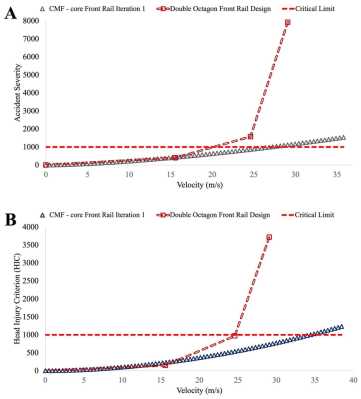
Results from the simulations were striking. Creating a double-wall tube front rail with composite metal foams allowed the vehicle to survive impacts at higher speeds before hitting safety limits. In the case of the conventional double-octagon rail, impact speeds could be 34% higher before hitting a critical crash-severity limit, or 40% higher with regards to head-injury limits.
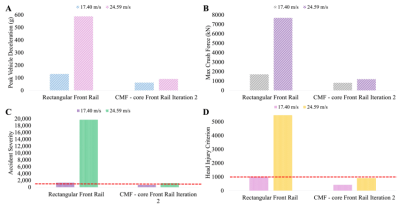
For the rectangular rail case, the model determined the speed was 32% higher for crash severity limits and 48% for head injury limits, respectively. Exploring crashes at 55 mph, the CMF rail of the same size and weight reduced the maximum deceleration experienced in the collision by 38%, while reducing crash severity by 45% and a measure of likelihood of severe head injury by 45%. The improvements were even higher in the case of rectangular rails, with maximum deceleration slashed by 84%, with crash severity and head injury likelihood cut by 94% and 83% respectively.
It’s worth noting that, at this stage, the study was performed in simulation. Finite element models do exist for composite metal foams and were key to this work. However, to really make an impact, pardon the pun, further research will be needed.
As is always the way in the automotive industry, metal foam-based crash structures would have to prove themselves in real crash testing—something that doesn’t come cheap. Even if composite metal foams do improve crash safety, there will still be a level of bean counting that determines whether they become a part of future vehicle designs. If metal foams cannot be readily produced at a reasonable cost, and vehicles are still passing the required crash tests, automakers may decline to employ them in future designs. For now, the concept remains just that, as an interesting area for further study and application.












Please be kind and respectful to help make the comments section excellent. (Comment Policy)