

Full-Blown Cross-Assembler…in A Bash Script

Have you ever dreamed of making a bash script that assembles Intel 8080 machine code? [Chris Smith] did exactly that when he created xa.sh, a cross-assembler written entirely in Bourne shell script.
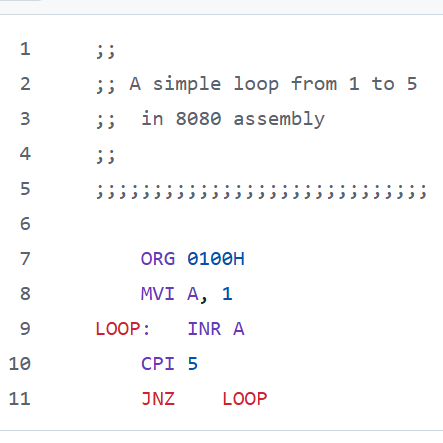
Assembly language (like the above) goes in, a binary comes out.

The script exists in part as a celebration of the power inherent in a standard Unix shell with quite ordinary POSIX-compliant command line tools like awk, sed, and printf. But [Chris] admits that mostly he found the whole project amusing.

It’s designed in a way that adding support for 6502 and 6809 machine code would be easy, assuming 8080 support isn’t already funny enough on its own.

It’s not particularly efficient and it’s got some quirks, most of which involve syntax handling (hexadecimal notation should stick to 0 or 0x prefixes instead of $ to avoid shell misinterpretations) but it works.

Want to give it a try? It’s a shell script, so pull a copy and and just make it executable. As long as the usual command-line tools exist (meaning your system is from sometime in the last thirty-odd years), it should run just fine as-is.

An ambitious bash script like this one recalls how our own Al Williams shared ways to make better bash scripts by treating it just a bit more like the full-blown programming language it qualifies as.


Linux Fu: Alternative Shells

On Unix — the progenitor of Linux — there was /bin/sh. It was simple, by comparison to today’s shells, but it allowed you to enter commands and — most importantly — execute lists of commands. In fact, it was a simple programming language that could make decisions, loop, and do other things to allow you to write scripts that were more than just a list of programs to run. However, it wasn’t always the easiest thing to use, so in true Unix fashion, people started writing new shells. In this post, I want to point out a few shells other than the ubiquitous bash, which is one of the successors to the old sh program.

Since the 7th Edition of Unix, sh was actually the Bourne shell, named after its author, Stephen Bourne. It replaced the older Thompson shell written in 1971. That shell had some resemblance to a modern shell, but wasn’t really set up for scripting. It did have the standard syntax for redirection and piping, though. The PWB shell was also an early contender to replace Thompson, but all of those shells have pretty much disappeared.

You probably use bash and, honestly, you’ll probably continue to use bash after reading this post. But there are a few alternatives and for some people, they are worth considering. Also, there are a few special-purpose shells you may very well encounter even if your primary shell is bash.

Continue reading “Linux Fu: Alternative Shells”








