
When we think of 1960s synthesizers it’s usual to imagine instruments with vast arrays of controls and patch cables for configuring their many filters, oscillators, and other parameters. They created the templates for much of what we know today as electronic music.
In all the rush to look at full-blown synths though, it’s easy to forget their more mundane cousin, the electric organ. These instruments graced many a ’60s suburban home or church hall, and [Emma Repairs] has an interesting one. It’s a Philips Philicordia, and it’s sent us here at Hackaday down one of those rabbit holes when we should really be writing.
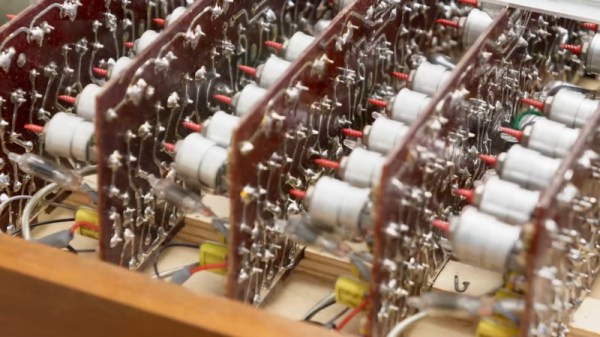
The instrument is a relatively straightforward single voice electric organ on the outside, but under the hood it’s a different matter. In an age when the transistor was revolutionizing electronic music, the folks in Eindhoven designed this one using tubes. There are a set of conventional enough tubes performing the role of amplifiers and oscillators, but the real party piece of this unit is the array of neon tube dividers. A neon bulb can be used as a switching element, and in those days when affordable digital logic chips were several years away, it made sense to use them in digital circuits.
The inside of the Philicordia is a feast of vintage Philips parts that will be instantly familiar to anyone who’s worked on Western European electronics of this era. The exterior design of the instrument screams understated early-1960s cool, and after she’s introduced it you can hear her playing it in the video below. Further down that rabbit hole we found that one of these instruments provided the distinctive organ sound on Chris Montez’s 1962 hit Let’s Dance, so they weren’t all uncool.









