Targeting Allele-Specific Faulty MRNA In SCNA2 Mutation Patients

When an individual is born with genetic defects, there are a few ways to deal with the impact of the faulty genes. The most extreme solution is direct DNA editing to repair the mutation, while the treatment of symptoms with medication is the least invasive, though this comes with its own set of disadvantages. Antisense therapy keeps a middle ground here, by targeting the messenger RNA (mRNA) that forms the bridge between DNA and the translation into a functional protein by the ribosome.

In a recent study by [Olivia Kim-McManus] et al. antisense therapy with an allele-specific feature was demonstrated in two individuals with SCN2A mutations. These mutations had resulted in severe epilepsy and developmental disorders, due to how instrumental this gene is for normal functioning of the human central nervous system (CNS) where it regulates the initiation of action potentials.

Although SCN2A mutations are rarely inherited, for the approximately 1 in 80,000 affected the consequences can be quite dramatic. The two major types of mutations are classified as gain-of-function (GoF) and loss-of-function (LoF) with respectively hyper- and hyposensitivity of the resulting NAv1.2 sodium channels.

This translates especially in the case of GoF mutations into various symptoms, ranging from mild to severe (daily) epileptic attacks starting as an infant, stalled neurodevelopment and various types of autism (ASD). Often sodium channel blockers are prescribed for the GoF cases to limit epileptic attacks.

Usually with the responsible mutations only a single copy of the gene is affected, so while regular antisense therapy could be used, this would risk also modifying the healthy SCN2A mRNA copy. To get around this, an individualized treatment was developed, targeting the allele with the mutated gene for the two patients in the study: 9- and 14-year old boys with severe developmental and epileptic encephalopathies (DEE) that had left them with daily seizures and despite sodium-channel blockers and other typical medications.
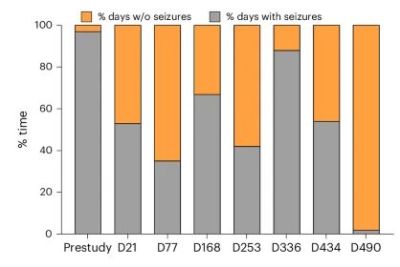
Study outcome of the 14-year old boy with DEE after ASO therapy. (Credit: Kim-McManus et al., Nature Medicine, 2026)

During the trial, the 9-year old boy received 12 doses over 24 months of antisense oligonucleotides (ASOs) adapted to his affected allele, allowing for the cessation of the anti-seizure medication phenytoin, with an overall reduction in seizures. In the case of the 14-year old boy 8 doses were administered over 16 months, resulting in an average of two seizures a day being reduced to zero.

Although the focus of the study was on treating these seizures, by addressing the underlying cause of faulty mRNA transcriptions, changes in the neurodevelopmental state could also be observed. In particular language and motor skills improved, with erratic and irritable behavior reducing. The by then 15-year year old boy was able to walk unassisted, showing clear progression from the previous infantile state.

The advantage of ASOs over typical anti-seizure medication is of course that it directly addresses the faulty mRNA and thus the resulting faulty sodium channels. Since ASOs tend to hang around in a cell for a considerable amount of time, they could be quite a viable alternative treatment even for less severe cases. Whether early application of individualized ASOs in affected infants could lead to a more or less normal neurodevelopment would also be an interesting study question.

Naturally, directly addressing the faulty gene or upregulating the healthy gene would be the ideal and permanent solution, with research here also underway in mice models with the use of CRISPR-based tools.
Antiviral PPE For The Next Pandemic

In what sounds like the plot from a sci-fi movie, scientists have isolated an incredibly rare immune mutation to create a universal antiviral treatment.

Only present in a few dozen people worldwide, ISG15 immunodeficiency causes people to be more susceptible to certain bacterial illnesses, but it also grants the people with this condition immunity to known viruses. Researchers think that the constant, mild inflammation these individuals experience is at the root of the immunoresponse.

Where things get really interesting is how the researchers have found a way to stimulate protein production of the most beneficial 10 proteins of the 60 created by the natural mutation using 10 mRNA sequences inside a lipid nanoparticle. Lead researcher [Dusan Bogunovic] says “we have yet to find a virus that can break through the therapy’s defenses.” Researchers hope the treatment can be administered to first responders as a sort of biological Personal protective equipment (PPE) against the next pandemic since it would likely work against unknown viruses before new targeted vaccines could be developed.

Hamsters and mice were given this treatment via nasal drip, but how about intranasal vaccines when it comes time for human trials? If you want a short history of viruses or to learn how smartwatches could help flatten the curve for the next pandemic, we’ve got you covered.

Feline Genetics And Why Orange Cats Are The Most Special

Recently, butlers to orange-colored cats got a bit of a shock when reading the news, as headlines began to call out their fuzzy feline friends as ‘freaks of nature’ and using similarly uncouth terms. Despite the name-calling, the actual reason for this flurry of feline fascination was more benign — with two teams of scientists independently figuring out the reason why some cats have fur that is orange. Tracking down the reason for this turned out to be far more complicated than assumed, with the fact that about 80% of orange cats are male being only the tip of the cat-shaped iceberg.

It was known to be an X chromosome-linked mutation, but rather than the fur coloring being affected directly, instead the mechanism was deduced to be a suppression of the black-brownish pigmentation (eumelanin) in favor of the orange coloration (pheomelanin). Finding the exact locus of the responsible ‘O gene’ (for orange) in the cat genome has been the challenge for years, which turned out to be a mutation related to the X-linked ARHGAP36 gene, whose altered expression results in the suppression of many melanogenesis genes.

Interestingly, this particular mutation appears to be of a singular origin that apparently persisted over millennia courtesy of the domestication of humans (H. sapiens) by Felis catus.

Continue reading “Feline Genetics And Why Orange Cats Are The Most Special”

High Energy Gardening Means Nuking Plants

We live in a world transformed by our ability to manipulate the nucleus of atoms. Nuclear power plants provide abundant energy without polluting the air, yet on the other hand thousands of nuclear warheads sit in multiple countries ready to annihilate everything, even if it’s not on purpose. There are an uncountable number of other ways that humanity’s dive into nuclear chemistry has impacted the lives of people across the world, from medical imaging equipment to smoke detectors and even, surprisingly, to some of the food that we eat.

After World War 2, there was a push to find peaceful uses for atomic energy. After all, dropping two nuclear weapons on a civilian population isn’t great PR and there’s still a debate on whether or not their use was justified. Either way, however, the search was on to find other uses for atomic energy besides bombs. While most scientists turned their attention to creating a viable nuclear power station (the first of which would only come online in 1954, almost ten years after the end of World War 2), a few scientists turned their attention to something much less obvious: plants.

Continue reading “High Energy Gardening Means Nuking Plants”