Flex Filament Stuck To Your Build Platform? Reach For The Isopropanol

3D printing has been around long enough that everyone’s heard at least one weird trick regarding 3D prints. [Angus] of [Maker’s Muse] puts a few to the test, and came away with one solid tip for releasing TPU from a build platform to which it has unfortunately welded itself.

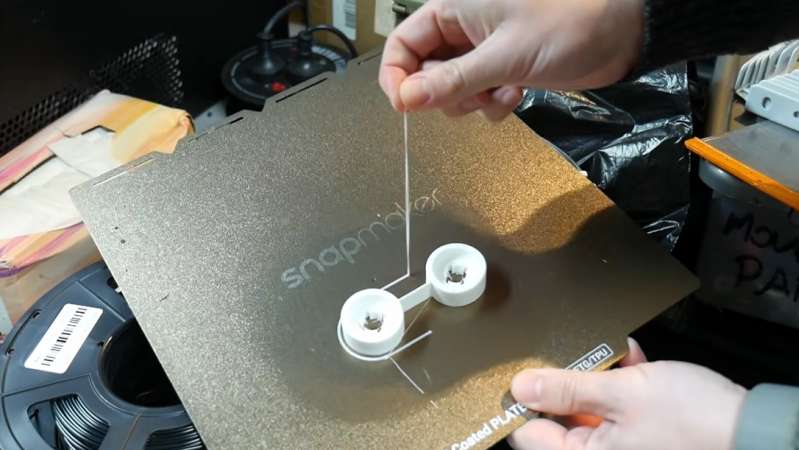
Flexible filaments tend to stick too well to build plates, which is why an interface layer like a thin layer of glue stick is called for. But what if one forgets to apply it before starting a print job? That can result in a print that is well and truly stuck. Peeling flex filament off a textured PEI bed is a bad time, because the print can tear and tends to leave little bits behind.

[Angus] heard that applying isopropyl alcohol helps release things in that case, so he gives it a try. Lo and behold, it seems to work! See for yourself at 18:10 in the video and keep it in mind if you end up in a similar situation. The print doesn’t exactly fall off on its own, but it does remain in one piece which is more than one can expect otherwise.

Watching isopropyl alcohol help release a stuck print is reminiscent of the way it also removes hot glue from just about any surface. The trick is getting the alcohol to wick in underneath for best results, and the same seems to be true with releasing TPU from a build plate.

One thing to keep in mind when evaluating tips and tricks from over the years is that the landscape changes. Something that maybe seemed to have potential years ago might not make much sense today. A good example is sugar as a bed adhesive, which [Angus] tries out. What started as an experiment in getting PLA to play better with glass build plates years ago doesn’t really carry over to now, with PEI-coated magnetic build platforms pretty much a solved problem. The more likely result nowadays is just a mess.

Continue reading “Flex Filament Stuck To Your Build Platform? Reach For The Isopropanol”
Homebrew 3D Printer Goop Promises Better Bed Adhesion

Back when 3D printers were pretty new, most of us had glass beds with or without painter’s tape. To make plastic stick, you’d either use a glue stick or hair spray. Many people have moved on to various other build surfaces that don’t require help, but some people still use something to make the bed sticky and there are quite a few products on the market that claim to be better than normal glue or hairspray. [Jonas] wanted to try it, but instead of buying a commercial product, he found a recipe online for “3D printer goop” and made it himself.

You need four ingredients: distilled water and isopropyl alcohol are easy to find. The other two chemicals: PVP and PVA powder, are not too hard to source and aren’t terribly dangerous to handle. The recipe was actually from [MakerBogans] who documents this recipe as “Super Goop” and has another formula for “Normal Goop.” You’ll probably have to buy the chemicals in huge quantities compared to the tiny amounts you really need.

We assume the shots of the 3D printer printing its first layer is showing how effective the glue is. This looks like a very simple thing to mix up and keep in a sprayer. If you have some friends,  you could probably do a group buy of the chemicals and it would cost nearly nothing for the small amounts of chemicals you need.

If you don’t want to order exotic chemicals, you might not need them. We used to make “goop” by dissolving ABS in acetone, but hairspray usually did the trick.

Continue reading “Homebrew 3D Printer Goop Promises Better Bed Adhesion”

Self-frosting snowman

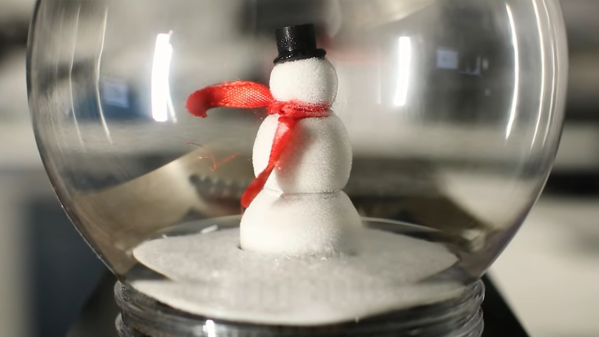
Peltier Snow Globe Features Snowman Who Dresses Himself In Real Frost

We doubt that few of us ever thought that snow globes contain real snow, but now that we’ve seen a snow globe that makes its own snow, we have to admit the water-filled holiday decorating mainstay looks a little disappointing.

Like a lot of the Christmas decorations [Sean Hodgins] has come up with over the years, this self-frosting snowman is both clever in design and cute in execution. The working end is a piece of aluminum turned down into the classic snowman configuration; the lathe-less could probably do the same thing by sticking some ball bearings together with CA glue. Adorned with 3D-printed accessories, the sculpture sits on a pedestal of Peltier coolers, stacked on top of a big CPU cooler. Flanking the as-yet underdressed snowman is a pair of big power resistors, which serve as heating elements to fill the globe with vapor. [Sean]’s liquid of choice is isopropyl alcohol, and it seems to work very well as the figurine is quickly enrobed with frost.

But wait, there’s more — as [Sean] points out, the apparatus is 90% of the way to being a cloud chamber. Maybe we’ll see a less festive version after the holidays. Until then, enjoy his ornament that prints other ornaments, his blinkenlight PCB tree-hangers, or his tiny TV that plays holiday commercials.

Continue reading “Peltier Snow Globe Features Snowman Who Dresses Himself In Real Frost”