
Fixing An Onkyo Receiver With Multiple Faults

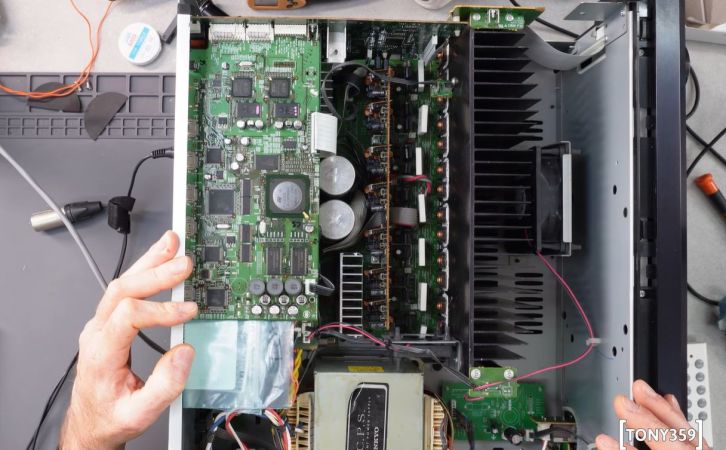
Modern-day receivers are miracles of digital audio and video processing, but compared to their more analog brethren, they can come with a host of new and fascinating faults. The Onkyo TX-SA806 and SR806 receivers were released back in 2008, with [Tony359] recently getting the latter variant in for repair. Described as having weird digital distortion on the audio outputs, this particular issue got fixed by recapping the PCB with all the digital processing in the first video on this receiver, but this left the second issue unaddressed of a persistent hum, which is the topic of the second video on this repair.
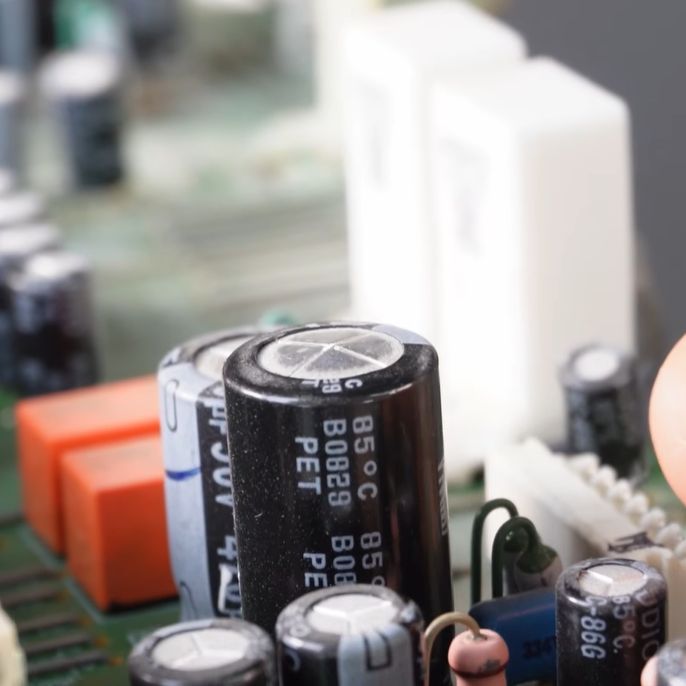
Capacitor C5662 in the Onkyo TX-SR608 receiver with a slight bulge. (Credit: Tony359, YouTube)
Capacitor C5662 in the Onkyo TX-SR608 receiver with a slight bulge.

With the easy fix of recapping of the digital board already tried, next was a deep-dive into the receiver’s schematics to figure out where this low-frequency hum was coming from. With it sounding very much like mains frequency hum bleeding through, this was the starting point. Presumably somewhere on the power rails the normal filtering had broken down, so all rails had to be identified and checked for this interference.

With ripple on the 10V and 12V rails as well as the others seemingly in order, it wasn’t clear where the 100 Hz hum was coming from, but people on the BadCaps forum offered some help. After some back and forth it was deduced that the problem was the +15 VA rail, with heavy ripple on it due to a dead capacitor on the +22 V rail that comes straight from a transformer.

Continue reading “Fixing An Onkyo Receiver With Multiple Faults”
Onkyo Receiver Saved With An ESP32

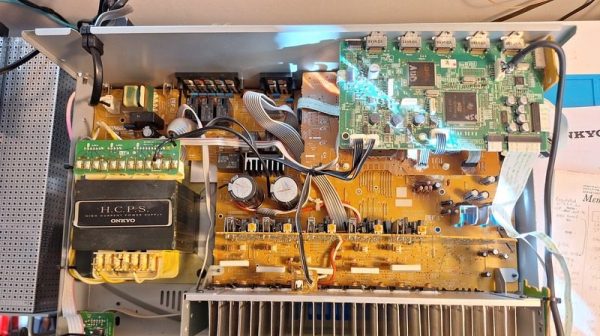
[Bill Dudley] had a problem. He had an Onkyo AV receiver that did a great job… until it didn’t. A DSP inside failed. When that happened, the main microprocessor running the show decided it wouldn’t play ball without the DSP operational. [Bill] knew the bulk of the audio hardware was still good, it was just the brains that were faulty. Thus started a 4-month operation to resurrect the Onkyo receiver with new intelligence instead.

[Bill’s] concept was simple. Yank the dead DSP, and the useless microprocessor as well. In their place, an ESP32 would be tasked with running things. [Bill] no longer cared if the receiver had DSP abilities or even the ability to pass video—he just wanted to use it as the quality audio receiver that it was.

His project report steps through all the hard work he went through to get things operational again. He had to teach the ESP32 to talk to the front panel display, the keys, and the radio tuner. More challenging was the core audio processor—the obscure Renaisys R2A15218FP. However, by persevering, [Bill] was able to get everything up and running, and even added some new functionality—including Internet radio and Bluetooth streaming.

It’s a heck of a build, and [Bill] ended up with an even more functional audio receiver at the end of it all. Bravo, we say. We love to see older audio gear brought back to life, particularly in creative ways. Meanwhile, if you’ve found your own way to save a piece of vintage audio hardware, don’t hesitate to let us know!









