How Low Can You Go? The World Of QRP Operation

Newly minted hams like me generally find themselves asking, “What now?” after getting their tickets. Amateur radio has a lot of different sub-disciplines, ranging from volunteering for public service gigs to contesting, the closest thing the hobby has to a full-contact sport. But as I explore my options in the world of ham radio, I keep coming back to the one discipline that seems like the purest technical expression of the art and science of radio communication – low-power operation, or what’s known to hams as QRP. With QRP you can literally talk with someone across the planet on less power than it takes to run a night-light using a radio you built in an Altoids tin. Now that’s a challenge I can sink my teeth into.

Continue reading “How Low Can You Go? The World Of QRP Operation”
Transmitting Data Long-Distance With Morse Code

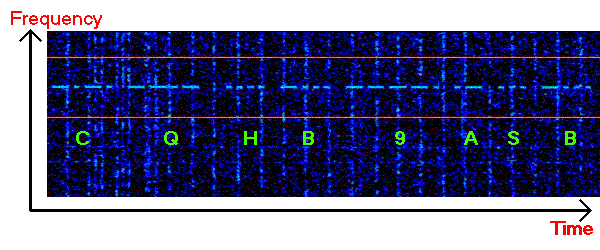
[Konstantinos] wrote in to tell us about his CDW project: a digital encoding scheme for ham radio that uses CW (continuous wave) Morse code for digital data transfer. [Link updated 1/5/16] CW operation with Morse code is great for narrow-bandwidth low-speed communication over long distances. To take advantage of this, [Konstantinos] developed a program that takes binary or text files, compresses them, and translates them to a series of letters and numbers that can be represented with Morse code.

The software translates the characters into sequences of Morse code pulses, and plays an audio stream of the result. His software doesn’t support decoding Morse from an audio stream, so [Konstantinos] recommends using one of many existing programs to get the job done. Alternatively those with a good ear and working knowledge of Morse can transcribe the characters by hand.

After receiving a broadcast, the user pastes received characters back in the software. The software re-assembles the binary file from the Morse characters and decompresses the result. [Konstantinos] also added a simple XOR encryption feature, but keep in mind that using encryption on ham radio bands is technically illegal.

Arduinofied QRP Radio Beacon

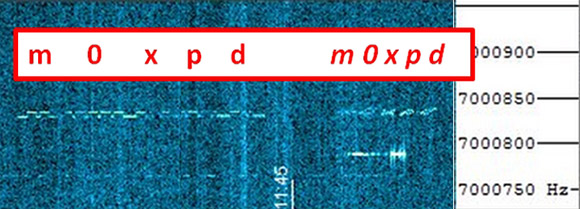
moxpd

A while back, [m0xpd] picked up an unbearably cheap AD9850 DDS module from ebay. He turned this in to a Raspberry Pi-powered radio beacon, but like so many builds that grace our pages, the trolls didn’t like using such an overpowered computer for such a simple device. To keep those trolls quiet, [m0xpd] is back again, this time using the AD9850 DDS module as a radio beacon with an Arduino.

The previous incarnation of this build used a Raspberry Pi, and as a consequence needed a level converter. This was thrown out as [m0xpd]’s own Arduino clone, the WOTDUINO – pronounced, ‘what do I know’ – is able to handle the 5 Volt IO of the AD9850.

In addition to fabbing a shield for the DDS module, [m0xpd] also constructed a transmitter shield to amplify the signal and allow the ‘duino to key out a few simple messages. It’s a quite capable device – one of [m0xpd]’s messages traveled from merry olde England to Arizona, his best ever westward distance.