
Open Source SLA Printer Software Slices From The Browser

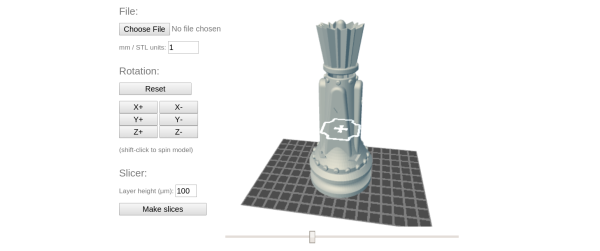
Resin-based SLA printers need a different slicing algorithm from “normal” melted-plastic printers. Following their latest hackathon, [Matt Keeter] and [Martin Galese] from Formlabs have polished off an open source slicer, and this one runs in your browser. It’s Javascript, so you can go test it out on their webpage.

Figuring out whether or not the voxel is inside or outside the model at every layer is harder for SLA printers, which have to take explicit account of the interior “empty” space inside the model. [Matt] and [Martin]’s software calculates this on the fly as the software is slicing. To do this, [Matt] devised a clever algorithm that leverages existing hardware to quickly accumulate the inside-or-out state of voxels during the slicing.

[Matt] is stranger to neither 3D mesh manipulation nor Hackaday. If you’re just getting started in this realm, have a look at Antimony, [Matt’s] otherworldly CAD software with a Python interface to get your feet wet with parametric 3D modeling.
OpenExposer, The DIY SLA Printer

printer

Precisely applied ultraviolet light is an amazing thing. You can expose PCBs, print 3D objects, and even make a laser light show. Over on the Projects site, [Mario] is building a machine that does all of these things. It’s called the OpenExposer, and even if it doesn’t win the Hackaday Prize, it’s a great example of how far you can go with some salvaged electronics and a 3D printer.

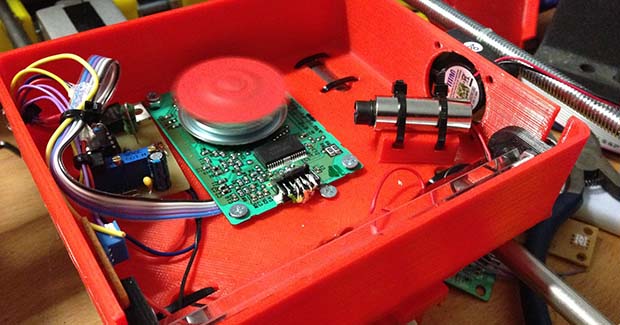
The basic plan of the OpenExposer is a 3D printer with a small slit cut into the bed, and a build platform that moves in the Z axis. The bed contains a small UV laser and a polygon mirror ripped from a dead tree laser printer. By moving the bed in the Y direction, [Mario] shoot his laser anywhere on an XY plane. Put a tank filled with UV curing resin on the bed, and he has an SLA printer. Put a mounting bracket on the bed, and double-sided PCBs are a cinch.

The frame is made of 3D printed parts and standard RepRap rods, with the only hard to source component being the polygonal mirror. These can be sourced from scrounged laser printers, but there’s probably some company in China that will sell them bulk. The age of cheap SLA printers is dawning, friends. Video below, github here.

Continue reading “OpenExposer, The DIY SLA Printer”









