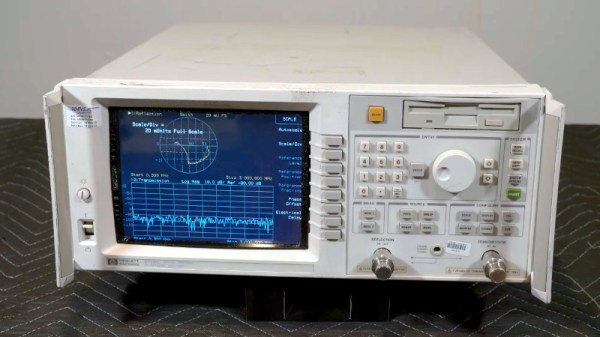
A 1990s VNA Gets An LCD

A Vector Network Analyser, or VNA, is the ultimate multi-tool of RF test equipment. They can now be had in not very capable form for almost pocket money prices, but the professional-grade ones cost eye-watering sums. Enough to make an older VNA for a few hundred on eBay a steal, and [W3AXL] has just such a device in an HP 8714C. It’s the height of 1990s tech with a floppy drive and a green-screen CRT, but he’s homing right in on the VGA monitor port on the back. Time for a colour LCD upgrade!

There are two videos below the break, posted a year apart, because as we’re sure many of you will know, events have a habit of getting in the way of projects. In the first, we see the removal of the CRT module and safe extraction of its electronics, followed by the crafting of a display bezel for the LCD. Meanwhile, the second video deals with the VNA itself, extracting the VGA signal and routing it forward to the new module. Continue reading “A 1990s VNA Gets An LCD”

LibreVNA Is A Quality Open Hardware Vector Network Analyser

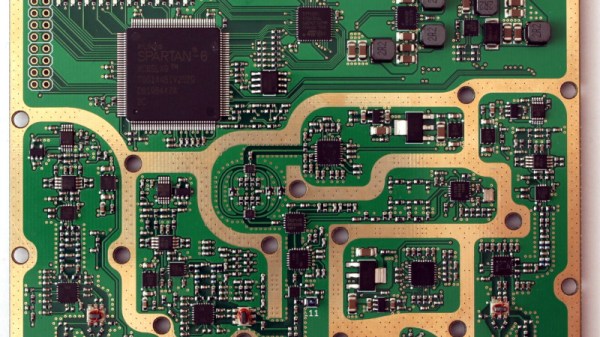
There was a time when a Vector Network Analyser or VNA was the type of instrument that cost as much as a very fancy car or even a small house. The advent of commodity semiconductors that perform at high RF frequencies coupled with microcontrollers powerful enough to handle the data acquisition and processing might not yet have put those high-perfomance instruments within reach, but at our end of the market it’s opened the possibilities for some useful yet affordable devices. A fresh contender comes from [Jankae], whose LibreVNA tops out at 6 GHz and shows some significant attention to design detail that puts it above some of the budget offerings.

At its heart is the versatile Si5351 multi-way clock generator, accompanied by a pair of MAX2871 phase-locked-loop chips for the higher frequency local oscillators. A switched bank of low-pass filters take care of local oscillator harmonics, and in the receive chain there are ADL5081 mixers feeding a dual conversion IF running at 70 MHz and then 300 kHz. Finally the ADCs are Microchip’s MCP3313, and all is kept in sync by an FPGA and an STM32G431 microcontroller. The main data proccessing is offloaded to a host computer, with a software package and GUI able to be compiled on Windows, Linux, and OSX.

The PCB shows the attention to detail, not least in the power supply arrangements, with every major component receiving its own regulator to ensure no RF makes it down the power rails. It’s clear that a properly made LibreVNA won’t be as cheap as some of its rivals, but we think the corresponding performance hike would make the extra cost worthwhile.

If VNAs are new to you, we covered an introduction from [W2AEW] a while back.