

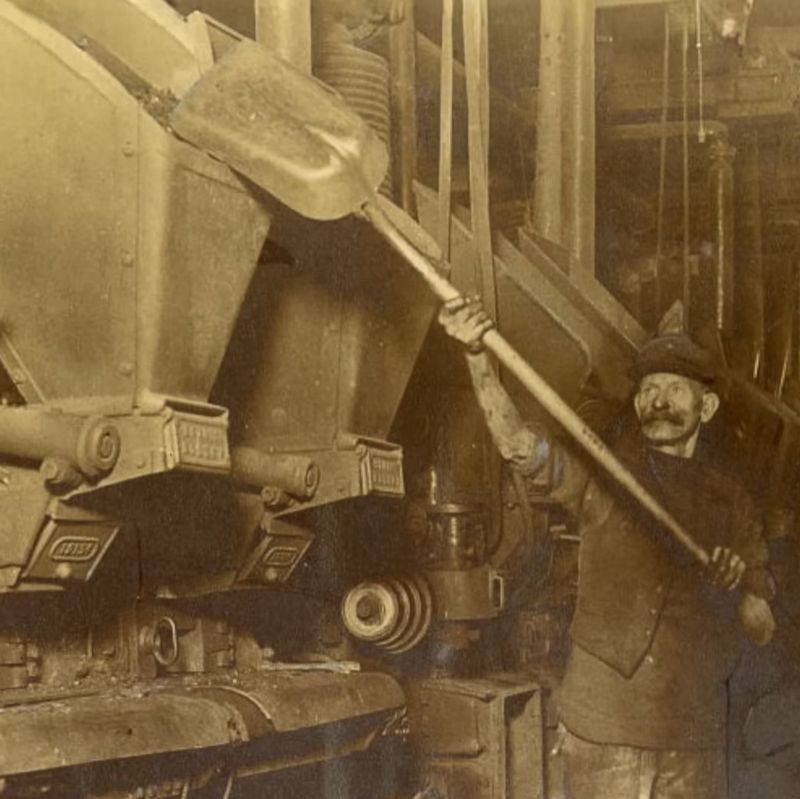
Hacks are of all ages, with the Victorian-era Claymills Pumping Station being no exception. When its old Lancashire boilers from the 19th century were finally replaced with modern 1930s boilers, the 1920s-era automatic stokers were bodged onto the new boilers with a rather ill-fitting adapter plate, as there was no standard Lancashire boiler design. Nearly a hundred years later it was up to the volunteers at this Victorian-era pumping station to inspect and refurbish this solution, before fitting it back onto the boiler.
Lancashire boilers have two flue channels in which the coal is burned, which used to be done purely by hand. The automatic stokers are belt-driven devices that continuously add fresh fuel and massively lighten the workload. The 1920s stokers are still in place at this pumping station and a feature that they would love to retain.
Thus, after previously pressure-testing this #1 boiler to well beyond its operating pressure, the refurbished adapter plate was mounted back on with some percussive persuasion of the ‘very large beam’ variety.
Before the stokers could be mounted again, however, the boiler inspector had to give his OK to put the brickwork around the boiler back in place which helps to insulate it, among other functions. Once this is completed the boiler can finally see a fire again since it was last used in the 1970s. Whether these vintage stokers will work flawlessly will remain a surprise until then, but it’ll be a treat to see them operate.












I’ve often wondered why steam engines couldn’t harness the huge engine to make coal delivery a bit easier – say a conveyor belt to shift coal from where it is stored to where it is needed.
Now I learn there is an “automatic stoker” albeit for a much larger fixed boiler. But a man still has to shovel coal from ground level to 8 feet in the air using a long shovel with a counterweight at the end of the handle – that must have been heavy. I wonder how many shovellers showered themselves in coal!
As a youngster I recall seeing automatic stokers in action in a Yorkshire woollen mill. The boilers were in the basement so the hoppers were just below street level. Coal deliveries were made next to the hoppers so the only manual shovelling needed was a few feet horizontally.
All gone now, of course.
So hard to believe we are moving back to that time.
An “automatic stoker” exists, I’ve learned, but it’s for a far bigger stationary boiler. However, the task of lifting coal from the ground up to eight feet in the air requires a heavy, long shovel with a counterweight attached to the handle. How many shovellers got their hands dirty with coal?
Thus, after previously pressure-testing this #1 boiler to well beyond its operating pressure, the refurbished adapter plate was mounted back on with some percussive persuasion of the ‘very large beam’ variety.
Nice to see such a high proportion of young men involved, rather than “us oldies” :-|
For anybody with even minimal interest in this sort of thing, please remember that there are plenty of smaller heritage railways and industrial heritage sites around: either running or aspiring to run.