
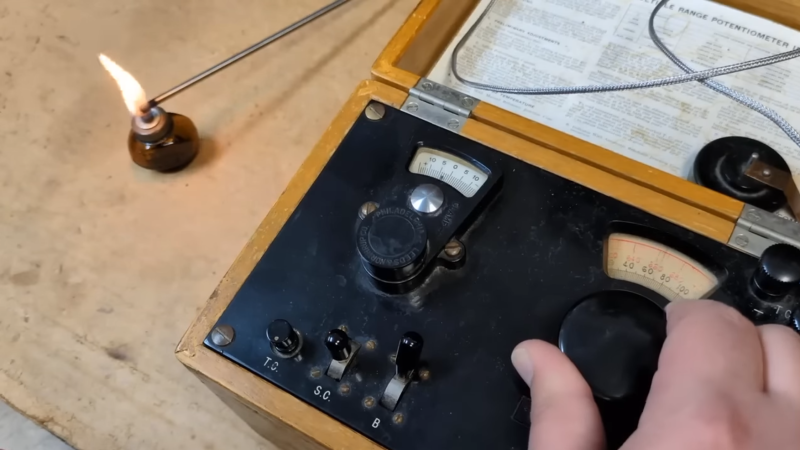
A man's hand is shown adjusting a black Bakelite dial on the front panel of an instrument. The instrument is contained in a wooden box, and to the left of the box, a thermocouple is inserted into the flame of an alcohol burner.

Reading A Thermocouple With Mercury And A Potentiometer

If you’ve ever thought about the nomenclature of electrical components, potentiometer stands out as a strange name, etymologically suggesting something like a voltmeter. In fact, the component took its name from a voltage-measuring instrument also named the potentiometer. [Alnwlsn] recently took a look at one such device, which was integrated into a thermometer, and the Weston cell used to calibrate it.

The potentiometer (instrument) has a galvanometer at its heart. One side of the galvanometer is connected to the center lead of a potentiometer (component) which spans a voltage source; the other side is connected to a reference voltage. The potentiometer can be adjusted until no current flows through the galvanometer, at which point both sides match the reference voltage. The reference voltage source can then be replaced with some other source, which can then be measured relative to the reference by adjusting the potentiometer until both the voltages match. The reference voltage source is a Weston cell, which uses two mercury electrodes, one amalgamated with cadmium, to produce a stable 1.018 volt reference; despite being 74 years old, this particular cell still measured at 1.017 volts.

In this case, the potentiometer was made to measure the voltage produced by a thermocouple. After calibrating the potentiometer and connecting an iron-constantan thermocouple, [Alnwlsn] tested it with ice and boiling water, and in each case it proved accurate. In a more extreme test, it captured the temperature difference between the base and the tip of an alcohol flame.

For a bit more on the history of similar devices, check out the history of Weston Electrical Instruments.

Continue reading “Reading A Thermocouple With Mercury And A Potentiometer”
Retrotechtacular: Weston Electrical Instruments

A ‘meter is one of the most important tools on any electronics bench. After you’ve exhausted your five senses trying to figure out what’s happening in a circuit, firing up the old ‘meter is usually the next step. Meters are largely digital nowadays, but their analog ancestors are still widely available. We have a chemist and inventor named [Edward Weston] to thank for the portability and ubiquity of DC measuring equipment.

After immigrating to the United States from England with the degree in medicine his parents wanted him to earn, [Edward Weston] asserted that he was more interested in chemistry. His career began in electroplating, where he soon realized that he needed a reliable, constant current source to do quality plating. This intense interest in power generation led him to develop a saturated cadmium cell, which is known as the Weston cell. Its chemistry produces a voltage stable enough to be used for meter calibration. The Weston cell is also good for making EMF determinations.

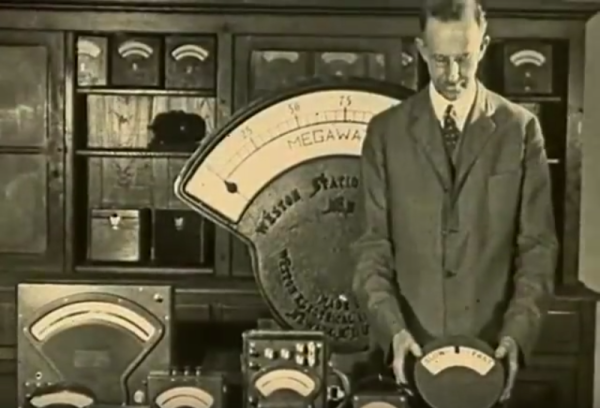
Within a few years, he co-founded the Weston Electrical Instrument Corporation. The company produced several types of meters along with transformers and transducers known for their portability and accuracy. In 1920, [Weston & Co.] created this 1920 educational film in cooperation with the United States Navy as part of a series on the principles of electricity.

The viewer is invited to consider the importance of measurement to civilization, most notably those fundamental measurements of length, mass, and time. [Weston] positions his electrical measuring instruments at this level, touting them as the international favorite. We get the full tour of a Weston meter, from the magnet treated for permanence to the specially designed pole pieces that correctly distribute lines of magnetic force. What education film about electromagnetism would be complete without an iron filings demonstration? This one definitely delivers.

Continue reading “Retrotechtacular: Weston Electrical Instruments”









