
[John P. Barker] writes up an interesting product called Wire Glue. This conductive adhesive is a paint-on alternative to soldering. At first it seems like a bizarre product but we can think of a few uses. Who hasn’t had a solder joint on a free-formed circuit break? One thing’s for sure, we’d recommend throwing a resistor into that LED circuit he’s working on.
Wire Glue
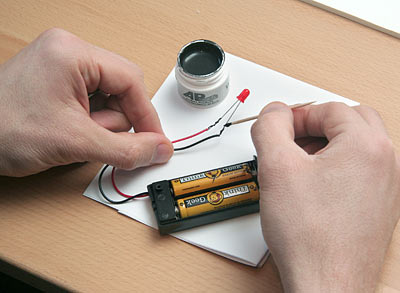












The resistor won’t be necessary, conductive glue is made of carbon particles suspended in the adhesive. It has a pretty high resistance itself, unless the contact area is pretty large.
I tried some of this (or something like it) a couple years ago. I was impressed at how well it actually holds things together. the one thing i didn’t like was the long set time. when i want something soldered, i want it ready to go within a few seconds of the solder being applied. but, that’s just me.
Actually, I can think of a good use (considering the set time). I am trying to make a silent door alarm with an LED light, two contacts (each connected to different sheets of aluminum foil), and conductive glue. If the two foil sheets come into contact, I want them to stay in contact and start the circuit, but I also want the glue to stay wet for a very long time so that it sticks to the foil at the right moment.
most l.e.d.’s can handle 3 volts.
Some LED’s have resistor built in and can take up to 5 volts native.
Smart stuff.
Easy for the beginner to test SMD.
But the resistance would be a problem maybe.
Nice for kids, but for real work solder is probably still the best way to go. And even for kids… it needs a long time to set which is a major drag.
This might be good for the aluminum ribbon leads on some Li-Poly sackpacks. Can’t solder them reliably and they’re rather fragile. The contact area is there so this might work.
You know, I wouldn’t consider myself a hardware hacker quite, as I’ve never built anything more complex than a telephone kit, but this is so freaking handy! Y’know for those odd speaker wires, etc…
This would be great for gluing wires to things like fabric bend sensors and ITO (indium tin oxide) film, which you can’t solder to. Much cheaper than conductive silver epoxy!
the LED may tolerate the voltage, but the battery may not like the load current without a resistor. I think that’s what was implied by the blurb’s comment.
they’re all named john!
John Bigboote
john many jars
john st john
john ya ya
john smallberries
what the hell is this?
Lectroids
red lectoids from planet ten by way of the eighth dimension
hey in all seriousness this Seems like it might be a good solution for you folks that were sniping at each other over soldering directly to memory card contacts.
you could affix the leads and maybe again on a second spot for some additional strain relief.
sure you have to wait for the curing time, but that could possibly give you a more robust package to mod into your circuits than soldering to those little tabs would.
I wonder if you could run this stuff through a silkscreen and do printed circuits on cloth.
I used 2-part conductive epoxy for a xbox controller mod where my solder contact kept breaking during re-assembly. Unfortunately, I moved the wire while it was still setting up and it lost its contact again. I blame my lack of patience. Also, i like the idea of a premade glue, as mixing any amount of the epoxy was too much for what i needed, leading to a lot of wasted epoxy.
@strider_mt2k:
What’s with the watermelon?
I’m surprised that no one mentioned repairing traces on flexible cables and specifically repairing the LCD ribbons that join to the board. I don’t know how many cell phone’s I’ve thrown away that could have been repaired with this stuff, as most of them simply needed to be re-connected to the board. Soldering those doesn’t work, you’ll melt the plastic ribbon.
> fabric bend sensors and ITO (indium tin oxide) film, which you can’t solder to
Yes you can. Set light to it first, it’ll burn off the fabric, just leaving a thin strand of metal which you *can* solder to! Great for fixing headphones.
You’ll thank me later =D
“One thing’s for sure, we’d recommend throwing a resistor into that LED circuit he’s working on.”
I lol’d.
The best use there is for this is attaching broken solar cells together. Anyone who has worked with these before should know, they are expensive, fragile as hell, and cannot be soldered, yet they still need conductive attachment. This stuff and conductive epoxy are the only way to go.
what about magnetic glue?
@chris – nice idea. stencil might be ok, too. either way, reuse is probably out.
I want this in Blu-Tack form
Mike is the one person who has posted the most articles on this site! And this is his very first post. Nice Job!
Has anyone tried to glue a 38 awg magnet wire to a smd.