
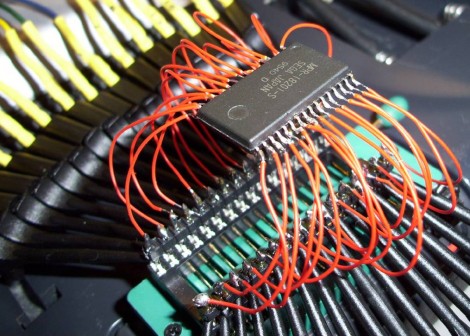
[Gerry O’Brien] tackled his most recent project, designing a flash ROM cartridge for the Sega Game Gear, with great success. Above you can see the test rig he used to reverse engineer the communications between an original ROM chip and the circuit board that it came on. He removed the chip, soldered a ZIF socket to the pads, then used a DIP socket as an adapter for that chip. Connected to each pin is a test lead for a logic analyzer. That’s a heck of a lot of channels to decipher!
It turns out that the cartridges use Integrated Mapping (does anyone have a link explaining this?) so dropping in a flash memory chip is not an option; you need a memory bank controller. [Gerry’s] solution to this issue is twofold: you can etch your own board with a controller chip and ZIF socket for the flash chip, or you can modify a Sega Master System cartridge to use as an adapter board. We’ve got pictures of both methods after the break, as well as his five instructional videos walking us through the fabrication process.
This isn’t [Gerry’s] first time working with flash cartridges. We looked at his work with Game Boy ROMS earlier in the year.
Here’s an etched adapter board. The IDC plug is used for testing with an oscilloscope and logic analyzer.
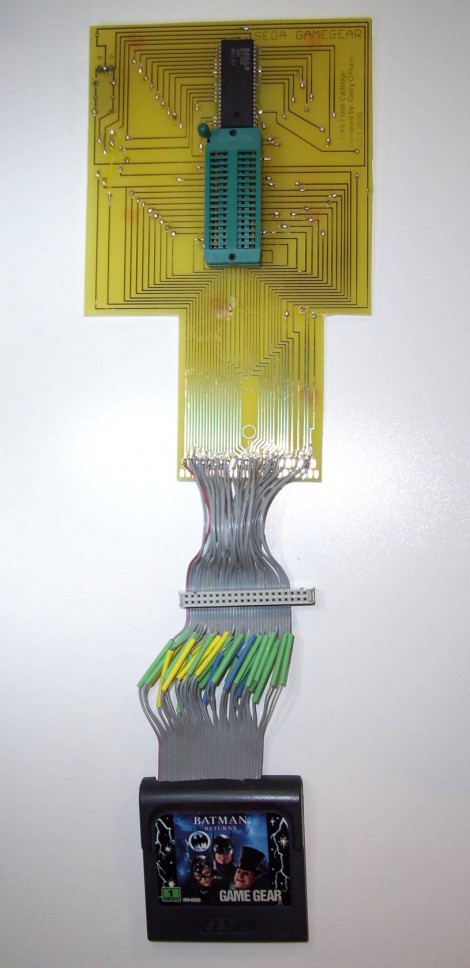
Here’s a much more compact adapter made from a Sega Master System cartridge.
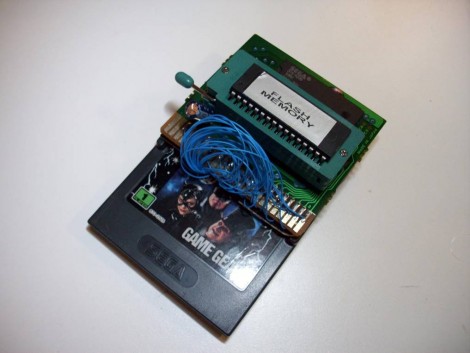
Check out [Gerry’s] youtube channel where you’ll find his instructional videos.
[youtube=http://www.youtube.com/watch?v=YY-Yt31U3Oo&w=470]
[youtube=http://www.youtube.com/watch?v=XZZvtaxkz58&w=470]
[youtube=http://www.youtube.com/watch?v=VHtsm6M8uDE&w=470]
[youtube=http://www.youtube.com/watch?v=fJ8TXklpKXA&w=470]
[youtube=http://www.youtube.com/watch?v=X5pI5iraq9A&w=470]












Excellent work. :-)
More information about the two main mappers used on the Sega Master System (and by extension the Game Gear) can be found on the SMS Power! wiki: http://www.smspower.org/Development/Mappers
there should be a soldering world championship O_o
If only the cartridge slot on the Game Gear wasn’t so flaky. Anyone else have that problem? Mine wouldn’t run if you just pushed the cartridge all the way down, you had to pull it out of the slot a tiny bit in order for it to work.
Sadly, I found my old Game Gear at my parents’ house, and I couldn’t get it to work. RIP Matt’s Game Gear, 1992-2010.
Thats pretty epic soldering.
Last time i used my GG the screen was going funny but i might see if i can fix it for a bit of nostalgia gaming.
Cleaning the cart contacts with an earbud or the classic blowing on it always fixed the problems for me, don’t you just miss the old skool gaming :D
Really impressive craftsmanship and documentation. It’s pretty inspiring.
@matt Is that an accurate time of death? I’d wager that it died sometime earlier since you “just found” it :) BTW, I look forward to seeing the 8-bit computer finished :)
Now, I really want to build one of these. Then continue learning the hardware & Z80 ASM to try to make some silly demos (and make sure they run on real hardware and not just emulated hardware.)
matt: The Game Gear has fairly poor-quality capacitors in it. If you desolder them you’ll be treated to the lovely fishy smell of leaked electrolyte, and replacing them should restore the sound and video to its original glory.
@Ben Ryves Oh yeah, that’s another thing I need to do. I hear it does wonders.
@Ben Ryves @losinggeneration I’ll have to try that one of these days. My Game Gear was definitely working in 2008, not sure if I’ve tried since then. I also have an original Game Boy (got it in 1990) that still works, but the LCD has lots of dead lines. I hear that’s fixable too.
also, the Labyrinth Zone music from Sonic 1 on the Game Gear has to be in the running for best chiptune ever.
The intro “Montage” in his part 1 video is Bad Ass. A great tribute to one of my favorite hand helds.
I guess I know what I’m doing over the holidays. :)
Great Job!
Anyone know if the game gear screen is reuseable (ie pinout, yada yada). i’m afraid to open mine up unless i know for sure – it works as good as day one still.
@matt Yep, I fixed a Game Boy that was given to me with many dead columns. All I used was a hair dryer and an eraser.
i hate soldering smd spiders (smd chips wired to a dip socked)
i prefer plates like this http://www.tme.eu/katalog_pics/b/f/8/bf81f1f87e66af8c487588df57053f21/ms-dip_smd5.jpg
alot less fucking around
@Matt
Don’t give up! There are plenty of tuts out there for repairing seemingly dead game gears. Every one saved keeps them from extinction a little longer! I had to replace a cap and resolder a few cartridge connectors on mine but it is alive!
@nah!
I prefer these type of things:
http://www.futurlec.com/SMD_Adapters.shtml
Nice dramatic intro music… from a Nintendo game (Killer Instinct)!
Maybe I should look into resurrecting my defective GG now.
Lots of channels??? The chip has 28 pins, you have a pair for vcc/gnd, so you have 26 pins to connect to the logic analyser…the cheapest SERIOUS logic analyser you can buy has at least double that. The only serious thing you can buy with less than 32 channels is the Logic from Salae. But aside automatic decoding of serial protocols, you can have an HP16500C for way less. Mine has 136 channels :) And a 40 channel pattern generator. And a two-channel 100MHz scope :D
Killer instinct wasn’t a nintendo game. It was a rare game. Nintendo just happened to own them at the time. Fanboys know nothing of beaurocracy or legalities. Look at what nintendo did to them since. stole all of their ip’s and did nothing with them. way to go nintendo. “let’s make another game about a stereotypicaly racist fat plumber and forget the bad-assery of killer instinct”. That’s right I make up my own words (and mispell already known ones).
I bought a 15-in-1 Game Gear cartridge when I was on holiday once in 1998, and I wondered how the guy at the shop managed to produce these… It just looked like a normal cartridge except the metal star screw was missing from the back – was just plain plastic where that normally is. How did they make those carts??? It looked far better than either of the options above. It had a menu to choose between roms.
Those Bootleg Carts use a custom mapper chip that was implemented using a CPLD chip. This allowed the use of larger memory sized flash chips to hold more than your standard 512Kb sized GG game. Although most of those types of carts used EEPROM memory.
A hobbyist on the SMSPower.org website has just built his own Mapper chip in the same manner, by using a CPLD chip. However he has not yet posted the code for implementing the mapping. Hopefully in the future he will do so. From the looks of it, Gerry has been following this matter closely but I think he is busy with other projects.
Here is the Thread from SMSPower.org
http://www.smspower.org/forums/viewtopic.php?t=13014
:)
He is working on a Neo Geo Pocket color Flash cartridge project with game programmer “Flavor”.
Some pretty cool stuff this guy Flavor is doing, as always.
See the details here:
http://ngpc.freeplaytech.com/
Gerry & Flavor recently finished the Flash cartridge for the SNK “Neo Geo Pocket color”.
Flavor is now selling these cartridges along with a USB Linker & software.
You can order them from Flavors webpage.
http://ngpc.freeplaytech.com/
http://www.digital-circuitry.com/Projects_NGPC.htm
Way to go Gents!!
Nova
Mhh… The instructions how to build a DIY-Flash-Cartridge are always welcome. But I am a bit disappointed, that Gerry did not publish one for the Neo Geo. Seems like he is now more willing to make some profit, rather than giving something to the community…
Anonymous, you’re always free to roll your own, and give the schematics free for the comunity :) Why not pick the soldering iron up, instead of blindly (and anonymously) complaining? :o)
Also just to point out……
I’m not making any money off of that project whatsoever. I teamed up with Flavor under the conditions that I did not want to have any part of the selling or profits. All my work on The NEO GEO FLASHMASTA project was completely volunteer Pro-bono.
You should not make accusations when you don’t know the facts. :)
I’m still totally down with listing my own projects open source.
Cheers Folks,
-Gerry O’Brien