chipKIT Max32, an Arduino Mega upgrade with a PIC32 under the hood

posted May 12th 2011 1:08pm by
filed under: arduino hacks

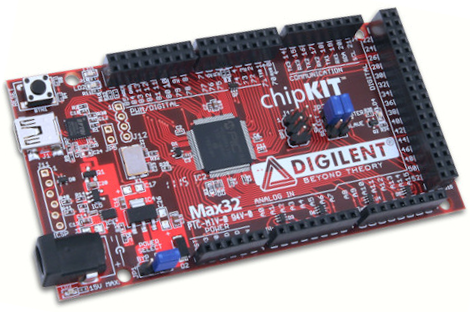
For those of you who are looking to put some power behind your Arduino shields,  Digilent just released their chipKIT Max32 prototyping platform. The board  features a Pic 32 microcontroller, USB programmer and all the things you would typically expect from a development board.

The PIC32MX795F512 is a  32-bit MIPS processor core running at 80Mhz, 512KB flash memory and packs 128KB of SRAM data memory. Digilent also mentions utilizing the Pic’s built in USB 2 controller, 10/100 Ethernet and dual CAN controllers, but these will require shields specific to the chipKIT Max32. The board is also fully compatible with Arduino IDE and libraries as well as MPLAB  and the PICKit3 in-system programmer/debugger.

With a price point just below the Arduino Mega 2560 this looks like a great resource for anyone looking to upgrade their Arduino webserver, or just embarrass their Arduino Arduino shield. Maybe it’ll just spawn some interesting gameduino upgrades. It can certainly cut down on extraneous Arduino usage. Either way we’ll be on the lookout to see what this performance bump can bring to table!


91 Responses to chipKIT Max32, an Arduino Mega upgrade with a PIC32 under the hood

  • Spork says:

    Love me some 32bit micros.

    You kinda glossed over the fact that it’s compatible with Arduino IDE as does the website you link to.

    When you say compatible with arduino IDE, do you also mean the arduino libraries?

  • fred says:

    @Spork

    “The board is also fully compatible with Arduino IDE and libraries”

  • I cant believe I’m designing a similar board -.-

  • Scott says:

    WOW.. this is pretty sweet.

    I kept hoping that the “Netduino” boards would actually become Arduino-compatible (instead of confusingly implying so).

    Basically, this is all I really wanted… more powerful hardware in the super friendly Arduino package.

    This looks powerful enough to masquerade other hardware… say, providing a SD card bridge for a Commodore 64 or Atari ST. Or maybe you can do Ethernet right off of the pins (no extra hardware necessary?).

    Tie this in with the Google accessory API… wow!

  • Adrian says:

    Only negative I have to say about this is that I hate that the non-standard pin header distances are becoming “standardized”. Other than that, awesome.

  • poslathian says:

    dual CAN bus is nice. Has anyone played with one of these? I wonder how “fully compatible” this really is the Arduino IDE and libraries. Seems like a lot of work to port everything to pic32 no? It was certainly a ton of work to port everything over to cortex m3 for the leaflabs Maple board.

  • poslathian says:

    also, I wonder what licensing is in play here, digilent is usually pretty bad about closed source windows only tools.

  • BiOzZ says:

    i was never a fan of pics … i always loved AVRs and ARMs XD

  • Taylor Cox says:

    One of my EE professors at Washington State University is the owner of Digilent. I am only a five minute drive away in Pullman WA…hope to get an internship there this next summer.

  • Marks says:

    Please please somebody do this for the analog devices Blackfin. 400Mhz DSP – then we can do some computer vision with these boards too

  • Taylor Cox says:

    My EE professor at Washington State University is the owner and founder of Digilent :) Only five minute drive for me to the main building…hope to get an internship their this next summer.

  • ftorama says:

    Well….I’ll play with a Maple from Leaflabs instead….

  • Reid says:

    Awesome! I work literally just around the corner from Digilent. I had no idea that they made non-FPGA dev boards there…very neat!

  • hpux735 says:

    Awesome. I’m more excited about this because if microchip can support a arduino clone, that means that the pic development tool chain can support it. This is a win. Hopefully they mean support the arduino IDE means on all platforms (linux/mac)

  • Spork says:

    @fred

    guess I missed that, thanks.

    That is really cool. I am more of an ARM fan for 32bit, but this will be nice for arduino project upgrades. Glad to see this kind of progression as the norm shifts to 32bit.

  • Sodor says:

    @hekilledmywire

    Me too HA!

  • Taylor Cox says:

    you too what?

  • I have one on the way courtesy of Microchip. Should be here in the next few days. I did not think the official launch was until next Wed.

  • cgmark says:

    Some of the other features not mentioned are the Real time clock calendar so no need for external time keeping, hardware IrDA support so it can communicate with laptops and printers using IR.

    I can’t see it happily coexisting with the arduino IDE though if someone wants to use the full power of the chip. There are just too many functions that this chip has that the ardunio doesn’t . I would definitely look at using C on it from hitech or others . To use it like another arduino would be like only playing DVD on a bluray player, yeah it plays them and it looks good but you are missing out on some of the best things about the hardware.

  • WestfW says:

    “The board is also fully compatible with Arduino IDE and libraries”

    I didn’t see any evidence that this is actually true. I mean, theoretically PIC32 is supported by gcc so it’s not out of the question, but I didn’t see any downloads, I don’t know of any support by the Arduino IDE for alternate compilers, and a lot of people have discovered that porting libraries isn’t as simple as it would seem (even between AVR families) once you consider the rather large base of rather poorly documented libraries that exist.

    It still looks like a pretty sweet board for the price, though. It could certainly give some of the ARM contenders a run for their money.

    Did you see there is also a “small” version: http://www.digilentinc.com/Products/Detail.cfm?NavPath=2,892,893&Prod=CHIPKIT-UNO32

  • MattQ says:

    I might be in the minority, but I kind of like PICs. PIC32 bundles in a ton of communication tools, so I hope to see some sweet ethernet/usb projects. Real question, why is the alternate text perfectforLEDflashing? Isn’t that a little over kill?

  • WestfW says:

    Nice EAGLE schematic. I like the way that they split up the PIC32. Also interesting that it still has an FTDI for the USB/Serial converter, considering that microchip offers a competing chip. I guess this is essentially a “leak” and full details will come out closer to the “ship” date of 21-May ?

  • Will says:

    I’ll have a review sample in my hand within a week, will post details on TBCS!

  • pt says:

    “The board is also fully compatible with Arduino IDE and libraries”

    @westfW is correct, our first question was “is it actually fully compatible with Arduino IDE and libraries”. i think the answer is not yet.

  • Brennan says:

    PIC32 is very powerful indeed. FYI the Keurig coffee makers use them, although I doubt they even use a fraction of the processing power for that application.

  • Daid says:

    Shame that the ethernet is not on the main board. That would make it a real killer.
    But with the very high priced Arduino Mega2560, this was bound to happen. I rather had seen an AVR32, or an ARM. But it works :)

    They also have a smaller PIC32 on a slightly different form factor: http://www.digilentinc.com/Products/Detail.cfm?NavPath=2,719,896&Prod=CHIPKIT-UNO32
    But it’s much better priced (26$)

  • makomk says:

    Last time I checked the PIC32 compiler and toolchain was Windows-only. Even though the compiler is just a slightly modified version of the open source GCC MIPS compiler, Microchip’s licensing conditions on the PIC32 libraries and headers forbid you from recompiling the compiler – including recompiling it to run on another OS.

  • makomk says:

    So thanks, but I think I’ll pass. The licensing on AVR tools is just so much nicer.

  • X says:

    Do ppl not read the summary? IF this can be coded using the Arduino IDE and Processing language, then what does it matter if some /other/ IDE is Windows only or has bas licensing terms?

    It might just be that Arduino IDE is now the CPU agnostic development chain it was always intended to someday become…

  • JimParker says:

    @makomk I don’t think that will be an issue now that Microchip’s new and soon to be released MPLAB X IDE will be cross-platform.

  • cgimark says:

    @MattQ
    Nothing wrong with liking pic, I like them as well. Arduino is popular because it is easy for beginners to understand, though pic isn’t hard either. PICs really have a lot going for them in the hardware area and price points. You can get pics like the 18F13K22 that run at 64Mhz and have 18 I/O, for $2.00 each. I think the programming aspect is what scares people away. But microchip sells the pickit 3 programmer on their site for $34.95 and that works with all pics.
    There is also a ton of software that people can use for free like swordfish basic if they want to start with something arduino like.

    http://www.sfcompiler.co.uk/swordfish/

  • specv002 says:

    The PIC32 7 series is the buggiest mCU i have ever worked with. I just graduated college as an EE, my senior project was a robot driven by the PIC 32. I found that it had bugs that were unexplainable. For instance i used the SPI peripheral to comm with a gyro, and a PWM to drive an H bridge circuit, sometimes the SPI would turn the PWM off. So it was a guess which peripheral would work. I dont know if it was the PIC 32 starter kit or the chip but too many bugs, I read the errata cover to cover and found nothing. None of my teachers could explain it either.

  • Taylor Cox says:

    @Reid. Do you live over in Pullman?? Do you know Clint Cole?

  • DJ JD says:

    @ftorama – I’ll play with this UNO clone if it’s $20 cheaper than Leaflabs… And much more powerful than the Arduino version.

    Ditto on comments about PIC toolchains – this isn’t even Microchip’s board, it’s Digilent’s. TBD on how well they make it work in the Arduino IDE but if they pull it off, that’s fricken sweet. Seems like those of us who don’t get early samples will find out May 21st…

  • makomk says:

    X: Arduino is very much not CPU agnostic. The standard Arduino release compiles code to AVR binaries; whatever the chipKIT Max32 webpage might claim those aren’t going to run on a PIC32. Now, it’s possible in theory to modify it to compile code for a different platform – but that means supplying your own C compiler and libraries, and the ones for PIC32 are Windows only and have onerous licensing conditions.

    JimParker: ah, that’s somewhat better. Presumably it still has the lovely copy protection that disables compiler optimisations (most or all of which were actually developed by GCC contributors) after a “trial” period, ties your license to a particular machine, etc though.

  • addidis says:

    @Daid

    I dont think the pickit will fit onto that 25$ board while either the usb or power cable is attached.

    @jimparker
    You can actually use mplabx now. The links are easy.
    http://www.microchip.com/mplabx
    you could also try
    http://www.microchip.com/arduino
    http://www.microchip.com/android
    etc etc

    If you havent looked into Microchip , you probably should .

  • addidis says:

    I guess if you dont use 90 o headers it would work on second thought. There appears to be a coffee shortage today.

  • ftorama says:

    @cgimark

    The PIC18F13K22 runs at 64MHz but each instruction needs 4 instruction cycles to excute, so it really runs at 16 MHz. Adding the poor assembler, you’ll see that an ATmega is much more powerful than this

  • WestfW says:

    @makomk: “Microchip’s licensing conditions on the PIC32 libraries and headers forbid you from recompiling the compiler – including recompiling it to run on another OS.”
    Reference? I hadn’t heard that part before. The “missing optimization” when using the gcc-based compilers (pic24, pic32) is some sort of microchip-added global optimization, not the basic optimizations that the HiTech compiler has been dissed for not doing on pic16/pic18. I think.

  • makomk says:

    WestfW: all -O2 and higher optimisations, apparently, unless they’ve changed it. (For those not familiar with GCC, those are all standard generic GCC optimisations as far as I can tell.)

  • makomk says:

    Hmmmm. Looks like it might only be the GCC-based Microchip C18 and C30 compilers that have the really nasty anti-open source restrictions, but no-one’s dared test this yet.

    It’s far from clear Microchip are in a position to restrict their use – they didn’t even write the standard libraries for PIC32, instead appearing to have used the MIPS ones – but that might not stop them.

  • cgimark says:

    @ftorama

    You need to look at page 280 of the data sheet. Almost all are 1 instruction cycle except compares which naturally take 2 or 3 cycles depending on the result. Hardware multiplies are 1 cycle as well. Add to that I2c that runs at 16Mbps and it is a hard chip to beat for $2

  • Well, I’m also using PIC32 in one of my classes, we are more than 260 students using them an no one as yet found an hardware bug, my professors are also using it in the MSL team, and in a lot of other classes.

    You can donwload MPLabX that runs under Linux, Windows and Mac, the same for the compilers.

    Yes the compiler as some limitations in the free/lite/student version, but you dont gain a lot using the super agressive optimizations because almost all the libs where re-written in hand-crafted assembler, so the compiler cant optimized them much more, and if you really want and you are using for personnal and non commercial use, just download the source and compile it, you are free to do it.

  • Dave Jones says:

    This product release was under an embargo until May 23rd – OOPS.
    Guess i can mention it now on The AmpHour now the cat is out of the bag?

  • WestfW says:

    The digilentinc web page has been updated to say:

    “Program using a modified version of the Arduino IDE, available as a free download for PC, Mac OS, and Linux. (Coming 5/21)”

    I’m a whole lot more comfortable with that statement. Three cheers to Digilent for clarifying the situation!

    > this isn’t even Microchip’s board, it’s Digilent’s.

    I think that (one of?) Digilents target markets is to design and “manufacture” evaluation boards for semiconductor manufacturers. I have a Xilinx “starter kit” in a fancy box that says “Xilinx” all over it, purchased directly from Xilinx at a trade show, that has “DigilentInc” on the actual PCB. It sounds like a fun business; always getting to play with the newest toys… I wouldn’t be surprised if this ends up being Microchip’s next PIC32 eval board.

  • WestfW says:

    “(Coming 5/21)”
    Hmm. For Maker Faire? I see Microchip is a vendor this year. oughta be a lot more interesting than a multi-hundred-dollar “sunspot.” I’ll SO be buying one if there’s a Faire Discount (and there are any left…)

  • ftorama says:

    @cgimark

    Look at the product page: 16MIPS for 64MHz

    1 instruction cycle needs 4 clock cycles. All PICs below PIC24 work like this

    PIC24 and some DsPIC (need to verify for them) work at half the clock speed.

    On PIC18, the PLL is here to compensate the core’s low speed.

    Only PIC32 seem to work at their actual clock speed

  • therian says:

    @ftorama
    dont forget that 4 cycles give stability and ability to wake up exactly each time

  • Why is there a FTDI on it period? That entire family has built in USB-OTG. A waste of UART if it’s connected to that instead.

  • am_i_evil says:

    @Roman Dulgarov
    Do you know for a fact that the FTDI is completely redundant, and there is absolutely -no- advantage to it?

    It may just be that the FTDI enables greater power savings (as little dedicated chips sometimes do vs. processors). Or maybe it’s another technical advantage (freeing up the processor to do more things or have more pins available). Or maybe it was done simply to facilitate a rush to market, by copying as much of the Arduino as possible.

    I would wait for a hands-on review before forming any opinion of it being “wasteful”..

    (Also, it seems wrong to look at any Arduino through the lens of “wasteful”. It’s a very general purpose board with a lot of stuff added on to make it easily approachable. Relax. :-)

  • @am_i_evil
    The only possible use I can see of it is for bus bit banging using that “infamous” FTDI bitbang mode.

    http://hackaday.com/2009/09/22/introduction-to-ftdi-bitbang-mode/

  • @SpecV Microchip is not the best at up-keeping with their documentation. You may also find in 2-4month that the “default” register values may not be “recommended values” Get into habit of explicitly stating all register values even when they state that there is a default. If you think there is a bug…there probably is. Fix it and don’t waste time waiting on official fix. They are also in a habit of jumping ships. So while PIC32 is the latest fad your in luck. But once they come up with their next “big thing” they will drop PIC32 to back burner. All in all the micro’s are good, biggest issue is lack of good documentation. You’ll resort to combing forum posts for bits of information to get the complete picture.

  • Jesse,
    I’m the PR person with Microchip. We’d like to ship a chipKIT(tm) board to you. What is your shipping address, including phone #?

    Also, I’m putting together a Virtual Press Conference to discuss the chipKIT platform. Would you like to attend?

    Michelle
    PR Person, Microchip Technology

  • DJ JD says:

    @Roman Dulgarov –

    They probably did it because the entire community freaks any time anything changes. I remember a thread on the Arduino forums where an admin asked why there are always conspiracy theories when they change stuff.

  • Will says:

    Got mine today and I’m getting the rundown tomorrow :)

  • Ike says:

    Wow, they managed to combine two crappy things: Arduino and PIC. The world never ceases to amaze.

  • WestfW says:

    >> Why is there a FTDI on it period?
    To implement simple serial communications (as used on Arduino) on a chip with built-in USB would require a significant amount of “background kernel” to be running on the chip, which is still sort of a researchy area (in Arduino-land) (as in “we don’t quite know how we’d like to do that”) (I think. What does teensy do ?)

  • J says:

    Well its 8:30 MST. Looks like we are 30 min past the Press Conference Start Time…. Anyone else who was invited not able to connect?

  • J, sorry for the confusion—the conference was scheduled for 8 a.m. Pacific, which is the same as MST, right now. Can we schedule a separate phone briefing for you? Please contact me offline at michelle.ragsdale@microchip.com

  • EmbeddedMan says:

    WestfW is correct regarding FTDI. There was too much work to get the ‘background’ USB stack working properly, in the time frame needed, and FTDI was seen as a safe, low risk way to go. Not really anything special about FTDI – other USB to serial chips could easily be used instead.

    Having said that, I know that it’s possible to make this work with just a PIC32 – no FTDI needed. I demonstrated it on my UBW32 board (which has no FTDI chip). The big piece left is the PC side of the bootloading process – avrdude does not support FTDIless PIC32 bootloading, so a new tool needs to be put into place for that to happen. Hopefully it will, eventually.

  • Mark says:

    Here are various answers to various questions above

    I did all of the porting of the core files for the PIC32 and I was the architect behind the multiple cpu implementation of the IDE.

    I will be at Maker Fair at the Microchip booth

    CROSS PLATFORM

    ALL of the development for pic32/chipkit was done on Mac. So the cross platform issue is resolved. In fact, from the IDE side, Mac was much easier to do than Windows.

    FTDI CHIP

    You cant use the on chip USB interface because the Arduino IDE resets the board to do a download. When you reset a chip running as a usb device, it disappears then comes back. There have been arduino boards that get around this (the Teensy) but they use a non-standard downloader.

    The reason for the FTDI chip instead of a microchip based USB support is again because of reset. The microchip M2200 could not do the reset correctly. Believe me, they tried to make the M2200 work.

    LIBRARIES

    Most of the libraries are ported and working. The rest of them should be ready on release date.

    Mark

  • poslathian says:

    The LeafLabs Maple line boards dont have the additional FTDI chip. It definitely adds a layer of complexity (to have the USB running the background, and dealing with RESET and bootloader effects), but also flexibility – users can control the USB peripheral if they wish. Uno uses a secondary chip to offer configurable USB, which is nice too but adds another chip to the design.

    In the end, I think the “use the onboard USB” approach turned out to be much harder than expected, but eventually it has become quite stable.

  • Alex says:

    @Mark

    Do you guys plan to make a shield that contains USB A host, USB B device, ethernet magjack, and possibly microSD card and RTC battery backup? I would like to see this shield for ChipKit Max32. Thanks.

  • X says:

    @Alex – forget all that on a shield. I want a version with all that on the main board! Kind of like the Freetronics Etherten (which looks awesome but is not available in the USA, frustratingly… )

  • Will says:

    @Alex and @ X

    I had my phone briefing with the people at Digilent and Microchip yesterday, and let me just say there’s a pretty awesome shield coming out for the Max32 this summer :)

  • Alex says:

    @Will

    Would that “pretty awesome”-ness include what I wanted plus Google ADK support and XBee/Bluetooth/Mifi, but with a good and honest price to boot. It’ll be the “Internet of Best Things”. Thanks. :)

    Can’t wait for the official press release with more details.

  • Beat707 says:

    Keeping my eye on this too, hope it turns out to be great, and that soon I can find “clones” on eBay. ;-)

  • Alex says:

    Check out a review at this link: http://themakersworkbench.com/?q=node/421

    The spec for Max32 says only 2 SPI available, but the MCU spec says 4 SPI. Nice to have one more though. Else, five I2C and 6 UART with IrDA look good.

    Can’t wait to get this with the “awesome” shield.

  • Dustin says:

    I’m confused… Is Ethernet built in on the either board? Also do they offer any student pricing?

    If anyone knows or the rep reads this, thanks in adavance

  • Mark says:

    The software is now ready to download

    https://github.com/chipKIT32/chipKIT32-MAX/downloads

    All 3 OS versions are ready to go (Mac, Windows, Linux)

    As far as how it works, the core files and library files of course have been re-written to use pic32 hardware instead of avr hardware

    The ide has been modified to have a platforms.txt in addition to the boards.txt. This allows multiple compilers to be used. The design idea is that any gcc compiler can now be made to work just by adding a text file (platforms.txt) Everything about the compiler is driven by that file.

    The biggest difference in what we did compared to what maple did, is now you can select back and forth between AVR and PIC32 without changing programs. Just go up the boards menu and select a different board. Mega2560, Arduino-UNO, chipKit-MAX32 or chipKit-UNO. and click download. Thats all there is to it.

    We are calling it MPIDE for Multi-Platform IDE

    For anyone that has looked inside of the java ide code, the section that drives the compiler has been COMPLETELY re-written. This was a MAJOR undertaking.

    I am at Maker fair this weekend if anyone wants to stop by and see it and learn more how it works

    Mark
    lead programmer in the pic32 chipkit/Arduino project

  • X says:

    thanks Mark! I’ll watch for the reviews and then place my order. This is HUGE for me because I was almost tempted to go with Netduino (more power than Arduino, but saddly incompatible… And old Linux dog like me could never switch to Visual Studio).

    I also have to comment in general, this looks like a FINE beginner board even if you want to avoid Aduino. It has everything you want on a development board. 128k and Ethernet for $50? Wow. No more hacking consumer routers for me….!

  • WestfW says:

    The chip using on the larger board includes an Ethernet “Mac”, but it will need a daughter card containing an “Phy” and the magnetics/connector to actually talk to an ethernet. Semiconductor economics being what they are (weird), I can’t see a Phy+connector “shield” being much cheaper than a ENC28J60 (which includes both Mac and Phy) shield. Potentially MUCH faster, though (no SPI bottleneck!)
    And a “combo” shield that includes the missing bits of Ethernet + USB host + other stuff might make for an interesting combination…

  • j_jwalrus says:

    i saw the combo usb/ethernet shield at the maker faire, SF yesterday.
    Talked with Mark Sproul from Rutgers U. /Fubar labs for a few minutes about it (Hes the guy who did all the software development, and Rick Anderson did the compiler modifications.
    Basically he said the Ethernet shield has some IC’s that talk on the physical level, and is going to be out in July ’11

  • X says:

    @makomk – See, it does what I asked. :)

    It may not be in the official Arduino tree YET, but suddenly the “Arduino environment” is CPU agnostic. That’s just perfect – people can start with small boards, learn their own platform, and work their way up. Plus, traditional ARM boards tend to be rather expensive… this isn’t.

    This is like learning xmas is happening twice this year!

  • WestfW says:

    Is there an official statement somewhere about the origins of this project and how the pieces are related? I’m curious as to whether Microchip engaged Digilent and Fubar, and etc. There’s nothing wrong with a company funding an open source effort, after all, and it would be nice to know who to credit or blame depending on how this works out…
    (“Mark Sproul from Rutgers.” Click. Any relation to Keith from “back in the days”?)

  • Mark says:

    @WestfW

    Microchip started the project from the Academics division. They approached Digilent to do the hardware design. Digilent had dealt with me and knew I had the ability to pull off the software side.

    Yes, Keith is my twin Brother….

  • Alex says:

    @j_jwalrus

    Can you please tell more about the ethernet/USB shield? What other stuff on it?

    Thanks.

  • There will be a chipKIT Ethernet shield released sometime in June. The details I have are: Ethernet PHY and transformer, USB OTG, 32 KHz oscillator, 256 Kbit I2C EEPROM, and 2 CAN interfaces

    There will also be a Basic I/O shield released around the same time. Details on it are: 4 switches, 4 buttons, I2C™ temperature sensor, 256 Kbit I2C EEPROM, 128×32 OLED display, 4 open drain channels, 1 potentiometer, and 8 LEDs

  • WestfW says:

    Is there a preferred forum location, mailing list, or whatever for continued discussion of MPIDE and the xxx32 boards?

  • Following the tradition of having the protoshield PCB available after a new board launch, here is the PCB

    and the KIT

  • solar32 says:

    Actually this is not so compatible. First of all the Arduino IDE doesn’t support it, second the Arduino libraries are not compatible and some shields that are designed for the regular Arduino won’t work.

    This is going to create a lot of confusion with noobs

    It’s kind of pathetic that a big company like this has to copy a lame open source platform instead of innovating (given they have plenty of cash to hire proper engineers)

  • Mark says:

    solar32

    There is a modified version of the Arduino IDE that supports BOTH the ATmega and the PIC32 chips

    Many of the libraries such as LCD and Stepper work exactly as is. Libraries that deal directly with the hardware such as Wire(TWI) and SPI have to be re-written, then they will be fully compatible libraries.

    Mark

  • Beat707 says:

    I really think they should remove any reference to Arduino from the project until things are really working correctly. I agree with solar32, this is going to be a mess. I am one that almost placed an order for the board, just to find out the SPI and TWI libraries are not made yet. So how come they say is Arduino compatible, when a lot of projects uses SPI and TWI?! That’s just lame for such a bit company indeed.

  • X says:

    You are much too kind Mark. I would simply have pointed out to solar32 that his comment was false, and and unnecessary actually had he bothered to actually read all the follow-up comments (such as yours, which added those details to the original breaking-news HAD post).

  • j_jwalrus says:

    twi /i2c working on beta release of mpIDE (the arduino ide for chipkit32). Mark and Rick are hauling A-word to get these things fixed. I think they need to make a video explaining how this works. Mark made it sound simple , saying it was just a text config file that separates us from compiling for other chips (think ARM Coretex)

  • Mark says:

    j_jwalrus

    I am working on getting the maple compiler chain to work under MPIDE, the compile process is working completely, I have a bug in the link command some place. Once this is working, we should be able to program the maple arm boards directly from MPIDE.

    I am going to put documentation to platforms.txt on the wili (www.chipkit.org/wiki)

    Mark

    I also am working on several other cpu families. If anyone wants to help, let me know and find me gcc compilers for the mac for your favorite cpu.

  • Z says:

    1 question. can the chipkit dev boards or any other dev board (like adruino’s) be used to program, another distinct micro-controller?

  • Mark says:

    Z

    I am not sure what you meant “to program another distinct micro-contoller”, The chipkit IDE is designed so that any cpu that you have a gcc C++ compiler for you can drop into it and use it like an arduino. A lot of work has to be done to make this work, create the platforms.txt file which drives the compiler and make sure you have a compatible bootloader, but then yes, you could use the MPIDE (chipkit version of Arduino IDE) to program other CPUs

  • Leave a Reply

    XHTML: You can use these tags: <a href="" title="" rel=""> <abbr title=""> <acronym title=""> <b> <blockquote cite=""> <cite> <code> <pre> <del datetime=""> <em> <i> <q cite=""> <strike> <strong>

    Hack a Day serves up fresh hacks each day, every day from around the web as well as hacking related news.

    Send us your hacks


    Hacks

    Resources