
 Cutting foam with a hot wire is a common technique to shape foam in a wide variety of shapes. If you want to cut something detailed and precise, like an airfoil, you probably want to use a computer-controlled cutting tool. Here [Michael Rechtin] has been working on creating a very versatile DIY CNC hot wire cutter, with the results recently announced in a video, along with the GitHub project repository if you want to give it a shake yourself.
Key in hot wire foam cutting is getting the nickel-chromium wire hot enough to gently slice through the foam rather than annihilating it or having the wire encounter significant resistance. For an automated cutter it either needs to be able to adjust the current on the fly, or have a predetermined optimal current for the cutting speed.
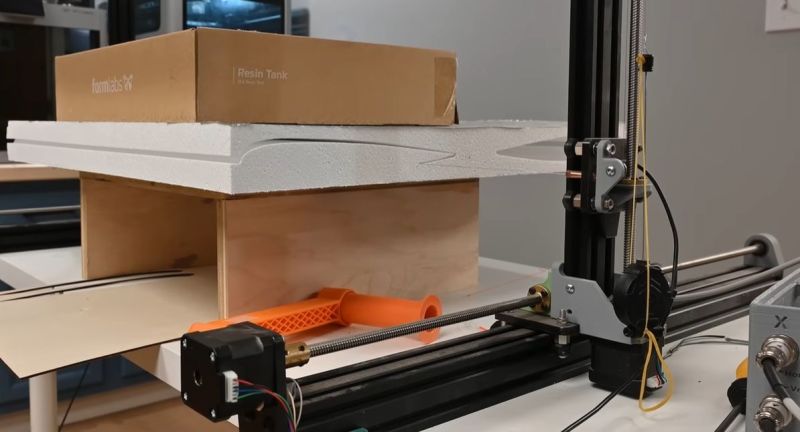
The machine itself is a 4-axis system, allowing the wire to be moved just about any way in between the two sides. It uses typical NEMA 17 stepper motors, along with other components that you’d find on a 3D printer. The same is true for the control board that processes the g-code from the software.
The unique part is the pulley-based mechanism that tensions the cutting wire, along with the way that the current gets passed through the wire, which uses MIG welding tips rather than just some alligator clips, which would probably also have worked but not looked as nice.
There are a few 3D-printed parts for which the STLs are provided, and the design is such that the entire assembly can be fairly easily collapsed into a compact shape that’s much easier to store if you’re not cutting foam every single day. For [Michael] cutting airfoils is the main use, for which you got a few software packages that are mentioned in the video.











Don’t forget, you don’t need a CNC or some third party company, if you have a hacksaw and a drill.
By that standard, any hobby project can be performed with a Dremel. Doesn’t mean it’ll be as elegant or as functional.
Note that I’ve made wings like this with very basic tools. You just have a wooden template and a long “bow” as a cut, and then slowly move the bow over the templates with two people. Takes a bit of practice, but not that hard to do.
Doing it with a CNC machine is cool, but definitely not a requirement.
Or two wooden templates. Some times a friend if it’s over 6 ft spsn
When I saw ‘CNC hot wire foam cutter’ I was hoping for something better than a straight wing.
I do really like the method for automatically tensioning the heating wire.
I think I’d have tried weights like a sash window myself, just to make it a little more fine tunable, although I guess a spring doesn’t flop around during acceleration. The result looks so much neater than cutting freehand or even following a jig.
I wonder if also compensating for the change in resistance as the length changes might make for a better cut when transitioning to a diagonal, a few inches could change the temperature quite a bit.
Not to mention, as with an incandescent bulb, as it heats up the resistance will increase.
I wonder about mounting a small loop of heating wire to the end of a robot arm, perhaps letting the robot dynamically adjust the loop diameter and having it sculpt a block in 3d as if it were cutting clay. No doubt the kinematics would be little tricky.
In CNC 4 axis usually refers to XYZ+a single rotary axis.
This system is more of a 2+2 axis than a 4 axis.
In computer numerically controlled what? In wire EDM, which this is similar to, this 4 axis nomenclature is used often enough.
I have often thought about tools like this to cut Imperial Star Destroyer shaped foam wedges.
The details would be atop 3D printed plates like these spiked caster cups for table-legs that rest atop carpets:
https://www.target.com/p/unique-bargains-square-carpet-furniture-leg-protecting-spiked-caster-cups-4-pcs/-/A-1011948888
You would press these lightweight plates into the foam where the spikes hold it fast.
This way, you could have a large model still light enough so you could still swoop it around.
The NiCr wire used is not mentioned anywhere, I wonder what AWG and amperage/voltage is.
I can’t see what is used as a tensioner for the hot wire either. Sigh.
At 3:50 he mentions that he uses a lanyard clip as a constant(ish) spring. Guess one could figure out the AWG of the NiCr-wire through guesstimating, but i assume it is all a balancing act of durability/current/precision which diameter you can/want to drive.
I’ve built several. For tension springs were used. A rough rule of thumb is 1W/inch of wire.
I was a bit curious about the used software, and with a handful of clicks I found “GRBL Hotwire”.
https://rckeith.co.uk/grbl-hotwire-mega-5x-for-cnc-foam-cutters/
https://hackaday.io/project/199287-fluidnc-4-axis-foam-cutter-controller/log/248207-using-grblhotwire
I would eliminate the rollers and go with linear rails.