
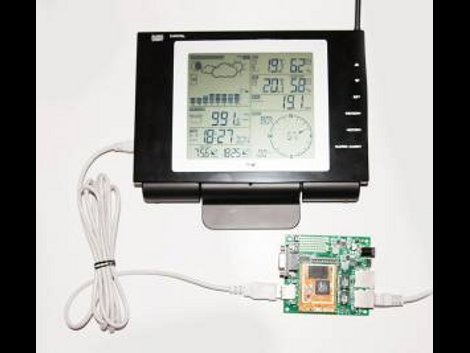
This Nexus wireless weather station has an array of weather sensors that you mount outside and monitor on the LCD screen. It also has the ability to stream the data over USB, but that feature is only supported in Windows and the companion software leaves a lot to be desired. Here’s a technique that will let you unlock the potential of the data by streaming it to your Linux box or directly to the Internet.
It turns out that grabbing the data via Linux has been made quite easy thanks to a package called TE923 (translated). With the base unit connected via USB, the software will pull down a string of colon-separated data which will be easy to parse using your favorite scripting language. But what if you don’t want to tether this to a computer?
The project goes one step further by using a Carambola board. This is a WiFi board with a USB port on it. It runs OpenWRT so getting TE923 going is as simple as building the package. The best part is, any wireless router that runs OpenWRT (or DD-WRT, etc.) and has a USB port can substitute for this board. With the module connected to the station, data is pushed to the Pachube website to serve as a custom web readout.
[Thanks Saulius]












$30, 802.11n, openWRT, 8MB/32MB, FCC … this module kills all the other embedded wifi modules.
Great. Now how do I get my linux box to recognize the USB receiver for my LaCrosse station? The software is Windows only, but runs fine in WINE. The only problem is the program doesn’t see that the USB receiver is plugged in.
Wow the carambola looks like a pretty sweet board. Not only can it be slaved for networking or i/o, but it seems to have a powerful host processor (how powerful??).
And to think I paid $35 for my Adafruit Arduino Ethernet+SD logging shield. (I’ve since abandoned the idea of buying any more shields.. not until Arduino fixes the pin spacing).