
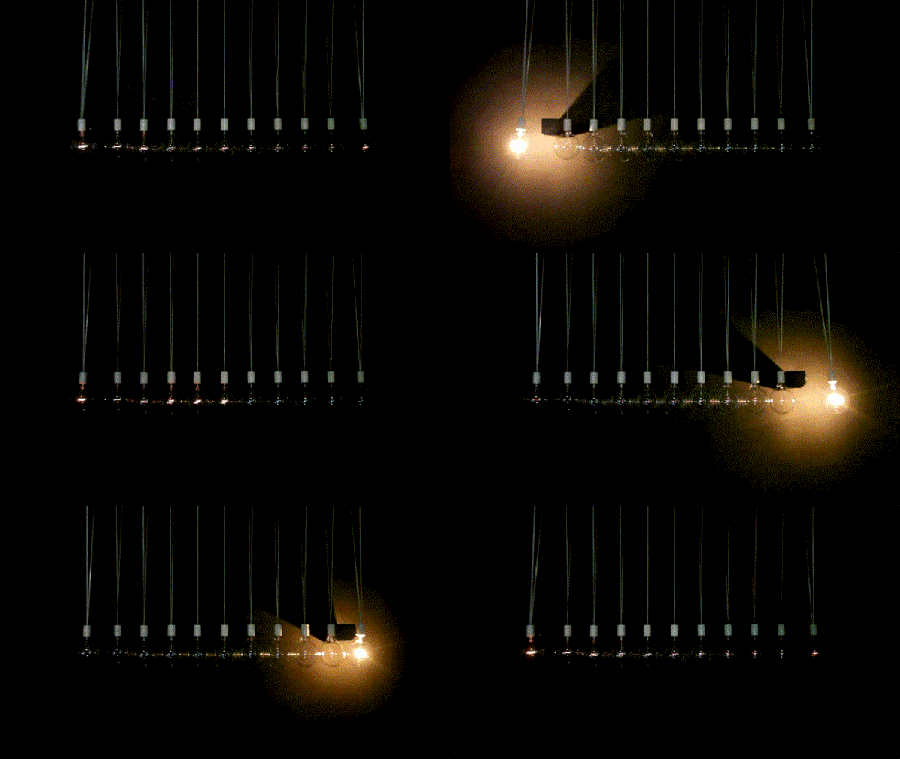
This interesting take on Newton’s Cradle is called “Asobi” and was created by [Yasutoki Kariya]. However, [Johnny] at Spoon and Tamago dubbed it “Edison’s Cradle”, which we think is a great name.
As you can make out in the video, it isn’t really a Newton’s Cradle. There is a solenoid pushing the bulbs at the end out at the correct time, but that’s fine. The overall result is quite brilliant. Unfortunately, we don’t know much about the setup. Anyone have more information? Anyone want to take a stab at making “Tesla’s cradle”?
[via Make]












Edison was a dick.
It would seem logical if it was electromagnets/solenoids pushing the last ones to create the illusion of a Newton’s cradle and then a hall effect/pressure sensor to detect when the bulb has hit the block again. The rest is a few lines on a micro controller. Simple but elegant.
Sorry I didn’t realise I was on a reply! What I meant to say in reply was that Edison is a Dick and that Tesla is the greatest geek that ever lived but that moment is gone now
That.
Anyway it’s a quite cool idea.
Tesla rules !!!!
When Thomas Edison wasn’t running around stealing inventions that weren’t his own, he was publicly electrocuting defenseless animals.
More Proof to Your Point.
defenseless, but the elephant killed like twelve people…
Tesla cradle makes me think of electrostatic forces pushing the objects, rather than direct collisions.
I’m right with you there. The things that would be pushed should be fluorescent tubes, which flash in the electrostatic field.
Now I want to try a “Lorentz’ Cradle” where it uses oppositely-polarized magnetic fields to repel each other instead of physical contact.
We still haven’t built a Hawking’s Cradle where the balls are actually equally sized black holes
Black holes aren’t balls though.
And there are another few issues with that idea :)
so bad ass
It’d be pretty cool to see an arcing version of this where it is a regular Newton’s cradle but has the outer two masses at opposite high voltages, while the inner masses only conduct between other masses. That way, the outer swinging mass will always have an arc between it and the nearest mass.
nice.
So has it been confirmed that it’s solenoids pushing the end ones?
To me it seems a bit too smooth and not nearly as loud as it(should be)would be if it was solenoids,
Personally I was thinking more of magnets and electro-magnets.
Yes, you can see it clearly in one of the videos.
are solenoids not electromagnets..?
You sir, are quite correct. Solenoids are indeedelectromagnets.
Lolz, that’s what yesterday’s Mythbusters was all about.
why anyone would name something after Edison is beyond me. He was a thief & a saboteur Tesla was/ is a better, smarter inventor & person bar none
most likely because of the connection between edison and the lightbulb. it is a logical connection.
he didn’t invent it, he stole it
Happens all the time, look at Steve Jobs and Bill Gates Stealing the GUI.
I appreciate the enthusiasm for Tesla– I’ve been a fan since before it was cool to be one. But your anti-Edison rhetoric is getting a bit silly.
Isaac Newton, whom nobody denies invented calculus, is quoted as saying: “If I have seen further, it is by standing on the shoulders of giants”. It is a rare inventor whose work is not based upon the work of others.
It is true that others developed electric light designs before Edison. But to the extent that these other devices worked at all, they were dim, short-lived, or had other physical/electrical characteristics that made them unsuitable for use in the home. A light bulb that doesn’t work well, can’t be relied upon, or is too costly for the average working stiff to afford is in effect, useless.
Edison conducted over 9000 experiments in the development of his light bulb. He literally sent explorers around the world looking for materials that could be carbonized into practical filaments. In one experiment, in which he attempted to prevent the blackening of the bulb by a disintegrating filament, he included a charged metal plate inside the envelope. In noticing a peculiar unidirectional flow of electric current from the filament to the plate, he unknowingly created the first vacuum tube diode.
John Fleming got the patent for the first vacuum tube in 1904, but Edison was the first to actually build one, back in 1883.
The bottom line is that Edison refined the electric light bulb to the point that it worked well, and could be manufactured cheaply enough that most people could afford them.
Tesla brought us the modern electric grid, and he’s responsible for the dozens of induction motors scattered throughout the typical home. But if it weren’t for Edison, we’d have spent most of the last 100 years in the dark.
Isaac Newton, whom nobody denies invented calculus…
Ummm, you are kidding, right?
PI – Well I am NOT a big Tesla fan at all BUT if Edison did not get the incandescent bulb right then we would have gone with Tesla’s fluorescent light bulbs which it seems we are doing quite heavily now in the USA. I think I don’t have one of Edison’s bulbs in my house right now. They are all GE fluorescent bulbs (the curly kind). I am using one right now to illuminate my laptop’s keyboard.
And the filament/bulb combination that finally worked for Edison was from his African-American assistant for which I am not sure he got proper credit for. I’m not sure about that sentence though might be wrong.
Edison was a little too hard on Tesla. If Edison played fair (very uncommon for his era) it would have been a very lucrative endeavor. Tesla gave away invention(s) to George Westinghouse Jr which today would be equal to BILLIONS today! Westinghouse today is in FULL EFFECT right now thanks to Tesla’s gracious gift to George. That gift could have been given to Edison if he wasn’t such a “hard-azz” going around electrocuting dogs to publicly defame Tesla.
I never liked Tesla’s life choices. His inventions where amazing and too far ahead of his time. But I believe there was an undocumented esoteric reason for that. And that’s where I part was with “Little Nickey’s” life choices (i.e. movie-reference pun intended). And his albeit tacit role in helping the German’s start WW1 with USA doesn’t go unnoticed by me nor did it with POTUS Wilson either.
ar0cketman – What is your problem with Newton and Calculus? PI is 100% accurate on that.
That is quite cool, I like it. But another way it could be, closer to a Newton cradle, would be to use plastic lightbulb shapes filled with epoxy or some other clear solid with embedded LED light and a power supply and motion/impact sensor in the bulb socket, but since I can’t build that this will do for me to drool over. :)
Edison did not invent the light bulb, not even remotely
You’re right. However, he was the one that invented the incandescent bulb that lasted the longest. I’m not sure but I think there is a little firehouse in Livermore CA (USA) that has an original Edison bulb going “mostly” non-stop for over hundred years! Was in Guinness BoWR too.
Very clean build! Captivating twist on an old classic. Oh and I invented the light bulb, end of story!
the sound is terrible! makes my fingernails twist backwards!
IMHO: A low-tech version of this Newton’s Cradle (or conservation of momentum and energy machine) would be to wire up 5 tempered glass (Pyrex – unbreakable glass) spheres with horizontally oriented mercury switches (in the plastic necks) wired in series to incandescent bulbs, with a small-value electrolytic capacitor wired in parallel (to stretch out the lamps glow a bit), and a common power supply (bulbs 1,2,3,4,5). Then the #5 sphere would have it’s mercury switch wired in series to, common power supply, a solenoid, and parallel-wired large-value electrolytic capacitor for delayed dropout mounted on the right end that pushed the #5 bulb (at the neck) away every time to give the illusion of perpetual motion. Yes the #5 would move on it’s own anyway due to the inherent physics but if it didn’t have an solenoid assist the motion would decay eventually and stop. In any event a human has to start the action by setting #1 into motion initially. He could use a left-side solenoid to do that too. Maybe there is a feedback line from #5 (right) to #1 (left) solenoid too but that’s a bit more complex and and a bit more problematic. But maybe that’s the big challenge of the whole thing too.
The hanging cables are also the feed lines to the common power supply in the ceiling. The capacitance would be key and you’d have to play around with it to find optimal values.
For all you Tesla-lovers please watch this movie to get the REAL story about this guy: ‘The Secret of Nikola Tesla’ 1980 by Serbo-Croatian: Tajna Nikole Tesle. There’s a lot you don’t know about him and his past.
Not in the movie but the reason why the newly formed BOI (aka FBI – headed by J. Edgar Hoover) was so interested in Tesla and why eventually his Wardenclyffe Tower was destroyed by US Navy (under orders from POTUS not JP Morgan as many falsely believe) is because of him selling his new advanced turbine engines to the Germans just before WW1 and the Germans used them in their warships against Allied shipping.
I’m not pro-Edison but Tesla did work for him before they became sworn enemies. Edison’s working commercial tungsten filament argon-filled incandescent bulb was invented by his assistants Hammer & Swan not Edison himself. But that was Tom’s M.O. to make other’s inventions his own not unlike Mr. Einstein – the sticky-fingered Patent Clerk? However, the movie hints that maybe Tesla’s inventions where not his own either (i.e. from a higher power?).
@sonofthunderboanerges you wrote of the lightbulb (as others keep pointing out):
“Edison’s working commercial tungsten filament argon-filled incandescent bulb was invented by his assistants Hammer & Swan not Edison himself. But that was Tom’s M.O. to make other’s inventions his own not unlike Mr. Einstein…”
My question to these “Edison is a dick/thief” folks is simply this: How is it that what is explained that Edison did (using work completed by his assistants) any different from nearly every big-time university PhD who shows up in his lab 2-3 times a week to check in on his/her load of assistants who work daily? When the “breakthrough” is finally made, it’s Doctor So-n-So that gets the credit, not “Weekend-Shift Jane.”
Was Tesla always working alone in his lab with no outside support or assistants helping while he was away?
Ed Jaws – What you are talking about today is called IP or Intellectual Property. A scientist working for a company or a university is usually obligated to allow the entity he works for to give up his IP rights to them. That includes any assistants in the lab. It’s all arguably about $$$ and not science.
Yes Tesla had assistants over time. One was George Westinghouse Jr who became a multimillionaire from Tesla’s gift(s) to him. Unfortunately it has come to light recently that another and final assistant of his (actually a German spy) was the real reason he died in that hotel room and his safe was empty when FBI came to check it. The deathbed testimony by the informant claims that the assistant, he, and a NAZI German spymaster entered the hotel room and tortured Tesla for his plans (in the safe) for the directed energy gun he was working on then smothered him with his pillow. The informant goes onto to claim that the assistant later became a US Senator and father to an actual POTUS.
Being that it was a deathbed testimony makes it “sound” credible. However, it may be fraught with conspiratorial plot holes which takes away from the credibility. The informant was a historically confirmed NAZI spy though.
this thing is not a edisons cradle look at the back wall you see to things that look like a block at the 2 ends that push the lamp at the right time and make the sound
look close and pause at 0.44sec you see the lamp do not even touch the cradle when it swing
You should read the post! It’s written on the page above you:
“As you can make out in the video, it isn’t really a Newton’s Cradle. There is a solenoid pushing the bulbs at the end out at the correct time, but that’s fine”
You mean it isn’t a newton’s cradle, which is fine because it isn’t supposed to be.
I believe it is based on Newton’s Cradle or Newton’s Balls. I think kinetic energy is being transferred through the balls but you can’t see it. Just like the EXECUTIVE BALLS you can buy at Spencer’s Gifts or Edmund Scientific both in NJ (USA).
If you want to see something TRULY amazing which you can make yourself, look up Tesla’s Egg of Columbus.
but it says in the description
“As you can make out in the video, it isn’t really a Newton’s Cradle. There is a solenoid pushing the bulbs at the end out at the correct time, but that’s fine”
and I just got that from the comment right above you…?
did you read anything…?
Matthew – I said “based on” not that is IS Newton’s Cradle. It’s obviously NOT Newton’s Cradle as he did not use tricks of electricity for his.
Yeah, he was a dick.. im wondering, cant they just put in much more power to make the ones in the middle light up real good?
SO TRUE DICK EDISON
Just so you know we American’s (and Brits) use the colloquial metaphor “DICK” to imply that a person is being very unreasonable, unnecessarily arrogant, and rude which Edison was. It really has little reference to male genitalia which I’m sure your (et al) salaciousness makes you think. The term originates from 1665 AD in the satire “The English Rogue” by Richard Head, an unsavory character is referred to as a “dick”: That’s because Ric(hard) rhymes with it. So many modern gutter-minded types just go one step further to think it has something to do with male genitalia.