
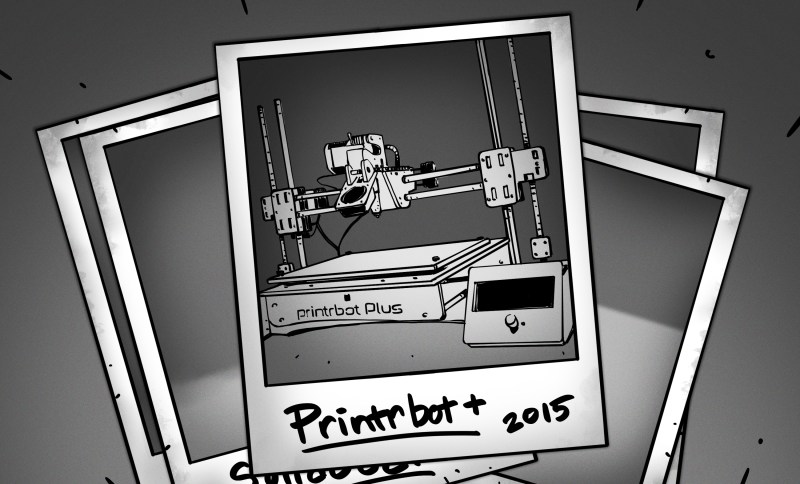
Bridges are a part of our constructed landscape that we take for granted. And bridges by themselves aren’t especially important. What is important is that bridges let you get from one place to another. Technology is often the same. We get from point A to point B through some bridge technology that, probably, most normal people never even notice.
Years ago, point A was commercial 3D printing. Industry had stereolithography, selective laser sintering, fused deposition modeling, and other rapid-prototyping technologies. These were not toys. They were expensive industrial systems used by companies that needed prototypes badly enough to pay serious money for them.
Fast Forward to Today
Today, you can go to a big box store and buy a 3D printer for well under $1,000, and often far less. Modern machines are almost plug-and-play and tend to do all the hard parts for you. That’s point B. How we got between points is a story of hackers who had a dream, and many Hackaday readers lived through it and even played a part in that bridging.
For a long time, RepRap was synonymous with hobby-level 3D printing. The project, started by [Adrian Bowyer] at the University of Bath in 2005, was built around a powerful idea: a machine that could print many of its own parts, thereby helping make more machines. RepRap Darwin reached its early self-replicating milestones in 2008, and the movement produced a thicket of descendants, variants, and arguments about rods, belts, bearings, extruders, firmware, and what “self-replicating” really meant. Of course, the machine could only print some of the parts you needed, but it was still impressive how much of a printer you could make with one printer.
Without RepRap, the desktop 3D printer boom would have looked very different. It created a common pool of ideas: Cartesian frames, printed brackets, hobbed bolts, heated beds, RAMPS boards, Marlin firmware, and a whole common vocabulary. It also created the expectation that a 3D printer was something you could understand, modify, repair, and improve. That expectation would not survive everywhere, but it defined the early culture.
Kicking Kickstarter
By the early 2010s, 3D printing had the right ingredients for a crowdfunding explosion. The technology was visible enough to be exciting, but not yet mature enough to be boring or attract big players. Hackerspaces were multiplying. Arduino had made embedded tinkering feel approachable. Laser-cut plywood, stepper drivers, and commodity motion hardware were easy to source. There were enough RepRap veterans to know what worked, and enough newcomers to believe the next machine would finally make 3D printing simple.
Kickstarter was a perfect amplifier. A desktop 3D printer looked good in a campaign video. It moved. It made things. It appeared to turn imagination directly into plastic. Printrbot was one of the defining examples. [Brook Drumm’s] original Printrbot campaign launched in 2011 and became one of the notable early 3D printer crowdfunding successes, raising far beyond its initial goal. The pitch was seductive: a printer you could afford, build, and actually use. Not an industrial system, not a laboratory instrument, but your first 3D printer.
I had a Printrbot Plus built from a kit, and that experience says a lot about the period. It was not a toaster. It was not even quite a drill press. It was more like buying a small CNC machine from a bright, optimistic friend who assumed you owned calipers, weren’t afraid of firmware, and could recognize when a machine was racking itself out of square. You can see some very old YouTube videos of my machine below.
The Printrbot was charming because it was so direct. There was very little mystery in it. It was made from wood! Even some of the gears were wooden. You could see the rods, belts, pulleys, endstops, and wiring. You could also see the compromises. The Printrbot used LM8UU linear bearings that were, in some cases, held in place with zip ties. This was not necessarily as terrible as it sounds; zip ties are a valid engineering material if your tolerance stack and expectations are sufficiently charitable. But the bearings could be a little loose. The folk remedy was equally period-correct: jam a bit of 3 mm filament in there as a wedge to keep the bearing from wiggling.
That little trick captures the mood of the time. The printer came from a factory, or at least from a company, but it still expected you to meet it halfway. It was full of these tiny bits of tribal knowledge. Blue tape on glass. Hairspray. Kapton. ABS juice. Tighten the belts, but not too much. Level the bed with a piece of paper, unless you had a feeler gauge, unless the bed was warped, in which case all bets were off. If the extruder skipped, maybe the nozzle was clogged, or the filament was too fat, or the hot end was too cold, or the hobbed gear was packed with dust, or the phase of the moon was affecting your controller board. Ok, maybe not the last one.
Solidoodle
Solidoodle was another emblem of that period. Founded in 2011 by [Sam Cervantes], the company pushed hard on affordability, with early machines such as the Solidoodle 2 attracting attention partly because they promised a usable enclosed printer at a price that seemed startling at the time. Wired covered the Solidoodle in 2012 as an assembled $499 machine, which was exactly the sort of price that made people start thinking desktop 3D printing might jump from hackerspaces to ordinary homes.
The Solidoodle story also shows the danger of that moment. The market wanted cheap, reliable, attractive, assembled, easy-to-use machines. The technology could supply maybe three of those at once. Companies were trying to scale production, support beginners, improve hardware, and hit aggressive prices while the entire field was still learning what “reliable” even meant for a low-cost filament printer. Solidoodle eventually suspended operations in 2016, a fate that befell more than one early desktop 3D printing company.
Part of Solidoodle’s problem was that they were too invested in the original RepRap idea. I almost bought a Solidoodle because I was fearful of trying to put a kit together with so many mechanical parts. Why didn’t I? Because RepRap lead times were enormous. At least part of the problem was that they were using Solidoodle printers to produce parts for Solidoodle printers.
Say you have ten printers. You get orders for 100. Great, right? But getting parts for those 100 printers done on your ten printers will take a long time. Of course, you could take the first ten to help, but now you can only ship 90 printers. If you only had 100 orders, you’d be fine. But in the printer-starved 2010s, a cheap printer like Solidoodle or Printrbot would get orders faster than they could fill them, and had to decide if they’d fill orders faster or try to make do with their existing printer farms. There really isn’t a right answer to that question. We heard that [Brook], for example, expected to sell 50 printers through Kickstarter. They wound up with a backlog of over 1,000 printers. Within a year they had $2 million in sales and it went up from there. Until, of course, it didn’t.
MakerBot
MakerBot deserves mention here, too, although it occupies a slightly different lane. It started in the open-source maker world and became the company most associated with the dream of consumer 3D printing. For a while, it seemed like MakerBot might become the Apple II of 3D printers. Instead, it became a cautionary tale about trying to turn a hacker tool into a mass-market appliance too quickly. The machines got slicker, the company moved away from its open-source roots, and the consumer revolution failed to arrive on schedule. By 2016, even mainstream coverage was asking what happened to the 3D printing revolution that had been promised.
But failure is too simple a word. The Kickstarter-era machines did not fail in the way that, say, a fad diet fails. They moved the ball down the field. They trained a generation of users. They revealed what mattered: rigid frames, better motion systems, predictable extrusion, heated beds that stayed flat, slicers that didn’t require a sacrificial offering, and firmware that could recover from ordinary user behavior. They also created demand. People who bought a Printrbot or a Solidoodle might have cursed it, modified it, and eventually replaced it, but they knew what they wanted next.
And what they wanted next was cheaper and better. That leads to the next wave: the low-cost commodity printers. The Monoprice Select Mini was one of the machines that made people do a double-take (see the video below). It was small, inexpensive, and not especially glamorous, but it was also a complete 3D printer at a price (around $200) that, up to that point, had seemed impossible. The Anet A8 represented another branch of the same tree: a very cheap kit printer, descended in spirit from RepRap machines, that put a large-ish build volume within reach of people willing to accept risk, tinkering, and sometimes questionable electrical design.
The End?
These machines were not the end state either. The cheap printers democratized access, but many still required an operator rather than a mere owner. The Anet A8 in particular became infamous not just for its low price but for the upgrades people considered mandatory: better firmware settings, frame braces, MOSFET boards, power supply caution, and general fire-safety paranoia. Still, it mattered. A rough kit at $150 or $200 changes a market. It lets students, hackers, model builders, repair-minded homeowners, and the merely curious take a chance. My A8 is unrecognizable today with an aluminum frame and a 32-bit controller board, a proper 24V power supply, a custom hot end mount, and other enhancements.
You can see my original A8 (and a peek at the Printrbot in the background) in the video below.
A few years later, it looked like this video.
The real consumer-ready printers came later, after years of iteration. Auto bed leveling became common. Filament paths improved. Machines got stiffer. Slicers became far better. PEI spring steel sheets replaced a lot of glass-and-hairspray rituals. Direct drive and better Bowden setups reduced extrusion drama. Enclosed CoreXY machines brought speed without quite so much ringing and finagling. Companies learned that the printer had to be a system: hardware, firmware, slicer profiles, materials, documentation, and support.
Right, Yet Wrong
Looking back, the funny thing is that the early hype was both wrong and right. Desktop 3D printers did not become like inkjet printers, and they certainly did not become like microwave ovens. Most people do not need to manufacture a plastic bracket before breakfast. Most people do not want to think about layer adhesion, nozzle wear, or whether that weird clicking noise is the extruder eating the filament.
I lived through the time when the hacker dream was that every home would have a computer. Most of us didn’t see what would really happen. Every person has at least one computer; every home has dozens. But we were on the right track; most of us just didn’t see what would drive it. But I never really thought 3D printers would become as common as personal computers.
I did think it might become like a drill press. Not everyone has a drill press. In fact, most people probably do not. But no one is amazed to learn that you have one. It is a normal thing for a certain kind of person to own. If you fix things, build things, make brackets, or restore equipment, a drill press is not exotic. It is just one of the tools that may live in the shop.
That is where 3D printing has largely landed. Not universal, but ordinary. A decade ago, saying you had a 3D printer was a conversation starter. People wanted to see it move. They wanted to know if you could print a wrench, a phone case, a toy, or, inevitably, another printer. Today, in technical circles, saying you have a 3D printer is more like saying you have a bench vise. The interesting question is not whether you have one, but what you use it for.
That normalization is the real legacy of the awkward Kickstarter era. Those machines were crude, but they were legible. They let us see the process. They forced us to learn what mattered. They converted 3D printing from an industrial service into a shop skill. A Printrbot with zip-tied LM8UU bearings and bits of filament jammed in as shims was not a consumer appliance. It was a bridge.
And like many bridges, it was not the destination. It was the thing that got us there. Of course, things continue to move. Maybe one day we will look back on the current generation of printers and wonder how we ever used them. But, like the personal computer, we probably can’t imagine what is going to drive the adoption of those new machines.












I got in relatively late. I started out with an Ender 3 many many years ago and fried the mainboard a day after putting it together, because I upgraded it with a touch probe. Turned out that the touch probe cable wasn’t plug and play for my board and I should have moved cables in the connector. After buying a new board, I was able to get it so it wouldn’t burn down the printer. But it took weeks to get to the point where I could actually use it. Turns out I had to modify Marlin firmware and after weeks, I couldn’t do it. No one was apparently willing or capable of helping me. After several weeks I found a pre-compiled firmware on a source I didn’t know if I should trust it, that had precompiled Marlin firmware. I uploaded it and it worked. I ran the printer like that for years. Eventually bought an Ender 3 pro version and used it for another few years, again with firmware someone else made so I wouldn’t have to touch Marlin. Last year I bought the Anycubic S1C. Great hardware but the software is a pain to use, locked down firmware so you can’t use other software. Their software is using their servers to connect to it. I sometimes open their software and it’s horrible. It’s a bad clone of OrcaSlicer modified with their cloud services. I’m glad that Rinkhals exists or that printer would have been an expensive paperweight.
I like 3D printing. I use it a lot and these days I’m glad that it’s come down to a ‘it just works'(TM) level of printing. Especially now the days of glass/PEI is over and we are in the cryogrip era. I’m constantly making brackets, mounting options for motorcycles, for things around the house, even for work.
But sadly when I look at manufacturers like AnyCubic and Bambulab, it’s nothing worth cheering for. They have amazing hardware, you just place it down on a stable surface and you can print. But it’s getting locked down more and more and it’s not looking like we are heading towards a good future. And now with new laws coming in California and New York that will impact the rest of the world too, companies are likely to be forced to lock down printers even further which will result in locked down being the new thing, just like it happened with cars. With several modern car brands, things like replacing a tail light on a BMW, causes the car to go into fault mode as it needs to be reregistered by the dealer. A new Mercedes model refuses to start if you open the hood yourself. I see that happening to printers too.
I got a bambu x1c. They rolled out an update to lock down orcaslicer from sending prints through their cloud. I just stopped updating my printer firmware. Probably never will. So far best printer one could ask. But i will not buy another bambu, due to them locking down the ecosystem.
As a relative newcomer, my first 3D printer was a K1C. I bought it to make some parts for my 70’s pinball machine. I’ve since done that and dozens of other parts and have incorporated 3D printing into my professional life.
I’m no stranger to building mechanical things and was aware of the RepRap movement from Makezine or similar, but I wasn’t looking to pick up the hobby of tinkering with a 3D printer in the early days.
The current state of the art made the idea interesting. The price was now well within my budget so I pulled the trigger.
My focus is on practical objects. With printers as ready-to-print as they were, my biggest challenge was learning the 3D CAD necessary to turn ideas into printable designs. As I started picking that up, I bought a Flashforge AD5M, used with low hours for $150 that I could use at work.
Then, a guy at work saw me printing and sold me his abandoned Ender 3 Max Neo for $50. Though relatively slow, it filled the need I had to print taller cylindrical objects at work.
These things are like a certain brand of potato chips. 🙂
“A new Mercedes model refuses to start if you open the hood yourself.” Source please
im still on the a side of this bridge, as my printrbot still works.
I started with a Makerbot Replicator 2 (which hadn’t been assembled correctly) and thought “this is the future!”. The (correctly assembled) Prusa Mk2S was next and it still works perfectly fine without any maintenance. The Mk4S MMU is also pretty faultless and sits beside my drill/mill machine. Add the printing pen for touch-ups and I’m happy living in the future!
And let us not forget about the end phase of all of this, when open source software for 3D printers is made illegal in America. Don’t laugh. It’s not funny. At least not in the United States.
Are the feds in on it too? Last I heard it was just a handful of states legislating printers needed to be locked down so they could magically detect if a bit of gcode was a gun part.
Maybe makers need to join the NRA. Surely the “right to bare arms” crowd has our backs on this if nothing else.
It’s just several states right now. Building or printing guns is perfectly legal federally unless you are prohibited from possessing them.
They have actually asked the NRA to stand down.
This directly effects me. As a dev/vendor.
I suspect I am going to need to block California from sales… Our board/project can easily be used to bypass any restrictions.
Now try to enforce it.
I remember this era really well. I had a great job that let me build and study machines across the industry; I built Darwin and Mendel, ten versions of every extruder, we had every printrbot, the solidoodle (holy unbroken metal edges batman), and dozens more. Every new entry into the market was exciting, but way too many promised the heavens and the earth, and delivered a good-enough-for-tinkers experience. I hate to think how many are just landfill now.
I try to keep my 2010-2014 printers working just as a fun thing to do, but none of them are very good compared to modern commodity machines. I even have a cupcake that still functions in a goopy way!
I joined the Milwaukee Makerspace in 2012 (member #8, I think) and started my first project to build a 3DP after one of the members brought a Cupcake printer to a meeting. I looked at it, pushed on it, wiggled it, and quickly came to the conclusion that it was a POS and I could build something much better with the tools at the makerspace.
I spent about 1 1/2 years gathering parts and materials and designing and building as I found parts. Many were found, added to the machine, and then discarded when better stuff was found. I used t-slot aluminum from a scrap yard to build the frame and started with a glass bed and quickly realized glass beds suck. Then I switched to kapton tape on an aluminum bed, then I discovered tooling plate that comes milled flat and used that, and eventually figured out how to make a kinematic mount for the bed.
I ended up designing and building 3 printers, the last being my corexy machine, Ultra MegaMax Dominator (UMMD for short) that has a 300 x 300 x 695 mm print capacity. I built it about 8 years ago and still use it. It has a cast tooling plate bed on a kinematic mount that I haven’t had to adjust in at least 2 years, belt lifted z axis that doesn’t move when power is cut, uses linear guides in all three axes, and has a heated enclosure for printing ABS. It has operated as an appliance the whole time. No auto bed leveling needed. It just works. Every time.
After I built it I left it at the makerspace for about 6 months so that other people could use it and find its flaws. If you ever want to test a tool or a 3D printer, put it in the hands of a bunch of cosplayers. They will find its weaknesses in very short order, and will do exactly what you tell them not to do (don’t adjust the bed, for example).
Who else participated in the 1st gen drop-shipped Chinese FDM challenge?
Tevo Tarantula was where I started in 2015. $200 for a box of parts from Ali. No instructions, just a single folded sheet with some photos resembling a Prusa and a link to a Facebook support group.
The heat beds were all warped, the big upgrade was a sheet of borosilicate glass binder-clipped to the heat bed. You couldn’t find PVC glue sticks, so everyone used hairspray for bed adhesion. Then of course you would add dual-Z leadscrews to fix the gantry sag, experiment with every type of leadscrew coupling to try to eliminate Z backlash, add belt tensioners, ‘upgrade’ to an all-metal E3D clone, try out every crazy layer cooling fan shroud, etc.
Before I got my Kickstarter X1C, the only thing original on my Tevo was the heat bed and aluminum extrusions. I was running a Duet 2 WiFi motion controller, BL Touch bed levelling probe, and a bootleg enclosure made from thermal blankets.
First, I accidentally hit Report. I didn’t mean it. Sorry.
Maybe I was trying to Report my Tevo Tarantula. I struggled with it for a year and a half, never got a decent Benchy or even calibration cube – even with help from the makerspace I was a member of. Even though I bought the kit from the makerspace and did the main assembly in a weekend session with a half-dozen other excited newbies.
Put me off the whole thing for years, until early 2025, when I bought a clearance-priced Mingda Magician from the Maker Store. That kept me going until this year when I got an AnyCubic Kobra X.
The Magician astounded me, and the Kobra X completely blew my mind, after the Tarantula.
So, yeah, Al is right: we have crossed that bridge into a new normal. I’m not sure what it will look like on the other side of the next bridge, but I plan to use the printers as long as possible.
My PrintrBot Play is 11 years old, the oldest member in my fleet, and still a daily driver. It’s precise, tough as nails, and darned-near maintenance-free. Small volume and PLA-only, but fitted with a 0.3 mm nozzle and printing .05 mm layers it makes very fine prints. With matte filament, layers lines are invisible. With silk filament it makes beautiful molds for silicone casting. It produces prints geometrically more accurate than anything coming out of the SLA printer.
Went through 6 printers starting with lulzbot taz 4 kit in 2014, the entire time each print required some tweak or adjustment to get a decent print. Wasn’t until recent printers like bambu where this was no longer necessary. I can appreciate the early beginnings, it helped my work projects and bought my own as they did not appreciate the impact of it. My first exposure was seeing a reprap Mendel made with 1/4-20 rods and could produce a ’round’ disk in the 2013-2014 time.
Not interested in tweaking to get a good print, just like it now that I can just print, and use it as a appliance like an air fryer or drill press.
Same here; started with a Printrbot Simple metal, ran it until hotend #2 fell apart (literally!) , fought with a very cursed Flashforge Dreamer (don’t ask) for a while, got a mostly functional Creality CR6-SE from the kickstarter(?!), and currently rock an X1C with triple AMS units.
Still have the CR-6, but it’s collecting dust along with it’s OctoPi sidecar waiting for me to do something with it during the great Shop cleanup that’ll happen Real Soon Now. ;)
Ah, the prophesied cleanup. I’m a big believer in that myself. LOL
This is cool, I see a lot of my own experiences mirrored above. Started with the Printrbot Simple maybe 13 years ago? Made of plywood, it was brilliant, using kevlar string and a dremel sanding drum to move the printer arm. Building it was an absolute joy, and I started printing mints and calibration cubes within 24 hours. Using repetier-host, I learned an absolute ton on that thing, eventually adding things like a heated bed (original was a piece of plywood with painter’s tape). I kept it running until about 6 years ago, when someone gave me a coreXY knockoff they could never get running right. It’s not fast, but it’s big and easy to maintain.
This very much matches my timeline too. I started with a Makergear kit of a Reprap Prusa – threaded rods and printed parts. I spent more time calibrating and tweaking it than actually printing with it, but it limped along for several years. I impulse bought the Monoprice Maker Select Minis, and that replaced my Prusa. It wasn’t a great printer, but it took much less handholding than the Makergear. I also bought a Monoprice Delta, but it was poorly calibrated and didn’t print square. Getting a Prusa i3 MK3 was an order of magnitude step up. It just worked. I could finally print things for my hobbies instead of 3D printing being the hobby. My Prusa Core One has been equally amazing but twice as fast and can now print ABS without any issue, and my MK3 just decided this month to start misbehaving after a rock solid 8 years.
This is a good article but it should consider the substantial follow-on influences of 3D printing transitioning to general use – you have whole generations learning some version of CAD even if it’s Tinkercad or similar, and being able to make needed components and avoid uncomprehending looks at hardware/parts stores. Beyond that they’re learning to deal with different materials (and things like anisotropicity in layered structures). In short, they’re manufacturing engineering natives (particularly the CAD part), often out of middle-school.
With all of that, the whole toolchain becomes much more than a drill press – it’s a custom fab plant and very accessible. My Ender 2 Pro may be laughable to the figurine and carbon-fiber set but it makes all the mounts, bushings, flanges and other unusual components that I need and actually cost less than an actual drill press.
i started in 2014 with a reprap kossel kit (delta geometry) from a long-gone shop called ‘mixshop’. i want to brag about how i got this thing…i watched people wait for years already on kickstarters so instead of going that route, i found a company that was shipping a kit today. They weren’t promising the moon, they just had something good enough that they were willing to throw in a box one-by-one until volume picked up.
i felt like it was an easy build but i had to make a few modifications…new trucks to hold the bearings on the rails, new extruder (for bowden – Greg’s Greg’s Wade’s geared extruder), end effector (the plate that holds the hot end), and authentic J-head hot end of course (the stock hot end was a joke). And my own software to talk to it over USB, and i invented my own bed levelling methodology, and also DIY cable and filament management of course.
Tiny build volume, PLA-only, etc, but I loved it and used it often for 10 years. Then all the PLA in the printer was brittle and everything broke at once and i replaced it with a $170 printer from Artillery3d, which is just ridiculous and amazing. Much faster, much larger, easily manages PETG, don’t have to babysit it as closely during prints, etc. Haven’t had to maintain it yet either, knock on wood.
Thinking about the comparison to a desktop printer…i print plastic much more often than i print on paper. About as often as i use the drill press, really.
I bought a Mix G1 (RepRap Wallace clone) from them around 2013! You’re not kidding about the stock hotend… What were they thinking?
I upgraded it to I think either an Ubis or a J-head and managed to successfully print out the parts for 3 Prusa i3’s, 2 of which are still operational and 1 of which printed out parts for an MPCNC.
Excellent learning experience for young me and helped me and gave me a good head start on a career in engineering.
Started in 2011. Got to be a part of the time where the devs were all in the same channels talking (reprap@freenode…long live kthx).
There is a lot different now. I still believe the things I learned building printers was more valuable than just using a printer. So glad to have worked with everyone…it may not have been super profitable but it was always interesting.
I actually wrote a post recently about how glad I was to find RepRap and where it lead. Instead of a long comment here it is.
https://www.robosprout.com/thank-you-reprap-for-all-of-it/
Printrbot Smalls was my first 3d printer, and it was a joy to build and use. It’s about time I got it out of the closet to see if it still works.
I really liked the style of the kit and the documentation. It was kind of a not-quite-complete product, but in a very good way. If they ever release another kit there’s a good chance I’d buy it.
Is there a go-to-recommendation for an entry level unit for a new user, today? Something that Just Works, but also isn’t the better part of $1k?
I too tried this once before, with a kossel/delta ‘kit’. Got it assembled after re-making many of the included parts from scratch, then found out that the controller didn’t come with any firmware on it (‘there are so many choices! you can use anything that best suits your needs! just grab these files and compile…’) which is where I realized this was not a tool, it was a new hobby all by itself and that was NOT what I was looking for. I just want to make brackets/ducts/other functional parts that would be ridiculous to machine from a solid block of aluminum!
I’ll get a lot of flak for recommending them, but Bambu Lab makes inexpensive printers that just work. The flak comes from software devs who don’t like the way BL is using/abusing open source slicers (at least I think that’s what the noise is about).
I picked up a Prusa Mk3S+, used, for about $500 USD shipped. It has been a champ despite clearly having come from a extended early career at a print farm
Zipties live on at least as far as the Y axis rods of the Prusa i3 mk3s. I believe they would still be present after you complete the 3.5s upgrade. While it’s no longer for sale, it’s only half a generation old.
I’m a bit surprised there’s no mention of Prusa elsewhere in the article. I think of them as the ones who made the first open-source printers that actually worked right out of the box (and kept working for years). They were the anchor on the far side of the proverbial bridge.
I was also surprised by that. Imo the prusa mk2 or mk3 marks the beginning of consumer 3D printers as a reliable workhorses that aren’t a project in and of themselves. I was wary of 3D printers because of all the hype and lack of results early on. But by the time the mk2 was out, my local maker space had an area with 4 set up. I saw those things used and abused non-stop, for months. And they just kept cranking out part after part with only minor maintenance and troubleshooting. I bought a mk3s kit right after that and I’m still using it daily with no major issues. I just checked and it’s got 155 days of print time on it, and the only maintenance has been a few cold pulls for a blocked nozzle once, and about 4 years in I had to go through and re-tighten all the screws. That’s appliance level reliability. It does it’s job and I don’t even have to think about it.
Afik Prusa was really the only printer in that category, for a couple years, until Bamboo Labs. There were other good printers but they all were either insanely expensive, or required tinkering.
I started with a Printrbot simple metal when they first came out, Brook was a great guy and when it wore the nozzle prematurely (maybe it was that testing string trimmer cord with its grp strands…) he offered to send me some foc.
I upgraded it to heated bed, built a heatbed controller from a commercial ssr and a xbox 360 psu, flexible filament modified the extruder (even with ninjaflex filmanet was a challenge) etc.
And it taught me a LOT about 3d printers. I’m sad for people who just bought a printer since as a commodity item and never did anything to it or learned anything.
Today I still have my simple metal, but now with a very stretched Z axis too and 3 extruders (two bowden and one direct drive as original), but it shares space with a Creality ender5 plus with a zeroG conversion and klipper, a large format (1m x 2m) diy 4040 framed frankensteined monster, and a couple of sla printers. Also some large cnc machining centres, one running linuxcnc and the other stock heidenhain tnc. Same design process, just cam instead of a slicer. 3dp made it easy to self teach.
Printrbot was a gateway drug, hooked for life.
As a first printer I bought a Chinese clone of an Ultimaker II back in 2014, it came unassembled with no assembly instructions, and over the space of a weekend, I managed somehow to put it together.
It was a rough and steep learning curve, but after a few weeks I got it to work well enough. Over the next year or two I made a few improvements, but in general it has been noisy but reliable. I still use it today, and only a week ago, I found that one of the sources of the noise was due to a spacer mounted in the wrong place which meant that one of the belts was not aligned properly and it was rubbing on the pulley edge.
This printer has built my MPCNC, which is another big learning curve where the top is not yet in sight for me.
Good piece. We started with a wooden Makerbot Thing-o-matic and it was great because we didn’t know any better. The first thing we did was put a laser on it and wired magazine picked it up. Then we had a company and needed to print parts and the Makerbot could not keep up. We got a printrbot, a solidoodle, several Lulzbot printers, a flying bear, and a bunch of others. Eventually we ended up a few years later with 100 Creality Ender 3 printers in our farm. Now we rely on just 6 bambu printers. It has come a long way over the years. Here is an old post from 2013 with the original makerbot laser cutting solder stencils for prototype circuit boards: https://jtechphotonics.com/?p=473
LOL!
I bought a SolidDoodle. Actually received it. It was a fairly flimsy POS. The example files provided with it we’re for small parts the printer could actually succeed in printing. I was never able to get it to print anything useful.
I sold it twice, the first buyer ghosted me and wing the auction. The second sale was for quite a bit less as word had gotten out about the use ability.
If you look around, you can find all the design files.
I bought a Printrbot kit 12 or 13 years ago. Spent and afternoon assembling it – and that marvelous little wood machine kept on trucking for nearly a decade. When I went to other brands and more advanced machines – the little Printrbot was my go to for weird or problematic materials. I worked in the high end custom/race/hot-rod industry for a couple decades and utilized my little Printrbot to print test/prototype parts before having them machined or making them on the lathes/mills we had in shop. Since 3D printing was relatively “new” on most people’s radar back then – the shop owners loved to brag about their in-house “rapid prototyping.” I have owned ~25 or so printers over the last near decade and half and I remember vividly how “Star Trek” it felt when the Printrbot was printing its first print. I currently own two FDM printers (BL P1S & H2S) and a resin printer (Creality Halot Mage Pro.) Those along side a laser engraver (Longer Ray) and it still amazes me that this level of manufacturing is affordable for consumers. Seeing how the technology has progressed in over the years via owning so many different machines has been really fun.
Recently retired in the UK and I want to get into 3d printing to support the numerous hobbies that have been on hold (car restoration, repairing tools and equipment that have been discarded etc etc). I’ve acquired an old Ender 3 to play around with but I am at a loss of where to go next. I’m not sure if I am being duped by the hype about software being locked down and the fear that this will end up being controlled by big tech. Followed by the inevitable subscription model and enshitification. Is there a good printer and software packages that can be ring fenced and kept offline or is this the end of the line?
You need to download a slicer to prepare the models for the printer. The slicer converts the 3d model into gcode that the printer understands. OrcaSlicer is a good opensource option. Its built on PrusaSlicer which is also a good option. Both should have profiles for an Ender 3.
Download models (or cad them up if you have the skills), slice, and transfer the gcode to printer. Maybe a calibration cube as a first start so you can see if there are any big issues.
Assuming its broadly outputting what is expected, there are plenty of tuning guides out there for the Ender 3. This one seems decent:
https://shinyupgrades.com/pages/ender-3-pro-starter-guide
The length of each comment reflects the amazing impact 3-D printers have had on the creative minds of intelligent people. Great science and engineering.
I learned 3D printing on an Ender 5 Pro and spent a year tweaking it. It has been an education and an invaluable retirement hobby (I am 76) that has taken me into CAD software, product design and solutions to every day problems. The community of people who freely share their ideas, designs and knowledge are the mainstay of the Internet for me. I bought a second printer because I found the first so useful and now have obtained a second-hand Ender 3 V2 which I am converting in to a laser engraving machine. It is more than a hobby it helps keep my brain active as time takes its toll physically.
Love this article. My OG PrintrBot still sits next to my modern A1 Mini. It takes a bit of tweaking but it can still print :-)
It was a triangle frame Prusa that printed the first fifty-ish Printrbots, and it kept contributing for most of the kickstarter run. I miss the Reprap spirit, I’m surprised we don’t have more exotic printer options today