
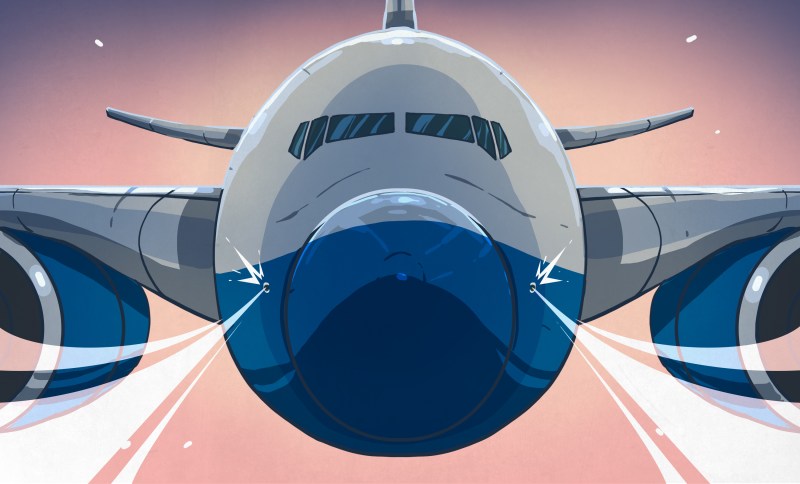
When you’re driving your car, you’re probably regularly looking at the speedometer to make sure you comply with the local speed limits. The method by which it works is simple enough: the rotation of the wheels is sent mechanically via a cable to a dial on the dash, or an electronic sensor counts the rotations of the drivetrain and an electronically-controlled needle or display shows the speed.
But what about if you were in an aircraft, and the wheels had nothing to do with how fast you were going? How would you even begin to measure speed? There are two ways: there’s a convenient solution to this problem rooted in simple fluid mechanics, and a far-more-complex modern solution. Today, we’ll explore how planes and helicopters are able to figure out how fast they’re going, by the old ways and the new.
Classical Methods
A key thing most aviators want to know is how fast their aircraft is going. Specifically, it’s nice to know how fast it’s moving relative to the airstream around it, which is referred to as airspeed. This is important, because it’s the aircraft’s velocity relative to the flow, such as wind, that determines the performance of the airfoils, how much lift is generated, and whether or not the aircraft is approaching a stall condition where it might fall out of the sky.
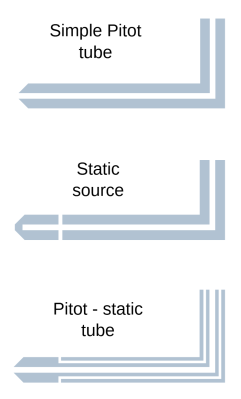
Measuring airspeed is most commonly achieved with the use of a device called a Pitot tube. The pitot tube is a tube with a hole in one end that points directly into the airflow in the direction of travel of the aircraft.
As air flows in, it reaches a dead end and the flow slows to a stop, or stagnates, since it has nowhere to go. This allows a pressure sensor or a manometer or other device to measure the stagnation pressure at this point. The stagnation pressure measurement is related to the flowspeed of the incoming air since the kinetic energy of the flow is converted to pressure as the flow comes to a halt.
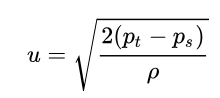
A secondary tube, pointing perpendicular to the airflow, is then used to measure the static pressure of the surrounding air, without the ram effect of the air being forced in by the aircraft’s forward motion. Then, it’s possible to calculate the velocity of the aircraft relative to the airstream by plugging the stagnation pressure and static pressure into a rearranged Bernoulli’s equation. If the pitot tube and static tube are hooked up to electronic sensors, the airspeed can be calculated electronically, and fed to a display or digital gauge.
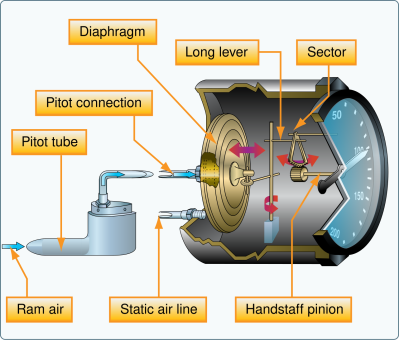
Alternatively, it’s possible to effectively do this “calculation” mechanically. In earlier days, static and stagnation pressure captured by each tube would be fed to a gauge. Inside, the stagnation pressure would be fed to a diaphragm which moved due to the difference relative to the static pressure which is fed into the gauge body, and the movement of the diaphragm would, via a simple mechanism, shift the needle on the gauge.
A small General Aviation aircraft might mount a single pitot tube on the aircraft, feeding the air speed instrument in the cockpit. Commercial aircraft might mount two or more for safety’s sake, in case one becomes inoperable, while large airliners may have four or even more to provide a high level of redundancy and error checking. Heaters are commonly included on pitot tubes to ensure they can be kept free of ice, which can otherwise completely block a tube and make it impossible to obtain an airspeed reading.
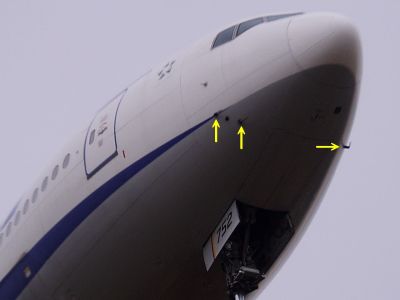
For pilots, not knowing how fast (or slow) the aircraft is going can be highly dangerous, as it can lead to entering unstable flight regimes such as stall. Thus, it’s imperative that the pitot tubes remain unobstructed and functional for safe flight. Many aircraft accidents have occurred because of blocked or malfunctioning pitot tubes or airspeed instruments.
The New Way
Of course, you could fuss about with pitot tubes and pressure sensors and deicing measures, but that’s all very fiddly and old hat. There is an entirely different way to figure out a plane’s speed, though it’s only been available for the last few decades. It’s as simple as throwing a GNSS receiver on the aircraft.
Yes, whether your particular poison is GPS, Baidou, GLONASS, or Galileo, any major satellite navigation system will be able to tell you the speed of your receiver. Simply measuring the change in the receiver’s position over time is enough to calculate out the speed, and any off-the-shelf receiver will present this information as standard. It’s generally not used as a primary indicator in aircraft, because it reports ground speed, not airspeed, the latter being more relevant for aviation purposes. Still, it can prove to be a useful sense check when traditional airspeed indicators are non-operative or reporting confusing data, and GNSS devices are widely used on many aircraft today.
Flying High
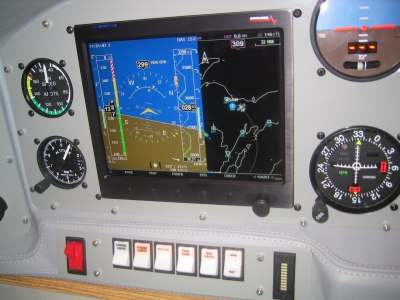
If you’ve ever wondered how an aircraft measures its speed as it floats through the amorphous gas cloud we call an atmosphere, now you know. Even to this day, where electronics and computer wizardry control our fanciest aircraft, airspeed measurements are still done with the same simple physics, just with some fancier sensors for help. The fundamentals haven’t changed at all. Now you know, you can always dig deeper into the many other rich applications of Bernoulli’s equation and fluid mechanics in general. Happy learning.












GNSS is great and all, but as pointed out, it measures ground speed. When you’re flying slow and near the ground (like landing and take off) wind is a significant factor. When you’re forced to fly by GNSS speed due to pitot failure, you always add (for example) 10 knotts. This is risky in it’s own way because of longer runway distances and higher speed approaches. GNSS also doesn’t naturally compensate for temperature and air pressure altitude. In Denver on a hit day your GNSS speed would need to be a lot higher than in Los Angeles in January.
The pitot system on the other hand, measures the aerodynamic “oomph” that the moving air has, which is the most important thing when you’re using that oomph with wings to keep the plane in the air, and the pitot system naturally compensates for this by the very nature of the design. That’s why they’re still on planes.
Redundancy is SO important here too, take my word for it – one very unlucky grasshopper minding its own business flying over the town can really make for chaos in the cockpit on a small plane.
is this some kind of reference to weed being legal in Canada?
Yeah, I saw that and stopped reading, then went to the comments to see it someone else saw it.
Freaking wannabe tech writers that don’t bother to become familiar with the basis of the tech they are reporting on. Whatever, the internet is dead.
Nah, it’s not so bad, we’re all here to learn, and I think we are. “They” say that the best way to learn the truth on the Internet is to confidently declare the untruth.
Underrated comment and maybe just soft enough to avoid deletion.
I used to be here all the time and appreciated the news. Now i FF to the comments section to get actual informed commentary from the real people that have been there done that. I get young writers need to start somewhere but to publish an article clearly outside your field of expertise then have that signed off on by an editor is…. bold. Very bold.
I seem to recall a commercial plane crashing years ago because it took off with the pilot tubes covered, which is apparently done when cleaning.
A lot of lives would have been saved with a backup method available.
This was helpful enough that I again wished for an upvote/thanks button. I knew groundspeed was for scheduling and airspeed for flight control, but I hadn’t thought through how having only the less unreliable GNSS would require a higher safety margin — and how that would eat into your landing and takeoff safely margins.
Typically another exciting source of error is that if you’re going to leave an airplane sitting for more than a few hours, you need to put a cover over the pitot tube, otherwise a wasp may decide that’s a great place to set up home, and then you have a jammed pitot tube that the deicing heater doesn’t fix. Likewise, you have to make absolutely sure you remove the cover before you take off. (They have a big visible tag hanging off them that you can see from the cockpit (usually) and one of the items on the pre-flight checklist is making sure the pitot tube is uncovered and at least not visibly jammed.)
Depends on how hot the deicer gets. :)
We had a hornet fly in through the chimney of our gas fired heating system. The hornet made it all the way through the chimney, through the combustion chamber, down the drain in the bottom for condensed water, through the hose to a sediment trap, and up to the exit of the trap. It got stuck there, and caused water to drip out of the trap and onto the floor. The heating system is in the attic, so the floor is plywood, with joists and insulation under it. I had to tear out the floor and pull out the insulation to get it all dry again, the put the floor back together. Fortunately the room below the heating system wasn’t finished at the time – it would have ruined the wallpaper, the paint, and probably the floor.
I’m a pilot and on my side of the Atlantic I had never heard the term of “stagnation pressure”. We use “dynamic pressure” instead.
Stagnation pressure is the sum of static pressure and dynamic pressure, they are not interchangeable.
Cracking the high precision GLONASS obfuscation feels like a nice weekend puzzle.
„When you’re driving your car, you’re probably regularly looking at the speedometer to make sure you comply with the local speed limits. “
Actually, I’m driving my grandma around for 2 weeks now (she has a more modern var than I’ve ever driven) but I’m relying solely on my navigation for GPS speed, as the speed given n the centre is continuously blinking by misdetected speed limits, and I can’t see the “actual” speed dial at left, as it’s obscured by the wheel at speeds between 30 and 180 km/h.
Note that the denominator in the equasion is the air density which varies by altitude and temperature. Also, that equasion assumes incompressible air, which is close enough at lower speeds but not at airline speeds. So pilots’ flight computers (E6B or such) include specialized scales to account for all that. Mathematically, the corrections can get complex. HP’s calculator manuals used to include an enormous formula for same as a way of demonstrating their ability to handle such tasks.
Pitot static systems are fascinating because of their failure modes. A plugged pitot tube turns your airspeed indicator into a bad altimeter. And it’s hard to detect this – many accidents continue to happen because of it. A plugged static system is much easier to detect and while accidents have happened it’s less likely an issue. (A plugged static system means your altimeter stops working and that’s easy. A plugged pitot tube means the airspeed indicator indicates badly and gives confusing results).
The B-2 bomber had an accident related to it’s complex air pressure system that provided the pitot static information and caused the computers to act weird.
Thames pitot sensor failures that were known, dragging their feet swapping them out. I think the heaters were undersized so they easily iced up.
Air France flight 447 tragic in that the A330 redundant pitot sensors all iced up the same, same make same problems. RIP.
They were flying through the ITCZ, where storms can reach higher:
https://en.wikipedia.org/wiki/Intertropical_Convergence_Zone
Icing threats from there are something space elevator advocates will have to deal with—and lightning as well.
Scientists and (theoretical) aerodynamicists probably call it stagnation pressure, but in the aviation industry, it’s called the total pressure, and it’s abbreviated as Pt. Stagnation pressure and static pressure having the same initials is a massive source of confusion…
Source: I worked for approx 10 years at design offices and labs at expensive civilian aircraft manufacturers, in particular on Air Data Computers (the computers that take the pitot readings and compute speeds, altitudes, temperatures, etc.) and on how they are used by the other systems of those aircrafts.
For added hilarity, put an airspeed indicator on your car (you can find videos of this)- you can actually observe some interesting stuff like vortex shedding if the Pitot tube is in the right place at the right speed.
I’ll leave it to the readers’ fortitude to try and explain going too fast to the police because of a tailwind throwing the IAS out of whack.
Storm chasers put instruments atop their vehicles….they worked despite highway speeds….that could be zero’d out
https://www.youtube.com/watch?v=0m_gfsIvfx8
That’s “The Dryline Kid” of NCAR
On practice runs, Formula 1 cars are sometimes fitted with arrays of pitot tubes to get detailed data on airflow over the car. In racing trim there is a pitot tube mounted toward the front of the car. Given the aerodynamic complexity of the cars (and the rules governing their design) such data is critical for designing and racing a fast, drivable, and legal car.
African, or European?
Stagnation pressure seems to be the scientists/aerodynamicists name for what we call the total pressure in the aerospace industry.
A minor detail, but isn’t gps speed calculated using Doppler, not location and time?
That would seem much more complicated and error prone unless you’re flying directly towards a satellite. Are you saying that (1) my intuition is off, trig approximations are really good (2) even if it sucks, it is typically done that way, perhaps because frequency measurement is so precise (3) by ”Doppler” you mean ground-based Doppler radar (but still displaying it with GNSS data) and using that is an FAA convention, or (4) something that still hasn’t occurred to me?
…looking at the speedometer to see where you are relative to the local speed limits.
Odd. The new airspeed measuring instruments are ultrasound, or newer still lasers (although even that is a decade old now). Really not sure what GPS has to do with airspeed unless you know the aircraft’s power setting and have a lot of prior performance data, or fly in a circle.
Maybe cover these and multi-hole pitot probes in the sequel.
https://qeprize.org/news/bae-systems-ground-breaking-laser-airspeed-sensor-means-accurate-data-safer-comfortable-flight
Sometimes you will see prototype aircraft like this Gulfstream with a “Narwhal horn” looking thing. It’s to calibrate the production model’s pitot tube without the effects of boundary layer affecting the pressures.
https://i.ytimg.com/vi/2Ctrud7EApY/maxresdefault.jpg