
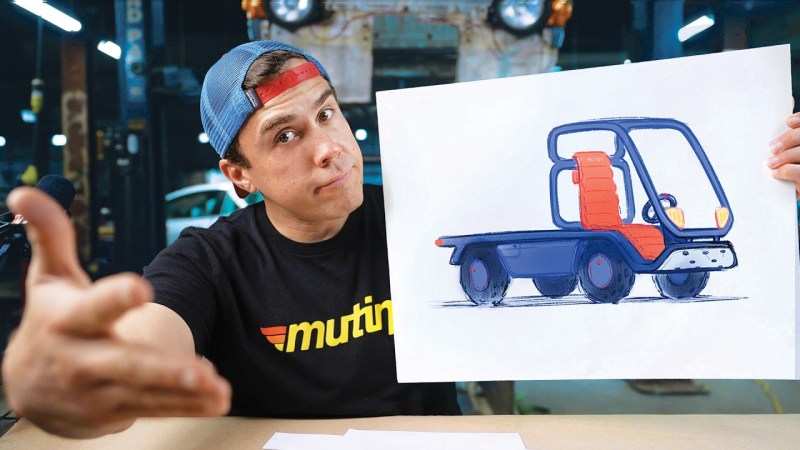
Cheap vehicles are thin on the ground in 2026, but [Andy Didorosi] thinks he has the answer for low-speed applications with an open source kei truck.
Still in the early design phase, [Didorosi] has an old factory in Detroit that has been home to his bus transportation business for the last several years, as well as the Sendpai kei truck project to make the world’s fastest kei truck. His vision is to make an affordable kit car truck that anyone can build in the comfort of their own garage. The current plan includes hub motors, which have so far not made it into any production EVs in the US, likely due to the problem with high unsprung weight.
While making a new vehicle from scratch is difficult, the project is targeting a modest set of capabilities at the beginning. The truck will be eschewing safety for low cost, which is probably fine for low-speed off-road use as a utility vehicle. Safety will of course get more important as speed increases. Once the design is sufficiently nailed down, [Didorosi] hopes to sell fully assembled trucks that are compliant with US Low Speed Vehicle (LSV) requirements. This would allow it on roads with posted speed limits below 35 mph. The kit version would be capable of highway speeds as it wouldn’t be required to meet safety regulations in most states.
Will Mutiny succeed where efforts like OScar, CarBEN, or Wikispeed could not prevail? Only time will tell. We hope they’ll keep the Minimal Motoring Manifesto in mind, and in the meantime, you should check out this kei camper or an EV-swapped kei truck that looks like it runs on a giant drill battery.












Hub motors have another problem besides unsprung weight: You’re asking a precisely assembled, high powered electric motor to absorb every pothole impact. Plus there’s the obvious question of where an open source car project is going to get a part that isn’t used on commercial applications and can’t readily be built at home.
This also looks more like a competitor with the John Deere Gator or Polaris Ranger.
yeah I dont see any advantage to using hub motors in this application. Its not like Ebikes where there is minimal load and room. Im just fine with a set of CV joints and halfshafts running from either individual motors with a differential or dual inbound motors.
Additionally, while I get the kei truck goal,
Id rather a 2f1r tadpole trilke implentation so you can have the $100-200yr motorcycle/autocycle insurance rate. You can still have a truckbed with a single rear tire, though you might want to take more care to balance your loads.
I was trying to think if there were any real-world examples of a tadpole-style trike truck, and the only thing I could think of was the “Shinra Hauler SA-37” from the video game Final Fantasy 7.. which as far as I know is not based on any real vehicle.
There were, in fact, plenty of trike kei trucks back in the day (like the Mazda K360 and the Daihatsu Midget), and of course many three wheeled “trucks” in other countries, like the Piaggio ape, Tuk-tuks, etc. But those are all conventional delta designs, not tadpole.
In practice, I wonder how bad the single rear wheel would actually be – the idea feels terrible to me, but if the bed wasn’t too wide, and if the rear wheel/tire/suspension was rugged enough, maybe it’d be less scary than I imagine.
I had a friend who converted his Geo Metro to a 3 wheeler.
I also met a guy in texas who did a 3 wheel conversion to a chevy cavalier that had been rear ended.
Never seen a tadpole truck myself,
but given how light duty a kei truck would have to be I doubt that it would be a real issue to pull one off.
A single front wheel is worse than a single rear wheel when you hit the brakes.
Depends. Both configurations have their weaknesses. If the single front wheel loses traction, you plow straight ahead. Stopping in a straight line, that’s not such a problem, but braking into a turn can flip you over.
If you had two front wheels and a single rear, it tends to spin you around if the braking forces are not balanced. For example, one wheel hits a pothole or a patch of gravel while braking. Braking hard pushes your mass forwards and lifts it off the rear wheel, and then that wheel loses traction. Once you spin, you end up in the same situation where rear wheel is now your front wheel, and then you flip over.
In summary, which configuration is worse depends on how many axis of rotation you want to tumble over when it all goes wrong.
@dude
Single front wheel (delta) trikes are less stable than dual front wheel (tadpole) trikes because the single front contact patch handles both steering and the majority of braking. This makes them highly susceptible to tipping during sharp turns and front-wheel skids during hard stops.
During a turn, centrifugal force pushes the vehicle’s center of gravity outward. In a delta setup, only one wheel resists this outward push. In contrast, a tadpole setup places two wheels on the outside of the turn, offering a much wider track width to resist lateral tipping
Tadpole sucks less than tricycle.
But 3 wheels remains the classic ‘compromise is worse’ example.
@haha
“But 3 wheels remains the classic ‘compromise is worse’ example.”
Car insurance on average is $87.56 per month in low-cost states, $112.80 per month in medium-cost states, and $165.02 per month in high-cost states
Motorcycle/trike/autocycle insurance averages in Low-Cost States $13.69/mo or $164.23/yr Medium cost states Average $16.34/mo or: $196.08/yr and in high cost states $20.31/mo or: $243.73/yr
That alone makes it a GOOD compromise in my books. My buddy with the 3 wheel metro loved it and that wasnt even a purpose built vehicle. I know a couple of guys who have bought those Polaris slingshots that love them. Their only complains have been a desire for a roof option, and that their single powered rear wheel can lose traction sometimes. My buddy with the geo says thats another PLUS for his FWD creation,
Im not saying everyone should drive a 3 wheeled vehicle, but if youre shooting for a budget conscious build, the annual savings losing a rear tire gives seems like a huge benefit.
Car insurance measures how much damage you’ll do when you wreck.
More weight, higher cost.
Motorcycles are not safer than cars, just cheaper to insure.
Because your head makes a small dent.
Says nothing about the vehicle’s safety.
Butchered metro?
I’ve seen tweaker work before.
Nope.
Baja bug!
Stinger header.
(But not at bug prices in 2026.)
That metro is still a metro on the title and insurance.
If the agent saw it and insured it, he’s a fool.
Slingshot is an Atom for those that can’t drive, doubt that’s cheap to insure.
If your going to drive fast, get a roll bar, uncomfortable suspension and all the tire that will fit.
@HaHa
“That metro is still a metro on the title and insurance.
If the agent saw it and insured it, he’s a fool.”
Confidently incorrect.
When you convert any vehicle to three wheel, whether its a VW bug being cut up to make a traditional motorcycle style trike, or a geo metro being converted into an autocycle the vehicle must undergo inspection by the state police. after which it is issued a new vin number and is designated as a ” Specially Constructed Vehicle” or an “Assembled Vehicle” depending on your states interpretation of the law. Interestingly, it also becomes whatever model year it is retitled. His 1990 metro is now a 2020 SCV Autocycle according to the state and his insurance company.
And the insurance on a slingshot
“Liability-only insurance for a Polaris Slingshot typically costs between $75 and $250 per year (or about $6 to $20 per month) for an experienced driver with a clean record.
Insurance costs range from $300 to $1,500 per year for full coverage, depending on your age, location, and driving record. Because the Slingshot is classified as an “autocycle,” it is often cheaper to insure than a traditional sports car, but rates vary widely by provider”
TYL
A trike needs to have its weight centered in the triangle formed by its wheels, which puts the ideal center of mass towards the two wheeled end. A tadpole truck would be very unstable when loaded, particularly if you didn’t put the bed entirely in front of the rear wheel.
I dont see a kei sized truck having a very significant carrying capacity in any wheel configuration.
A typical JDM (Japanese Domestic Market) kei truck is strictly limited by Japanese regulations to a payload capacity of 350 kg (approximately 770 lbs). Thats about half the payload capacity of Fords smallest truck, the Maverick.
Youve got the driver/passenger, motors, and batteries weight to offset the tiny load it would be capable of carrying.
Putting the bed entirely in front of the rear wheel seems somewhat obvious. Otherwise your bed would either be very high or have an awkward wheel hump in the middle.
Hub motors are available for things like forklift trucks and other specialty vehicles, and factories in China will basically make you anything you ask just to keep a western company off the market. Souped up electric motorcycle hub motor stuffed into a car wheel rim? You got it. Found several in a minute of searching. EV conversion kits with hub motors all over the place.
Whether these are truly viable for road vehicles is to be seen. Anything will work for a while, until it gets full of water and dirt, or overheats and burns a coil.
The main challenge they’re trying to solve is getting rid of the axles and joints and differentials which would limit the geometry of the car and the suspension system, and would require more design effort than “a box on wheels”. That’s what everyone’s trying to do with hub motors, because it gives you the freedom over the form factor, and that’s where everyone fails because it turns out designing a car that handles and rides well, and doesn’t break, requires more than four wheels on a tube frame.
The gator/ranger/side-by-side market is definitely a big part of what they’re targeting, and that’s mentioned later in the video. Most kei trucks imported into the US are used as small utility haulers for farm/ranch/local work already – unlike Japan, where they’re used for that and everything else a tiny truck can do.
Re: hub motors, I’m also concerned that the cons outweigh the pros here, but it’s early enough in the design and prototyping process that I’d hope they could switch to a more conventional electric drive if it doesn’t work well in testing.
Historically, there’s been another big problem with hub motors in four-wheeled vehicles; you’ve eliminated the synchronized control provided by the transmission and differential. This makes a lot of neat tricks possible, but it also converts a simple mechanical system into one that needs complicated computer control to run smoothly. Even getting two adjacent hub motors to run at the same speed when driving straight, rather than fighting each other slightly, is a challenge.
I’d hope that there are decent off-the-shelf controllers that manage this now, but until proven I’d be slightly concerned.
Yet another problem with hub motors is that because of their location, it’s hard to build a really good cooling system for them. Might not be a problem for this application, though, since it’s a (comparatively) lightweight and low-power vehicle.
On the other hand, I’m also less worried about supply; “not used commercially on EVs in the US” is hardly the same thing as “not commercially available”. They are pretty plentiful in the global supply chain – for use in electric motorcycles, some EV cars in asia, and most interestingly (to me anyway), in compact electric work vehicles like street sweepers and snowplows.
You also need brakes to stop the vehicle, and where are the brake discs going to go? In the motor of course. Where’s the heat from braking going to go? Same place.
Regen braking and an anchor. Reasonable stops will only use regen and for fast stops you drop anchor.
………………………………………….
Jarvis… what happens when an AC induction motor into a generator??
Where are the discs going to go?
Disk brakes inboard, attached by a half shaft.
Like a Jaguar E type, but not broken.
You do realize the discussion is focused on the issues of Hub motors. Dudes comment specifically focuses on the issues that hub motors already have, heat dissipation which would be exasperated by adding a mechanical brake to the hub motor.
If you were going to add cv joints and halfshafts to reach your inboard brakes Hub motors would be impractical.
BTW inboard brakes arent a great plan, you lose braking on one side if your cv joint fails, which on a three wheel vehicle almost guarantees a spin.
@hmmm I agree inboard brakes with outboard motors doesn’t make sense but when you use regenerative braking on an e.g. 95% efficient motor, you generate 20x less heat… and if you are constantly building significant heat with friction brakes in an EV then either your vehicle’s designer screwed you or you should not be driving the way you are driving.
or you live in a city like Portland, or San Fransisco where your regenerative braking cant function at all times because your battery tops off trying to keep you from speeding downhill. And your mechanical brakes have to operate significantly more than in flatland cities like phoenix or new orleans.
Its not always the driver, sometimes its the terrain
Joke, you halfwits.
“just joking” the battle cry of the idiot after being called on his ignorance. Weak deflection buddy. Youre half a wit short of being one.
@hmmm So don’t start your day at the top of the tallest hill with more than 95% charge then. Even a 5000lb vehicle only needs a couple kWh free to store all the energy from descending a thousand feet – while those cities have steep roads, they’re not actually mountainous so the roads don’t descend that far before leveling out or climbing back up again – the highest point in both is in the 900-1200ft range, it’s not that bad.
When I lived in portland my home was at one of the highest parts of town, and my work was at one of the lowest.
You dont choose where you start your day.
My car charged in my garage at night (plug in hybrid) so when I left home my battery was fulll and it was all downhill from there. Maybe 15% of my 6.4 mile to work commute wasnt going downhill.
From my old place to my old worksite was a 695 ft elevation change.
On my way home it was all uphill, so regenerative braking was useless there too, if you have to stop you really want mechanical braking on a 10% grade.
when I lived in California I was up in Twin Peaks and worked down in Redlands. My 25 mile commute was a 4,422 feet elevation change so Portland was a breeze in comparison, In Cali, I coasted to work and topped off my battery for the climb home there. Id have done the same in Portland had it been an option but there wasnt anywhere to plug in.
@hmmm I’m not saying you should move house, I’m saying that you should just limit your charging so that it stops at less than 100% since you already know ahead of time that you’re going to go downhill in the morning. It solves your problem, saves you a few cents of electricity, charging to only 80 or 90% makes your battery last longer, using regen makes your brakes last longer…
Also it doesn’t heat up or significantly wear out friction brakes to hold you in place without moving or to bring you to a complete stop once you’re rolling slowly. It only heats them up when you dump a lot of energy into them by applying them at high speeds or the whole way down a long downslope. (By which I mean, thousands of feet, like popular mountains where they have to station people to measure the brake temperature of clueless tourists and tell them to park and wait, not just a few hundred feet in portland.) In a regular car you’d be smart to save brake life by engine braking, it’s really not that different.
Seems odd to assume a hub motor manufacturer would build a motor around the precisely jeweled bearing of a pocketwatch or whatever you’re describing instead of building something at least as good as a regular wheel bearing which takes this abuse all day.
Considering how much play car wheel bearing can develop over time, and how tight the tolerances needed in an electric motor to keep the air gaps for the magnets as small as possible, it’s not an easy ask.
Ah, that’s where we differ. I’m fully assuming that the motor can have sufficiently tight tolerances between its own stator and rotor to work fine, by having loose tolerances between the rotor and the wheel and between the stator and the car, with most forces passing directly from wheel hub to car suspension without passing through the motor which just floats along inside that space applying torque, unlike on an ebike or similar.
Sounds pretty complicated. Got a diagram of the construction?
I don’t want to draw a realistic diagram or anything. I’m only trying to say that it’s not impossible, so I don’t need or plan to identify and defend a specific method that should be used.
So I’ll use as an example a normal looking inboard motor, outboard brake setup with cv joints and such. (https://imgur.com/a/adBBoV1)
The torque is already somewhat insulated from the suspension load; the CV which is poking through the middle all the way to the nut at the other end mostly sees the actual drive torque. It should not be hard at all to believe that if the designer preferred, they could rearrange and re-scale some of these parts while keeping essentially the same topology, so let’s not worry about whether things fit because clearly when designers choose to, they do, and we even know some common tradeoffs.
Anyway, even with this conventional arrangement, at minimum you should still be able to let the stator “float” while the rotor remains attached solidly to the wheel. That is, instead of transmitting rotating torque to the wheel thru the middle, fix the middle where the CV joint would be and let the stator of the motor be just as loosely attached to this as the wheel bearing with its larger tolerances. You shouldn’t, but to prove the point you could take this to extremes and have the stator suspended by spokes or soft rubber, anything to make it so that it can’t turn but it can flex like crazy. You could also make the rotor more loosely attached to the wheel as well, if you want to give it some hard rubber washers or whatever the heck you like.
None of this is what you’ll ever actually do, you’ll actually redesign things to be less awkward and costly and bulky, but it proves the point I think. It’s not logically prohibited for the motor to have tight tolerances internally while having loose coupling to the wheel and car.
You need a 1/2 short ton load capacity, a bed to hold 4’x8′ material plus a cab area. Something like a modern version of the M274. I’m thinking anything from golf cart electrical motor, or salvaged UTV running gear.
https://en.wikipedia.org/wiki/M274_%C2%BD-ton_4%C3%974_utility_platform_truck
A typical JDM (Japanese Domestic Market) kei truck is strictly limited by Japanese regulations to a payload capacity of 350 kg (approximately 770 lbs). ‘230 pounds short of a half short ton
Small but still practical to load and unload trucks have a place – even if you need to buy half sheets and take two trips bringing in the concrete mix sacks for this garden project having that easy access squareish loadbay with some tie down points is going to be very handy for lots of people. The bit that really matters is it has the traction to get up those narrow/steep/twisty tracks with a load and is economical enough to run that having to take that extra trip or two over a larger van from time to time isn’t so bad and offset entirely cost wise by all the times you didn’t have to drag the less efficient big van around mostly empty.
I was excited to follow this project until this video. Sorry, I can already buy a golf cart for in-city use, and it doesn’t suit me, as there are 35mph roads to drive on, and this would be legal to drive but is just basically asking for trouble with our local PD. I’d rather just get a used kei truck from Japan, thankfully Oregon is (working on?) making it easier to register them for our roads. Its still a state to state issue though, and I don’t expect the federal rules to change anytime soon (This could be a good thing, could be a bad thing for safety ratings, I won’t debate that here).
I would really love a small all-electric cheap car/truck that can hit 45mph as a top speed for in-city driving where I plan on never leaving the city limits. I was hoping this would hit that market, but it doesn’t seem it will. That’s just me though.
I’ve updated the article to note that kit versions are capable of highway speeds, but completed trucks won’t be sold that way as they’ll need to meet safety regs.
“likely due to the problem with high unsprung weight.”
We never seem to care about unsprung weight when it’s time to add giant disc brakes, huge tires, huge rims, etc. If you keep the overall weight down, an electric vehicle has enough regenerative braking that you don’t end up using the brakes very much, so they really don’t need a lot of heat dissipation and could probably be drums at least at the rear while still being able to do a few panic stops in a row. Also, you could put bigger hub motors in the rear where it affects handling less, if you insist, and only small ones up front, and you’d still get four fully independently driven wheels that way without needing all the suspension parts for inboard. Though, inboard using separate left and right motors is also an option if it packages well for you. Hub motors allow very nice packaging.
Except that time when you actually need to use the brakes and they overheat your motor.
Even on a conventional old vehicle with terrible brakes, if you’re abusing the brakes either because you don’t know how to drive downhill or you just like making your passengers’ heads bob from excessive brake applications, you’re still a moron if you are surprised by brake fade. Even a vehicle with bad brakes should still be able to stop quickly from its top realistic speed with a realistic load at least a couple of times before they fade, it doesn’t take 34 inch 6 piston racing brakes for that.
In a vehicle with strong enough regen to provide all normal braking needs, if your brakes are very warm it indicates you probably just used them to avoid an accident, and you can be mindful for the next few minutes to drive carefully and not need to avoid three accidents in a row, or otherwise you should pull aside and get away from the lunatics you’re driving near.
Solutions already exist
DeepDrive (partnered with Continental) developed an in-wheel “Drive-Brake Unit” for full size EVs It pairs a patented liquid-cooled, dual-rotor, radial-flux electric motor with an integrated braking system directly inside the wheel to reduce weight and overall vehicle part count
QS Motor is well known for producing liquid-cooled hub motors (such as their 138-series) which can be custom-paired with heavy-duty disc brake assemblies on the stator plate.
Falco e-Motors produces highly integrated e-drive systems for scooters that package liquid cooling, torque sensors, controllers, and brake compatibility into a single hub
Over here Japan Post have been using EV kei vans for local deliveries for years now and they seem quite effective. No hub motors, same familiar form factor and they are quiet and clean.
They will be doing some good mileage on standard roads as part of their duties and they seem to handle it ok. Japan Post are only adding more to their fleet in place of gasoline, so they appear to hold up well.
This comment thread is why nobody ever makes anything in public. :)
Just enjoy stuff.
Not to put you down, but there’s not actually a lot here in the first place. Just a concept drawing and a bunch of hand waving for a youtube video. It might be relevant to you, but for the audience here it’s a nothingburger, and those always get the peanut gallery going, and the peanut gallery consists of a bunch of jaded nerds like me.
They shouldn’t have made this article in the first place, or they should have written it as a broader piece into open source custom vehicles, legislation, etc. but this is what we get out of HaD these days.
On the other hand, what would you rather have? A bunch of people going “That’ll never work.”, or a bunch of people going “Shut up and take my money!”.
I guess it depends on whether you’re an engineer or a businessman first. A scientific approach to any idea demands contradiction to test it.
Well, I see you’ve avoided the mistake that killed the Oscar Project – you aren’t trying to build a cheap car that will pass stringent street legality rules while simultaneously running a lot bleeding edge technology.
But I’m just saying: You’ll save yourself a lot of trouble if you go with a proven chassis mounted motor layout. Lordstown Motors tried to go with hub motors and couldn’t make them work. With a conventional layout there are already motors and CV axles that are already proven to work for your purposes. If you try adapting a hub motor from other applications, you might have to test a lot of them to make sure they can carry the weight and stand up to mud, impact loading, and cooling requirements. Worse, you might end up testing a half dozen before having to give up and change approaches.
I’m curious as to why you didn’t just start with a proven EV motor and differential arrangement, and use CV axles.
I’ve wondered why we don’t see electric drive modules based on a swing arm suspension, like a swing-arm driveshaft motorcycle.
That moves the motor onto the frame sides, reduces the unsprung mass, makes the electrical connections stable and fixed (they don’t need to flex). Most importantly: it leaves the middle of the chassis free of under-floor hardware (no motor, no driveshaft, no half-shafts). It would make for a really low deck and good headroom or cargo capacity.
Our solar cars actually had a swing arm rear suspension, but then a hub motor on the end as that maximizes efficiency in an application where it’s critical, unlike here. I’m not sure what Aptera is using for their rear suspension, but at least the initial prototypes looked a lot like the same engineering from the solar race car world.
I was briefly interested in this but the moment he made it an LSV it seemed a bit pointless – side-by-sides and quads already exist and there’s some very well established manufacturers, this doesn’t appear to add anything.
Actual Kei trucks can do highway speeds happily enough and have a real cab that keeps you warm/cool & dry, a much more useful prospect.
This can do highway speeds, but only in kit form to avoid safety regulations. Perhaps I need to add clarification to the article for people who don’t watch the video.
Just a reminder to denzins of this site.
If you WTFV, the people that paid for this article will get some value for money and AdaDay will post even more of this kind of BS.
Also: Bartz You’ll get more for your money with Indian click farmers.