
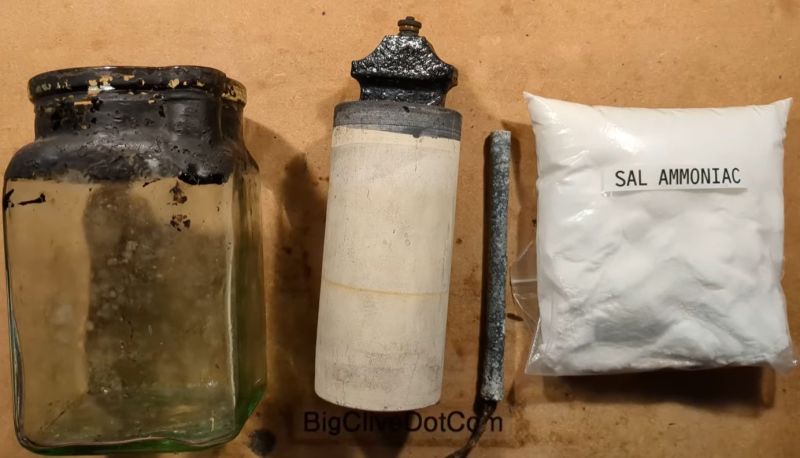
 The 19th century was an absolutely electrifying era, including in a literal sense. Although the phenomenon of electricity had been known by that time for centuries, actually making it do useful work was a much taller order. Aside from big, coal-powered generators, there also was a need for a more compact electrochemical solution, such as in the form of a wet or dry cell. One of the first major commercial successes here came in the form of the Leclanché cell, such as the genuine version that [Big Clive] found in an old UK building’s attic and has now revived.
Invented in 1866 by French scientist Georges Leclanché, the Leclanché cell features an ammonium chloride electrolyte solution, carbon cathode and zinc anode. There’s also a manganese dioxide depolarizer for preventing hydrogen build-up. Here water is the solvent for the ammonium chloride (also known as sal ammoniac).
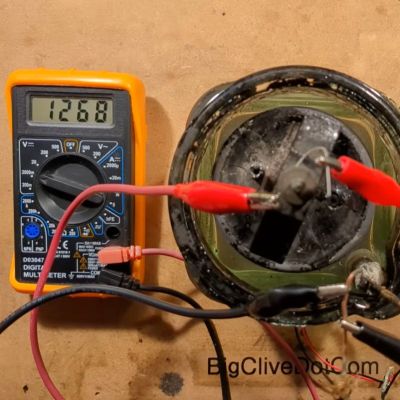
The version that [Clive] got his grubby mitts on features a glass container, an already partially consumed zinc electrode and a slightly cracked porous ceramic tub that contains the carbon electrode and the manganese dioxide. After placing the components inside the specially shaped glass jar and filling it with an electrolyte mixture of one part ammonium chloride and four parts water by weight, the cell starts generating its approximate 1.4 VDC.
This type of wet cell was very popular, being essentially ‘rechargeable’ by topping up the water and replacing the zinc electrode consumable. They did suffer from a voltage drop-off during use due to increasing internal resistance, something that got improved upon with the zinc-carbon dry cell. Itself effectively an evolution of the Leclanché wet cell.
From there zinc-carbon dry cells got replaced with alkalines, which itself got mostly replaced by NiMH and Li-ion cells. Despite more than a hundred years between the electrochemical cell that [Clive] featured in his video and today’s batteries, it’s clear that this wet cell was quite literally just the Victorian-era equivalent of an alkaline AA cell.












So what did Victorians do with 1.4v?
Doorbells were commonly powered with a series bank of such batteries.
Back in the 1960s my parent bought a large old house with several storeys (built in the 1700s and extended several times). The cell shown here looks just like the one that was connected to an electro-mechanical display in the kitchen where presumably the servants spent most of their time. There was a dangling string in each of the main rooms and bedrooms connected to a what must have been a switch on the ceiling. Pulling the switch would cause the display in the kitchen to ‘ding’ and on the display in the kitchen the relevant position for the room would show up red, (default was white). Presumably the servant then went to the required room, did their duty, and on return manually cancelled the request. (I’m sorry that’s a bit vague)
It was still working effectively when I was a boy because my parents used to use it to summon us from the kitchen. :)
Wow!
Take your pick:
telegraphy
railway signaling
early electric doorbells
Vibrating electric belts to restore “vitality”.
https://www.atlasobscura.com/articles/the-victorian-tool-for-everything-from-hernias-to-sexa-vibrating-electric-belt
I wonder what it was used for?
Just a science demonstrator, or did it have a practical use ?
In the video he suggested it could be used for a doorbell, or something else of intermittent use.
Doorbells, flash lights (flash, as in it would only be on briefly).
I imagine electroplating since the batteries design already incorporates knowledge of the technique?
they were used to charge lead acid cells. those again were used for lights. the lead acid cells could deliver a higher current than the leclanché cell could. I read this in a 1882 edition of “de natuur”, a Dutch language magazine concerning topics with cutting edge technology like mining, trains, telephony or electric light.
isn’t it easier to just change the acid in a lead acid cell to “recharge” it ?!?
It’s not the acid that produces the charge.
It’s interesting to note that lead acid batteries were invented before the generator to charge them. For a while, the only way to charge them was with another battery.
The edges of the existence of both lead-acid batteries and dynamos are pretty fuzzy, you could make a case for either existing before the other.
I was going by Gaston Planté’s first rechargeable lead-acid battery in 1859.
Small hand-cranked dynamos came around in 1832 but they only produced a small pulsating current. The first self-excited dynamos that could bootstrap themselves to make useful amounts of power were credited to Henry Wilde and patented in 1866. These dynamos began to be commercially available in the 1870s.
Planté battery factories were initially using other batteries to charge up the lead plates, and then switched over to generators once those became available. There was a brief period of some years when you could buy a lead acid battery, but virtually nobody had the generators to charge them.
Note that you should not use Clive’s pronunciation of leclanché as a reference on how to correctly pronounce it.
And while I’m on the subject, most people also seem to mispronounce ‘Zeeman effect’ and ‘Seebeck effect’, including teachers/professors.
aluminium?
ill fetch my coat on the way out..
Or alternately: you should.
In the case that you meet someone with the name it would be most polite to address them the way they pronounce it, of course, but if there’s a word in your language that comes from another language you’d be quite strange to try to pronounce it the way it is pronounced in its original language. That goes triple if you speak English, you’d need a different accent every other word.
It can sometimes be difficult; and perhaps at times silly; to do accents to say a name, sure. But sometimes the word/name is very easy to pronounce and it requires no imitation of an accent and all it requires is to inform yourself.
And if you are a teacher/professor and it’s a famous person from the past I think perhaps you should do a bit of effort, which is easy with the internet being available surely.
With the name Leclanché you can even see the sign over the E to tell you it’s not a normal e.
I don’t blame Clive though, he’s just making a video and is interested in the technical side and he’s not a teacher in the formal sense of the word, I just mentioned it since it’s rare you come across the name and thus the chance is that a slight mispronunciation when you come across it once gets stuck. And I also don’t care too much if people say it wrong, I just gave a little warning so people are aware that if they say it like Clive it’s not strictly correct, but it’s not important and I say carry on as far as I’m concerned.
Oh and sometimes the correct word/name is actually nicer, like with the name Mbappé. I like the real ‘hmmbap…’ better than the ’em-bap…’ people now often use. But that’t a matter of taste I suppose.