
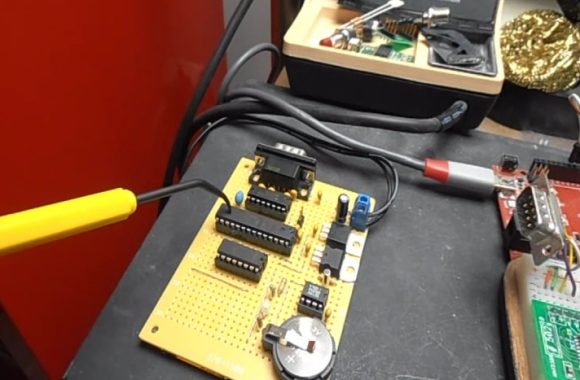
[Osgeld] is showing off what he calls a sanity check. It’s the first non-breadboard version of his Pocket Serial Host. He’s been working on the project as a way to simplify getting programs onto the Apple II he has on his “retro bench”. When plugged in, the computer sees it as a disk drive.
The storage is provided by an SD card which is hidden on the underside of that protoboard. This makes it dead simple to hack away at your programs using a modern computer, then transfer them over to the retro hardware. The components used (starting at the far side of the board) are a DB9 serial connector next to a level converter to make it talk to the ATmega328 chip being pointed at with a tool. The chip below that is a level converter to get the microcontroller talking to the RTC chip seen to the right. The battery keeps that clock running when there’s no power from the 5V and 3.3V regulators mounted in the upper right.
The video after the break shows off this prototype, the breadboard circuit, and a demonstration with the Apple II.
[Thanks Brendan]










Very Nice awesome Work
Awesome stuff! Thanks for the demo video — it really shows off the speed of this thing — the Apple II Desktop is not a small app by any means!
I agree with William good job but
The first Apple II computers 1 MHz, 4 KB of RAM
atmega328 20 MHz 32 Kbytes flash
Just had to make the comparison your adapter is more a more powerful computer than what is it connecting to.
It’s worth pointing out that this isn’t (and wasn’t) uncommon for older computers at the time they were new to be connected to peripherals at least as powerful as the host CPU. Examples: The LaserWriter came with a 68020 chip when the Mac had a slower 68000 and the IIgs had a 65C816 clocked slower than the SNES! The C64 had a 6502, but had a second 6502 on each floppy drive you had. The Apple // mouse card I believe had a 4MHz CPU. A speech synthesizer for the IBM PC/XT I used growing up had an 80186 on it. Certainly any 8-bit computer with a SCSI card or even it’s ancestor SASI would’ve needed a coprocessor that could keep up with the bus.
Well, hello HAD, been a while.
I just wanted to make note that the software running on the Apple II was written by David Schmidt, based on previous work done by Terence J. Boldt … I just did a port for AVR
Good to see ya again, Osgeld :) Glad you are still out there tinkering away :)
Wow, that is a nice piece of kit!
The a2 was my first computer and will always have that special place. a2 posts are too far and in between, thank you for this.
I’ve been using a CFFA3000 for this purpose, but it’s a closed product and not too hackable.
I’ve never been able to wrap my head around the low level disk controller protocols to design such a thing myself.
It was amazing what Woz could do in software for sure, but talk about complicated ;}
The board works with a specific ProDOS driver and acts as a hard drive; it doesn’t actually emulate any physical hardware or heads seeking back and forth or the like, but instead is a block device. You can’t boot off of it, for instance.
correct
DE9. The B size D-subminiature (sub-miniature compared to the honking big connectors before them) is what’s used for 25 pin parallel and serial connectors and weird things like DB13W3 SUN monitor connections.
Would it work with Apple][e same way?
yes, it should work fine with apple II’s and III
nifty! I always have problems with memory issues when loading programs with adt
Why the RTC chip?
to time/datestamp the files on the disk volume within the image, it was a requested feature as a rtc is not standard hardware on an apple II
Would somthing like this work with a IIGS one poped up under a sink in my high school and my friend and i have been meaning to get an operating system running on it rather than just using apple BASIC (or whatever the command line on it is called) but we dont have any disks for it just a 4.5 inch drive and a borked 3.5 inch drive
yes, the disk image that comes with ADT fits on a 140k 5.25 inch floppy, though I dont know how compatible it is with running GSOS off the SD card, I dont have one to try.
I know the 8 bit desktop runs, but its more or less a shell launcher, and on the other side of that geos will crash as of right now cause it overwrites the driver in ram
Great tech, but come on, an Apple II is boat anchor material.
Its posssible also saving data back to SD card???
I was thinking of doing something similar with my 5 apples. My question is … are for sale? and yes, what is the price and where I can buy.
Congratulations.
HI i think this post is too long ago, but i like to design/build a device like yours on a more modern Controller, i am thinking about using an ESP32.
I can not find anything on the web nowadays the links are dead.
I have a good idea how the softwre and patches for DOS or PRODOS should look like, change the RWTS-vector to my own RWTS.
But i have no idea how to handle .sdk, .dsk, .po and other disk images.
As i found .dsk contains all sectors in binary woz disk format, but how are they organized in the file? Are there additional headers, checksum,… that i have to skip when readingth image?
when i read the image binary, at where is the first sector?