
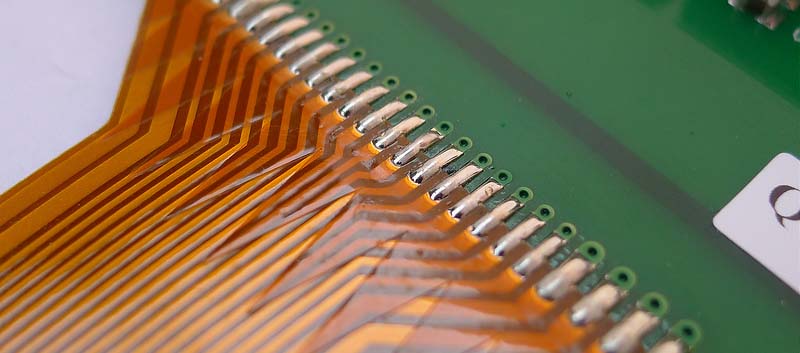
You can find flex PCBs in just about every single piece of consumer electronics. These traces of copper laminated in sheets of Kapton are everywhere, and designing these cables, let alone manufacturing them, is a dark art for the garage electronics wizard. Having these flat flex cables and PCBs manufactured still requires some Google-fu or a contact at a fab house, but at least now designing these cables is a solved problem.
[Oli] needed a way to connect two PCBs together over a moving part. Usually this means some sort of connector or cable, but he’s developed an even better solution – flexible PCB connections. To generate these copper traces sandwiched between a few layers of Kapton, [Oli] wrote a Python script to take a set of parameters, and produces an design for Eagle that includes all the relevant bits.
Of course, with a flexible PCB layout, the question of how to get these manufactured comes up. we’ve seen a few creative people make flexible PCBs with a 3D printer and there’s been more than one Hackaday Prize project using these flex PCBs. [Oli] says any manufacturer of flexible circuits should be able to reproduce everything generated from his script without much thinking at all. All we need now is for OSH Park to invent purple Kapton.
You can grab [Oli]’s script on his GitHub.











For straight through applications, why not just use ribbon cable, like IDC30 or IDC40, etc.?
Sometimes space is at a premium and flexible pcbs might well outlast something using and old IDE cable especially when it’s repeatedly flexed.
I wonder how well putting etched copper foil or better yet fine sprung steel wire, in the laminator would hold up to a stress test.
I don’t see how a single solid “trace” of copper could be more resistant to flexing than a stranded wire.
Capton copper film is max 0.07mm thick, you think 0.1mm thick solid wire threads can handle bending better ?
There is simply no way a flexible PCB would ever outlast a proper cable. They are the bane of my existence. Just use cables people!
Or FPC?
I know from experience that iTead produces flex PCBs in small batches. I’ve bought these from them a year or two ago.
DirtyPCBs aka Dangerous Prototypes has started *experimentally* offering flex PCBs as well.
Gold Phoenix offers them too, which makes me wonder if iTead/DirtyPCBs are just reselling them. Gold Phoenix only charges a nominal fee for multi-project panels, which was a godsend for me.
Yep, plenty of Shenzhen board-houses do flex-PCB. Costs more than the green stuff but it’s not like availability is a barrier at all now, and I assume you can use normal PCB design-tools.
You can purchase flexible copper substrate for etching your own flex-PCB’s, for example:
http://www.ebay.com/itm/Pyralux-Kapton-Flexible-Printed-Circuit-Board-Material-6-x-4-5-rolled-/171722204392?hash=item27fb70e4e8:g:6tcAAOSwv0tVBw1q
Making a cable out of one would be a minimal thing to do, you could just cover the rest of the circuit in Kapton tape.
Thanks for the link [Nikki], I will try some of this.
Chinese fabs offer them in sample-quantities sometimes.
Sees that they are not that crazy hard to make anymore.
I found a PDF some years ago where the pitfalls and rules for flex-PCBs were explained very well.
Similar one: http://www.flexiblecircuits.net/pdfdownload.pdf
This looks like a great idea and script, but I have to admit I clicked on the link because I am more interested in learning how, where and how much it costs to get prototype flex pcbs made… :) I would kill for OSHPark to start offering them!
Any advantage on OSHpark over dirttypcb?
Nope, they’re who I’ve use in the past, that’s all.
There was a time when one could buy flexible blank circuit board. In 1971, I think, Elementary Electronics had an article about an aero band receiver, a crystal radio with audio amplifier for the 108-136MHz band. Since you were to keep it in your pocket, as a gimmick they used this flexible circuit board. I can’t remember if it was in the catalogs, or single sourced, but you had to lay out the resist and etch it.
Michael
I thought I was the only one who remembered that article.
About time this is getting to mainstream DIY. Flex circuits have been used for things like vehicle instrument clusters since at least 1970.