
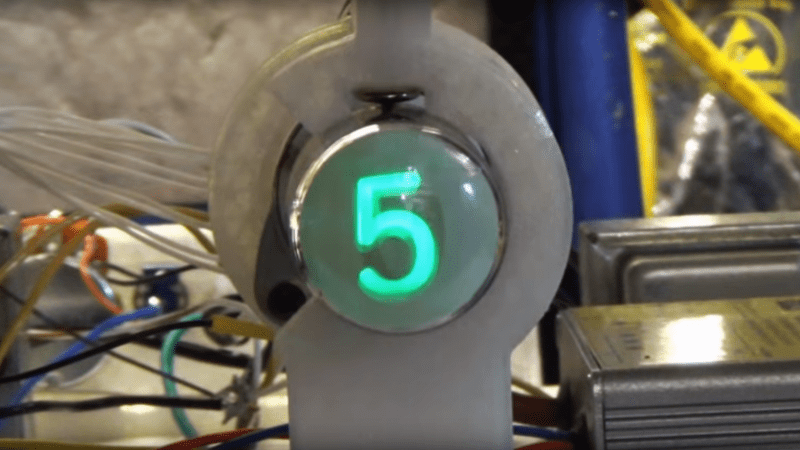
With the wealth of Nixie projects out there, there are points at which Hackaday is at risk of becoming Nixieaday. Nixie clocks, Nixie calculators, Nixie weather stations, and Nixie power meters have all graced our pages. And with good reason – Nixie tubes have a great retro look, and the skills needed to build a driver are a cut above calculating the right value for a series resistor for an LED display.
But not everyone loved Nixies back in the day, and some manufacturers did their best to unseat the venerable cold cathode tubes. [Fran Blanche] came across one of these contenders, a tiny cathode ray tube called the Nimo, and after a long hiatus in storage, she decided to put the tube to the test. After detailing some of the history of the Nimo and its somewhat puzzling marketing — its manufacturer, IEE, was already making displays to compete with Nixies, and seven-segment LEDs were on the rise at the time — [Fran] goes into the dangerous details of driving the display. With multiple supply voltages required, including a whopping 1,700 V DC for the anode, the Nimo was anything but trivial to integrate into products, which probably goes a long way to explaining why it never really caught on.
If you happen to have one of these little bits of solid unobtanium, [Fran]’s video below will go a long way to bringing back its ghostly green glow. You might say that [Fran] has a thing for oddball technologies of the late 60s — after all, she’s recreating the Apollo DSKY electroluminescent display, and she recently helped a model Sputnik regain its voice.












It might seem odd that LEDs competed with nixies.
As for driving a nixie-tubes – this will seem even more odd –
http://www.decodesystems.com/sn7441b.gif
We actually had 74xx series TTL chips to drive 90volt nixie-tubes (open collector with Vce of around 90 Volts).
There were other TTL chips for nixies to like 74141, 74142.
Also 1700Volts (1.7kV) seems high today. A pentode’s anode cap was normally around 800Volts. A small TV tube would be in the 12kV range and a large TV tube would be 25kV to 27kV
Yep, and the Soviets cloned the 74141 and others. AFAIK, most 74141 NOS and most of them found in prebuilt nixies are the soviet clones (along with soviet nixies).
I have a few of the Russian versions of those chips… I really hate where they decided to put the Vcc/GND pins!
A lot of the early TTL had the power pins in the center of the package, probably to reduce lead inductance. The 7490 decade counter is another one.
Early LED numeric displays were tiny and expensive, so there were a lot of competing ideas for displays that all made sense for a time. Nixies, 7-segment neon (panaplex), incandescent filaments (Numitron), and LEDs all existed at pretty much the same time. Gas pumps used panaplex displays into the ’90s because of their daylight readability.
A photo of a panel with nimo tubes:
https://www.flickr.com/photos/spacelama/2351317227
What kind of device is this? I’ve been curious to see these in action since watching Fran’s video on the subject.
There’s a photo of the full panel here.
https://www.flickr.com/photos/spacelama/albums/72157600378447133/page2
Want!
This seems to be the best photo with a number of the NIMO displays: https://flic.kr/p/2SBz8U
Hook an arduino to them and feed it with a webscraper to have a real time display of how many arduino projects have been posted to here, makezine, and instructables.
How about for a clock?
delightful video!
I think if I owned and regularly used a device that contained such tubes I would have a maintenance schedule that involved rotating the digits.
Rotating the digits might make them difficult to read.
6 -> 9 et voilà
interesting material, mostly because of the required support hardware to get it going. I wonder what the designers of this tube were thinking. Though all these requirements are easily forgotten when observing the pretty green glow…
If this would have caught on I’m sure that they would have made them in other colors also.
Thanks for posting.
I expect they were thinking – “Where am I going to get another job designing vacuum tubes when the LEDs come out?”
You could also use a meter, the digital output summed via weighted resistors. I’m not sure if that ever made commercial equipment, but it was shown in hobby circles, kind of expensive, except in the late sixties/early seventies, there were lots if cheap meters around, intended for tuning indicators and “vu meters” in consumer equipment, where trend is more important than exact.
Of course, you could be really cheap and have a bulb or later led for each binary output, 1-2-4-8. Add them together to get the number. Not too bad for BCD display, where there were four indicators for each decade. But a straight binary counter would mean adding up a string of numbers for the total count.
RCA published a hobby manual about 1971, when a lot of this was still relatively new, and I think they had Nixie circuits along with Numitron or one of those later readouts. They might have shown the meter scheme, I’m not going to dig out the book, but I think it came just before cheap led readouts, so those were lacking
Michael
Do they do ascii? It would be so cool if they did ascii. Or even hex!
They made, or at least advertised, 64-element tubes (including ascii/ebdic configurations)
Yes there are 3 types, IBM, ASCII, and universal. I wonder what app would have the deer-in-the-road-sign lighting up? Tube powered self driving cars? Bam-bi!
She said 750 V for anode, not 1,700 V.
… and then later, she says “1750 V”. Which is it?
At 1:55 in the video, she clearly says “it requires seventeen-hundred and fifty volts for the anode”.
For a tube of this size I’d guess 750V is more like it. I made a thing using similarly sized 3LO1i tube (look up Zloshnik) and it was about 750V. But maybe these tubes need more volts because they do not scan a thin beam, but project it all at once.
The original data sheet is 1750V. There is a graph in the video showing the transfer characteristics and the optimum operating region is between 1700V & 2KV. There are two beams, and each has a stack of 5 grids to get through, so 1750V is quite reasonable.
Sorry, didn’t watch the video.
I also searched for datasheets though and found that some of the Nimos require even higher anode voltage, so yeah, it’s pretty high. But doable. If we were flooded with these, powering them would be as easy as powering nixies.
it requires multiple voltages
Oh wow, these are apparently even rarer than the original Nimo tubes. Telefunken got sued for patent infringement, lost and had to destroy their entire stockpile.
How much do you have? Can you sell them?
Aah! You’ve back! I want to make something meaningful, more than a clock. Something more than 8. How I contact you in private? I’m kinda new here.
First of all Happy New Year! Second I will read HaD rules an will try to leave some contact information.