
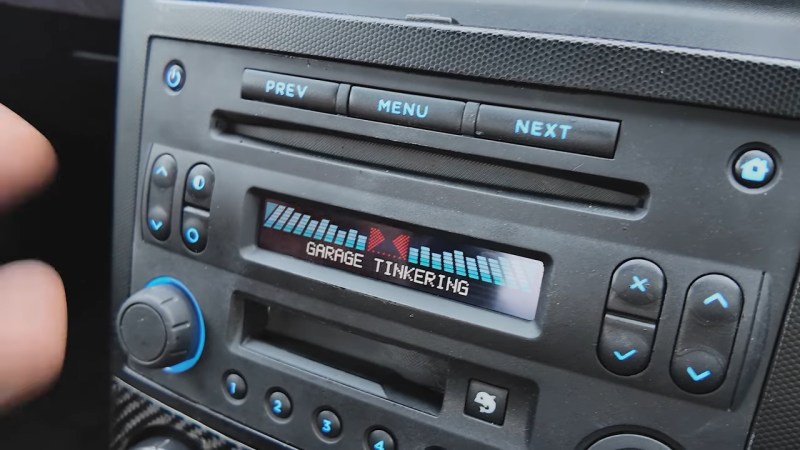
To our younger readers, a car without an all-touchscreen “infotainment” system may look clunky and dated, but really, you kids don’t know what they’re missing. Buttons, knobs, and switches all offer a level of satisfying tactility and feedback that touchscreens totally lack. [Garage Tinkering] on YouTube agrees; he also doesn’t like the way his aftermarket Kenwood head unit looks in his 2004-vintage Nissan. That’s why he decided to take matters into his own hands, and hack the buttons back on.
Rather than source a vintage stereo head unit, or try and DIY one from scratch, [Garage Tinkering] has actually hidden the modern touchscreen unit behind a button panel. That button panel is actually salvaged from the stock stereo, so the looks fit the car. The stereo’s LCD gets replaced with a modern color unit, but otherwise it looks pretty stock at the end.
Adding buttons to the Kenwood is all possible thanks to steering-wheel controls. In order to make use of those, the touchscreen head unit came with a little black box that translated the button press into some kind of one-wire protocol that turned out to be an inverted and carrier-less version of the NEC protocol used in IR TV remotes. (That bit of detective work comes from [michaelb], who figured all this out for his Ford years ago, but [Garage Tinkering] is also sharing his code on GitHub.)
Having the protocol, it simply becomes a matter of grabbing a microcontroller to scan the stock buttons and output the necessary codes to the Kenwood head unit. Of course now he has extra buttons, since the digital head unit has no tape or CD changer to control, nor AM/FM radio to tune. Those get repurposed for the interior and exterior RGB lighting [Garage Tinkering] has ̶i̶n̶f̶l̶i̶c̶t̶e̶d̶ mounted on this ̶p̶o̶o̶r̶ lovely car. (There’s no accounting for taste. Some of us love the look and some hate it, but he’s certainly captured an aesthetic, and now has easy control of it to boot.) [Garage Tinkering] has got custom digital gauges to put into the dash of his Nissan, and some of the extra buttons have been adapted to control those, too.
The whole car is actually a rolling hack as you can see from the back catalog of the [Garage Tinkering] YouTube channel, which might be worth a look if you’re in the intersection of the “electronics enthusiast” and “gearhead” Venn Diagram.
There’s no accounting for taste, but we absolutely agree with him that making everything black rectangles is the death of industrial design.
This isn’t the first time we’ve seen retro radios hacked together with micro-controllers; take a look at this one from a 1970s Toyota. Now that’s vintage!









Odd enough, back in the 00’s the all screen black control panel of death was peddled as the must have option for the very rich people
Cool project,Not exactly the button interface I was hoping for…. I want buttons on the newer car screen… like a can-bus interface that just adds all the physical buttons back (at least the new car has heater controls, Im looking at you id.4). It is almost to the point of using Bluetooth with some type of physical button and minimal screen draped over the factory ugly giant table in the middle of the car.
Yeah, I hear you. For the stereo portion, the “match the signals from the steering wheel controls” trick he’s using should work, but the giant rectangle of death does a lot more than just play music these days.
How long until someone makes a touchscreen robot arm specifically designed to interact with touchscreens while itself being controlled by something more human friendly? (It might also need a camera to keep in sync with the screen controls.)
Robot arms interfacing with touch screens are already quite common for “playing” (cheating?) games on phones.
One of the reasons I got my car when I did, was because the upcoming model was going completely touch screen (bigger), even replacing the environment controls :( . Yuck. So I guess, instead of keeping eyes on the road and turning up heat with a knob by feel… you have have to look and tap/slide … yuck… I guess it is ‘cheaper’ to do it in software, then have physical knobs/sliders….
I could have bought the next year model of the vehicle I bought, both were available. You know what? I didn’t want the feature differences.
Touch screens aren’t an improvement in a vehicle. Physical buttons are preferred.
Even the typical glass-cockpit airline has a lot of physical controls for key things.
mfd panels are awesome. the versatility of a touch screen but without the crappiness of a touchscreen.
Got me thinking, how hard would it be to leave the stock stereo alone and just find another spot somewhere for knobs that generate the relevant canbus signals?
bring back knobs! <3 knob.
When RDS was being developed I read something about a limit imposed on the display of text on the radio which was 8 letters still for 5 seconds. Too much data yet alone lyrics would be distracting, no car-a-oke. RDS radio data service was first tested in town (WXUS) and received over in Kokomo at Delco for evaluation.
Now there is another distracting screen needing attention. Drivers reading texts as well, movies and videos next
It’s not inverted and carrierless NEC. Its just… NEC.
NEC TSOP Receivers are typically active low outputs. They strip the IR Carrierwave and invert the signal. All electrical communication is inverted from the IR communication.
You could just stick an IR Receiver at the end and use an IR Led and standard NEC to make this wireless.
OOOOORRRR Dont. Because funny enough the KW stereo already supports a IR remote. And why is that funny? Because the Steering Wheel Remote line is (Most likely) physically tied into the output of the IR Remote TSOP Receiver in the stereo. Why? Because its the same standard, dont need to code multiple methods and support multiple inputs. Who cares if a SWC button and a IR remote button are pressed at the same time.
It’s like my pellet stove with Micronova board: the IR receiver is connected directly to the UART line exposed behind the stove, and the remote control uses the same serial protocol.
Thanks so much for the write-up, and glad you enjoyed the project.
Point of edit through, it’s Garage Tinkering, not Garage Builds.
Have a great day
Andy
Fixed! And apologies.
All good, no harm done.
Thanks so much
“Buttons, knobs, and switches all offer a level of satisfying tactility and feedback that touchscreens totally lack.”
And they are always there – no need to menu dive or screen swap.
I watched this last week, it’s a great build but I’d definitely have explored different options for labeling the buttons, perhaps casting new ones in some sort of resin or using that 3d printer’s dual colour features
Frankly, after thinking about this, this is a product we didn’t know we needed yet. There’s probably a saleable product here.