
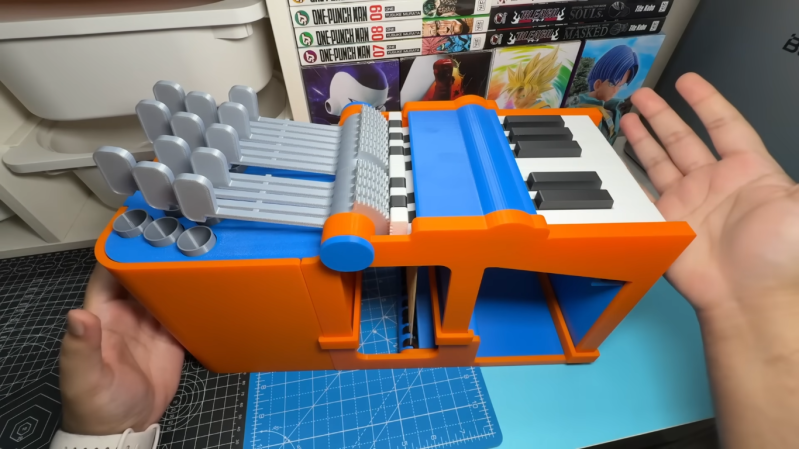
Part of the reason there are always free pianos on your digital classifieds listing of choice is that, at least economically speaking, a piano is less of a musical instrument and more of a complicated machine that can and will wear out (not to mention the physical difficulty of actually moving one). Once a piano reaches that point, whether through age, use, or neglect, at that point it’s to intents and purposes worthless. But still, they’re essentially just machines. [Toast] figured that, since 3D printers not only can print all kinds of other machines and musical instruments alike, he would take a stab at combining these two and made his own 3D printed piano.
A piano’s action is the mechanical linkage between the keys and the strings of the piano themselves. Over many hundreds of years this has developed into a complicated series of levers which not only rapidly strike strings when a key is pressed, but also mute the strings while the key is not being pressed and strike the strings in a way that the hammer won’t be pressed into the strings if the player leaves their finger on a key. Rather than try to recreate all of this in meticulous detail, [Toast] has swapped out the strings for a series of tubes which, unlike strings, do not much change their musical behavior if the hammer remains on the tube after being struck. This greatly simplifies the action (and cost) of his miniature piano.
The piano works by positioning hammers above these tubes, which strike downwards when a musician depresses the keys. Rubber bands return the hammers to their upright positions after the key is lifted. The instrument went through a few stages of design as well where [Toast] refined the size and shape of the tubes as well as improved the way by which the hammers are attached to the keys.
Is it still a piano if it has pipes instead of strings? Perhaps, but at the very least we can all agree that he’s built a working keyboard action capable of producing music, if not an outright definitionally-accurate piano. It’s an interesting build that we hope to see more iterations of in the future, if not to build a more functionally accurate 3D printed piano action then to see what is possible from a 3D printer in the piano space. Despite their complexity and weight, pianos are a fundamental and popular instrument in the Western music tradition and we’ve seen many interesting builds around them like this modern player piano built with a series of solenoids.
Thanks to [Vert] for the tip!











FIrst Law of moving a piano: you only ever attempt do it yourself once, then you get someone else to do it.
When I got someone else to do it (upright piano), I observed the trick and wished I had done it myself. The trick was a small two-wheeled platform. You lever up one end of the piano, put the platform underneath centrally, and you can then wheel the piano around, go around corners, between rooms etc. on your own.
The 2nd law is that if you execute the 1st law incorrectly, you have yourself a “piano kit”.
95% percent of the way to a keyboard tube drum!
https://youtu.be/YmkXYKt3YaY
I can’t find it back now, but I remember seeing a video once upon a time that started with a premise of “a piano action is needlessly complicated , certainly we can make one simpler” before walking through each of the competing requirements that actually makes every part necessary. It was pretty interesting.
Just like Ubuntu. You think it should be easy to write OS that has fopen, fwrite, printf, fork and some other syscalls but in reality it gets very hard when you try to run real x86 code and you have to base yourself on either Linux or BSD because HURD is nothing but a ComedyOS that will never be ready for serious gaming or power users.
“serious gaming” 😏
“Is it still a piano if it has pipes instead of strings?” no, because pianos are defined as string instruments (i think they’re technically hammered dulcimers?) and this has no strings. i think this is technically speaking a kind of glockenspiel.
This thing can be played piano or forte, soft or loud. The piano is a percussion instrument too.
More importantly it’s pretty bad at the whole quiet/loud thing that is a piano’s namesake. 3d-printable piano actions have been done, but they are a bit more complicated than a couple levers with gear teeth.
I don’t see how this reproduces a piano’s action. This is a way to play something like a marimba with keys. An interesting instrument in its own way, no doubt, but except for the keys there is no connection to a piano, let alone to a piano’s action.
Nothing wrong with inventing a new musical instrument (though, without clicking on it, this looks like one of the youtube clickbaits where no one makes music with it and hence it’s only theoretically an instrument). But it is most definitely not a piano action. A piano action is interesting to me and this is not. shrug Yeah i’m arguing about semantics.
“There is more plastic on plastic than a Kardashian family gathering”
LMAO
If expanded, this would make a very nice keyboard glockenspiel. (I’d probably go for metal pipes.)
I am curious to see if it the full piano mechanism can be printed