Piano Escapement Migrates To Drum Kit

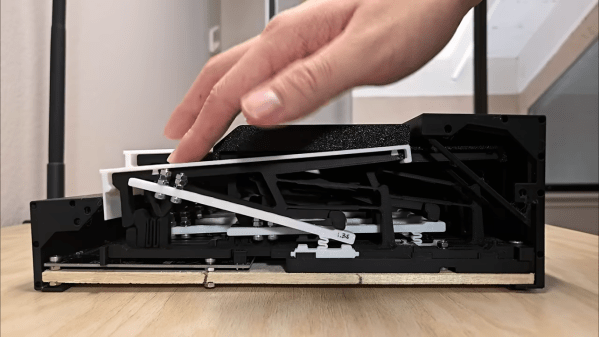
For as popular as the piano is in music studios, homes, and schools, it almost defies logic. Compared to a guitar, harmonica, or drum set, pianos are incredibly complex machines that can have somewhere on the order of 8,000 moving parts in a case that can easily weigh hundreds of pounds and which often responds quite poorly to seasonal changes in temperature and humidity. But for putting up with all of these downsides, musicians are rewarded with an instrument that uniquely responds to touch, style, and emotion. A big reason for that is that mechanical complexity, and [Super Valid Designs] is attempting to bring that design to a drum set.

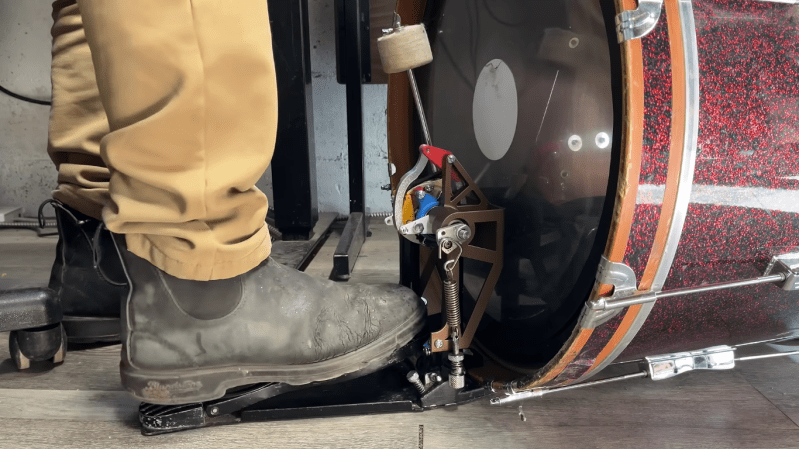
Compared to the complex machinery that connects the movement of a piano’s key to its hammer striking a string, a kick drum pedal is much simpler. It can only bounce off of the drum or get “buried” where the beater remains pressed up against the drum after hitting it. [Super Valid Designs] wanted something with a bit more finesse and control, so he first 3D printed a mechanism that throws the beater towards the drum head and then disconnects it mechanically from the pedal, so that it rebounds even if the pedal stays depressed. The next steps were more difficult, which involved making sure the mechanism reset itself in a repeatable way, without making too much noise of its own. This involved trying out a few different ideas and printing a massive amount of subtly different linkages, but in the end he’s left with a machine that nearly replicates all of the parts of a piano’s escapement,

The end goal of this project wasn’t simply to reproduce piano mechanisms on a drum set, though. [Super Valid Designs] hopes to make a kick drum that’s much smaller than those found in traditional kits, and since smaller drums respond poorly when the beater remains on or near the drum after striking it, a mechanism like this will dramatically improve the performance of the smaller drum and help reduce the requirement for perfect technique. And, maybe in 50 years or so, these types of escapements will take over the drumming world just like the piano escapement took over keyboards after its invention in the 1700s. Some simpler piano actions have been built before, but the complexity seems to be a requirement for all of the tasks they need to do whether its for a piano or a drum.

Continue reading “Piano Escapement Migrates To Drum Kit”

3D Printing A Piano Action

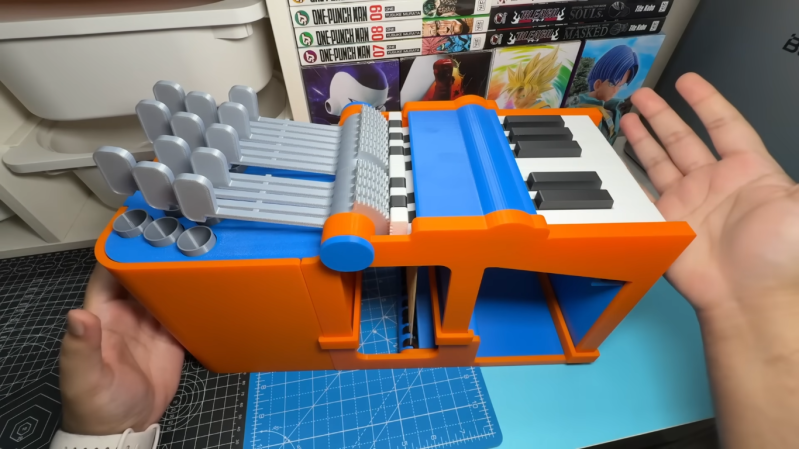
Part of the reason there are always free pianos on your digital classifieds listing of choice is that, at least economically speaking, a piano is less of a musical instrument and more of a complicated machine that can and will wear out (not to mention the physical difficulty of actually moving one). Once a piano reaches that point, whether through age, use, or neglect, at that point it’s to intents and purposes worthless. But still, they’re essentially just machines. [Toast] figured that, since 3D printers not only can print all kinds of other machines and musical instruments alike, he would take a stab at combining these two and made his own 3D printed piano.

A piano’s action is the mechanical linkage between the keys and the strings of the piano themselves. Over many hundreds of years this has developed into a complicated series of levers which not only rapidly strike strings when a key is pressed, but also mute the strings while the key is not being pressed and strike the strings in a way that the hammer won’t be pressed into the strings if the player leaves their finger on a key. Rather than try to recreate all of this in meticulous detail, [Toast] has swapped out the strings for a series of tubes which, unlike strings, do not much change their musical behavior if the hammer remains on the tube after being struck. This greatly simplifies the action (and cost) of his miniature piano.

The piano works by positioning hammers above these tubes, which strike downwards when a musician depresses the keys. Rubber bands return the hammers to their upright positions after the key is lifted. The instrument went through a few stages of design as well where [Toast] refined the size and shape of the tubes as well as improved the way by which the hammers are attached to the keys.

Is it still a piano if it has pipes instead of strings? Perhaps, but at the very least we can all agree that he’s built a working keyboard action capable of producing music, if not an outright definitionally-accurate piano. It’s an interesting build that we hope to see more iterations of in the future, if not to build a more functionally accurate 3D printed piano action then to see what is possible from a 3D printer in the piano space. Despite their complexity and weight, pianos are a fundamental and popular instrument in the Western music tradition and we’ve seen many interesting builds around them like this modern player piano built with a series of solenoids. Continue reading “3D Printing A Piano Action”

Robot’s Actions And Our Reactions

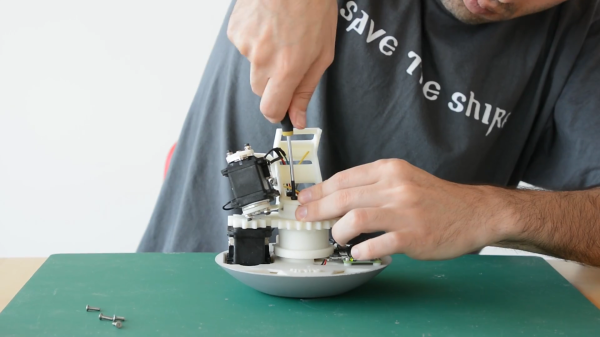
If you walk into a dog owner’s home that dog is probably going to make a beeline to see if you are a threat. If you walk into a cat owner’s home, you may see the cat wandering around, if it even chooses to grace you with its presence. For some people, a dog’s direct approach can be nerve-wracking, or even scary depending on their history and relative size of the dog. Still, these domestic animals are easy to empathize with especially if you or your family have a pet. They have faces which can convey curiosity or smug indifference but what if you were asked to judge the intent of something with no analogs to our own physical features like a face or limbs? That is what researchers at the IDC Herzliya in Israel and Cornell University in the US asked when they made the Greeting Machine to move a moon-like sphere around a planet-like sphere.

Participants were asked to gauge their feelings about the robot after watching the robot move in different patterns. It turns out that something as simple as a sphere tracing across the surface of another sphere can stir consistent and predictable emotions in people even though the shapes do not resemble a human, domestic pet, or anything but a snowman’s abdomen. This makes us think about how our own robots must be perceived by people who are not mired in circuits all day. Certainly, a robot jellyfish lazing about in the Atlantic must feel less threatening than a laser pointer with a taste for human eyeballs.


Continue reading “Robot’s Actions And Our Reactions”