
Changing the pads on your car’s brakes is a pretty straightforward and inexpensive process on most vehicles. However, many modern vehicles having electronic parking brakes giving manufacturers a new avenue to paywall simple DIY repairs.
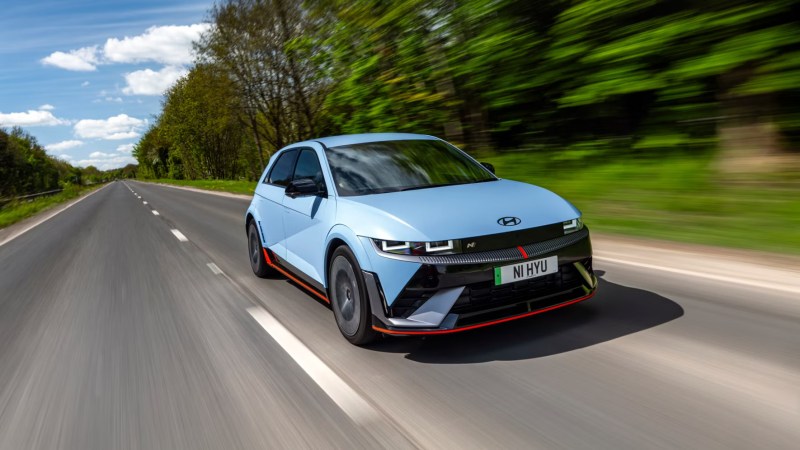
Most EVs will rarely, if ever, need to replace their mechanical brake pads as in most driving situations the car will be predominantly relying on regenerative braking to slow down. A hot hatch like the Ioniq 5N, however, might go through brakes a lot faster if it spends a lot of time at the track, which is what happened with Reddit user [SoultronicPear].
Much to their chagrin, despite buying the required $60/wk subscription to the National Automotive Service Task Force (NASTF) and the $2,000 interface tool, [SoultronicPear]’s account was suspended because it was not intended for use for anyone but “service professionals.” Not exactly a Right-to-Repair friendly move on Hyundai’s part. After trying a number of different third party tools, they finally found a Harbor Freight T7 bidirectional scan tool was able to issue the parking brake retract command to perform the pad swap, albeit not without throwing some error codes in the process.
Electrification of vehicles should simplify repairs, but manufacturers are using it to do the opposite. Perhaps they should read our Minimal Motoring Manifesto? There is a glimmer of hope in the promises of Slate and Telo, but we’ll have to see if they make it to production first.












I suspect the gent who diy’d an EV Fiat 600 here in Portland some years back was on the right track. At least he won’t be subject to corporate greed mongers when he wants to fix something.
Not as cool as my kid brothers bug powered Fiat 500.
1/8 mile wheelies and suicide doors!
Problem with all such cars, including my 60 Chrysler land yacht:
People are so busy looking at them, trying to figure out WTF they are, they forget to not drive right into them.
Which isn’t so much of a problem with a car made of plate steel, but the Fiat?
This kinda of thing just ensures I will never buy a Hyundai.
Lol shit cars that will have a catastrophic failure before 50k miles
And that is the easy part… just wait for knock to kick you in the balls every 2 weeks
You can say that about most new cars those days…
Well the ev probably won’t knock.
Probably. If anyone could manage, it’s Hyundai.
Careful guys, your age is showing…
I’m old enough to get your references, young enough to know they haven’t been true for a quarter of a century.
If i wasn’t so old i forgot, i could name many car brands that went this route with proprietary parts, tools and assembly processes.
yousureaboutthat.gif? I seem to recall multiple recent campaigns of recalls and TSBs for some of the wildest issues from subframe/chassis failures due to rust on four year old cars to a massive sweeping recall for engine failures across both brands.
IDK what it is, but this internet gaslighting campaign surrounding the Kia/Hyundai automotive brand is unlike anything I’ve seen in fifty years.
I have two Hyundais and completly different experience.
Hyundai is not the only company doing this. Volvo, for example, although there is a roundabout way to do this mechanically. Worse, try to service a Volvo. You have to pay to READ the service manual to find such things as torque specs. A NHTSA safety issue, IMO.
The mechanical workaround is a good option. I have used it on occasion when scan tool coverage was not available. For those interested, most (all that I have encountered) rear brake calipers with electronic parking brakes use a standard Allen or torx drive to couple the parking brake motor to the caliper. All it takes is removing the motor from the caliper and winding the piston back. They are made this way so that when the vehicle has no power, you are able to get it rolling to ease service.
Why do that. 9v battery. Applied in reverse retracts the mechanism. One batter and the terminal with wires. Pull plug Apply in reverse voltage. Wait for the motor to stop. Done.
BTDT, worked fine.
A 9V battery would not have the power delivery required to operate a parking brake motor. It’s several amps at 12V. These brushed motors are highly inductive. The last thing you want is someone making sparks at some terminals that have just been cleaned with brake cleaner
On some cars you only need to apply 12v to a set of pins on the connector to open it and then do it the opposite way to re-engage it. However, knowing which pins means either finding someone who has posted that info online, or access to a shop manual / wiring diagram. Once in a blue moon the connector is actually labeled in some fashion.
Typically the pins are pretty easy, since it’s a separate connector to the motor with most likely only 2 pins(maybe 3 if there is some sense line, but doubtful in most applications)
According to the person originally posting, the Hyundai system doesn’t have the torx drive to pull it back like some other brands from what they could tell. Several people were suggesting this approach to them since it does work on other cars. Haven’t looked at our Ioniq 6 myself to see how it’s setup.
Got one and wanna unload it. Last one ever!
A massive number of cars have an electronic parking brake and yes, they need a scan tool to command the brake to open, close, and calibrate. It’s a non-issue for mechanics because most every shop now has a third party scan tool made by one of the major automotive tool companies.
Electronic parking brakes hit the market about twenty years ago and adoption was very rapid because of the cost savings and reduction in parts count (and arguably, higher reliability as anyone with a mechanical-handbrake car who lives in a place where it gets below freezing can attest.)
The author of this article is either an idiot who doesn’t know anything about car repairs/maintenance and shouldn’t be writing about it, or is intentionally doing this as a “shit on EVs” story.
Missing the point here. It’s not that an electronic tool is needed that is the issue. It’s that the electronic tool needs a subscription, account, all your personal info, your right kidney and your first born child before it tells you actually no, it still won’t let you do that.
Even if it worked flawlessly that is still far too many hoops. That is the point.
Yeah, we’ve got an Ioniq 6 and I’d never buy a gas car again. I just want Hyundai and other manufacturers to do better to not purposefully make it a huge PITA for folks to work on their own cars (EV or ICE) if they choose to do so. The number of DIY folks isn’t huge, so it can’t be a huge hit to their bottom line to not be jerks, IMO.
A scan tool is all that is needed in this case. If you read the original Reddit thread at the end the OP says he bought a harbor freight scan tool and he was then able to get it sort of out.
Farmers have been fighting this for years, loosing the use of equipment during harvest can be disaster.
My sister has needed to drive over 100 miles one way to get a part they needed to get a harvester back working. Tough way to make a living.
Or worse. Trailering the harvester to nearest shop. BS.
Did you read the whole thing? This is a car specifically designed to be driven hard on off-highway private racing courses. One of it’s main selling points.
Note that this is not a treat (threat) of electric vehicles, but of the ongoing computerization of vehicles. I guess Hyundai will happily pull off the same trick in their petrol vehicles.
Volvo already did, years ago.
Hyundai does something similar on their petrol vehicles, but there is an easy work around. I assume it works on the Ioniq 5, but I haven’t had to change the brake pads and don’t expect to need to for a long time.
Exactly – this always gets framed as “Boo! EV’s complicated!” as if ICE vehicles aren’t doing exactly the same stuff (and are often more mechanically complex) for decades now. I’ll bet Hyundai’s ICE cars have the exact same issue.
Ultimately though, people will always find a way round it whatever the manufacturers do to lock them out – an angle grinder will over-ride any electronic lock in the end!
I think if we the consumer (you know the guy who spends the cash on these garbage goods) keep accepting products DESIGNED to MAKE US PAY un heard of and high prices for what should be simple upkeep and maintenance tasks, this trend will wind up being normal! Wait until people start getting killed because some one didn’t think his breaks were bad enough to pay $1000 bucks to replace!
electric parking brake should include a hard switch that puts the system in service mode, until the system is started and put in drive! no special data terminal, no subscription service needed! Better and more automation shouldn’t mean new costly services added to systems, Smart designs monitor and regulate themselves, that hard switch make it only work when that service is called for! REFUSE to buy non user serviceable products AND if some company slicks one by and you find a service not able to happen w/o Major cash at the dealer SUE The pants off of them!! Make it known publicly as well dont settle if they want a NDA!
Would if we could … How much effort and expertise do you think it would take the average person to figure out an option that works like you suggest? And not just for cars, but everything?
iPhones have gotten to the point that an “unauthorized” repair shop can’t put a replacement screen, battery, or anything else in, because they need to be given permission by Apple to work. Do you think there would ever be enough people willing to switch to Android for Apple to stop that nonsense?
As for suing, I feel like their (winning) defense would be something along the lines of “it’s something we – and others in the industry – have been doing for years now, without complaint.” Throw in a sympathetic “we do it this way to ensure our customer’s safety and to make sure it’s done to spec!” and that would be it …
Don’t get me wrong – I hate the direction we’ve been traveling, but I don’t know what the solution is. Louis Rossman has been campaigning for right to repair, and I think maybe trying to get a lot more people to join him might help, but society is fundamentally broken in a way that makes it hard to imagine any benefit coming to the average person at the expense of the billionaire class.
well, to Hyundais defence it might not be related to making $$$ here.
The whole EPB system has very likely a lower ASIL classification as it prevents obvious hazards or is providing a fallback protection.
With that many systems may require a cyber security assessment and the whole thing gets tough, if the TARA finds yellow/red items (see ISO21434). And some “temper protection” is a mitigation for some cases.
Sometimes the automotive safety guys are even tougher than the bean counters… ;)
As someone who has worked on powerrtrain components at ASIL D rigor. Your comment is sensible and accurate.
The system likely has ASIL D aftery goals and they need to perform a calibration after every service to guarantee the diagnostic coverage needed to meet failure targets.
Just a guess..
Shouldn’t it be like in BMW? Just connect directly 12v to brake and wait until it unlocks?
That is a very dangerous assumption, since brake components will corrode if not regularly used. If you drive your car like a granny, always brake with the motor/regen and feather the brake pedal, chances are your brakes will get stuck after a winter or two. That’s because the brakes never get hot, the hydraulic pistons don’t move but a tiny bit, and rust and dirt accumulates everywhere and isn’t removed by the mechanical action of using the brakes.
The next time you have to use the mechanical brakes, you’ll find that they grind and stutter, and may no longer release after you let go of the pedal.
Same thing with regular cars: if you don’t drive much and the car’s just sitting on the parking lot, whenever you do drive, the first few miles the brakes are going to feel awful. Take it up to highway speed and brake hard on the off-ramp (make sure nobody’s behind you), repeat once or twice, and the grinding and stuttering clears away. If you didn’t do that regularly, the pistons would start to jam and the pads would move closer and closer to the discs until they start to drag. Running the brakes hot now and then makes the components expand from the heat and pushes the pistons back into their cylinders, restoring the clearances and working the grime out of the gaps.
For reading:
https://doi.org/10.56578/pmdf020203
The takeaway is that manufacturers can apply surface treatments and coatings to extend the lifespan of new brake discs/pads in EV use, but the long term performance when the parts inevitably do wear down and the surface treatments are lost is a different concern.
In other words, the brakes will perform well for a while, and then start deteriorating faster in the lack of use like regular brakes would. It doesn’t solve the issue, it delays the symptoms – most likely just long enough to put the car out of warranty or off the hands of the first owner, adding to the problem of mounting “maintenance debt” with second hand vehicles. Instead of fixing the problems while they’re small and relatively cheap to remedy, they’re left to accumulate until small problems become big costly problems.
The reason why cars eventually get taken off the road and scrapped is often because they develop multiple simultaneous problems that require repairs exceeding the market value of the car, so it’s cheaper to just replace the car at once instead of attempting to maintain it. If you’re looking at a brake system overhaul, battery system overhaul, and whatever else in the span of the next few years, you’d be a fool to pay a lot of money for the car. That creates a sharp drop in the value of second hand EVs beyond a certain age. That goes back to the first point: when soon to be broken EVs can be bought for a song, it makes more sense to just get another one and drive it until it breaks. Treat it as a hot potato – get rid of it as soon as it starts to burn your hand.
The design point of “no maintenance required” turns it into a disposable product. This lack of a second life and the rapid loss of value shifts the cost onto the first owner, making EVs less affordable to new car buyers.
Don’t worry about the market value of your car, worry about the market value of the replacement.
The price I end up paying is the difference between a new (or new-ish) car and the resale value when I get rid of it. If the loss in market value is steeper, then I pay more.
Modern EVs are programmed to periodically apply the friction brakes to avoid buildup of rust on rotors and make sure the calipers are up to snuff. There were a few problems with earlier models WRT rusty rotors, which is why these changes were made. Also, if your battery is full, regen doesn’t work and you’re reliant on the mechanicals. Less frequent use isn’t zero use.
The article has a lot of yapping when it could have just said EV brake systems need reevaluating.
As other commenters mentioned, it’s more a problem with the electronic parking brake than EVs specifically. A lot of gas cars have them too, it just happened that Hyundai decided to be anti-consumer on this particular vehicle.
It doesn’t matter how much you “granny” the brakes, you are going to use the pads enough to prevent your hypothetical problems.
It’s not a hypothetical, it’s a documented issue. Some cars are especially susceptible to this, such as the Bolt EV which mainly uses its front brakes and regen, so drivers are reporting seized rear brakes.
Soft braking does not always clear the surfaces entirely, so spots of surface rust can sit for longer and develop into pits, which would take even more and harder braking to clear out. The rust retains water, which does not evaporate away if the brakes never get hot. Eventually the rust starts to move sideways in the pits and you get delamination of the pads and discs where flakes or sheets start to come off and your brakes are essentially ruined.
In essence, to keep the discs and pads good, you have to wear them out faster than the rust can settle in. In very dry climates you don’t have to do much, but in wet climates and coastal regions you might have to go out of your way even with regular cars to keep your brakes in good condition – or service them more often.
Sample of one (well 2). I “granny” my brakes – from new the only issue I had with the brakes came after 200000 km and 10 years was the front left piston started sticking on. The pads and discs were a little low but had life left. Changed left calliper and pads & discs both sides. 2 years later pretty much to the week, the right calliper did the same. Guy that looked at the calliper said he’d usually change the discs and pads when the calliper’s been stuck on, but even after 2 years he said they still looked almost new and left them.
I’ve run into something similar while rowing gears in my old manual Camry forever ago, I engine braked so much that the rotors started to rust while driving! Never got to the point of calipers locking up but I can see how that would occur.
Yep. Same thing if you’re commuting long distance on country roads where you basically never have to stop, just coast down and park. After couple summers of doing just that, same stretch of road, just one intersection at each end, my brakes started to jam. Drive in the city all the time, no problem.
Your inner Stig wants to just clip that apex, after braking hard at the last possible second.
Don’t be part of the ‘anti-fun brigade’.
I replaced the front tires on my mower with solid slicks, now I’m nursing an understearing/pushing (depending on turn direction) car to the finish in my head when I mow.
An EV should apply the brakes when the car is stationary and moving very slow, when regen isn’t effective.
and when it doesnt have enough battery capacity to take on additional charge.
And when it needs to stop more abruptly than regen allows.
it doesnt always take driving like an asshat. Regenerative braking works great in flat cities. But If you live in a hilly place like Portland or SF youll find that your brakes wear significantly faster as the regeneration doesnt do as when gravity gets added to speed. On my drive home, mostly uphill with frequent stops required, the regen barely rises my charge because gravity steals so much of the speed, but the mechanical brakes are constantly engaging as well. On the way to work mostly downhill with frequent stops, my regen tops the batteries off so quickly that MOST of the drive theres no battery capacity available for it to dump into, so its almost all mechanical braking.
Here’s another thought: maybe you are in the wrong place? You don’t seem to see the actual problem, missed the point of the article and reacts like someone not wanting to hack things.
Or perhaps it was an attempt to brag? Good boy!
2018 Toyota Camry Hybrid with 100K miles is here . Original breakpads are still good.
Yay, regen!
I’m not fan of hyundai, but let’s be honest, they’re nor the first or the worst in this. Volkswagen (car i own personaly), but not only them, don’t let you change rear braking pads on cars with electric parking brake without a diagnostic tool. Modern cars have displays and electronics more than enough to avoid to use diagnostic tools. But people still give them money, why would they not continu to do so?
i’ve seen comments by mechanics saying that they use a drill battery with a plug/socket to attach to the electric parking brake to retract it. maybe people are overreacting here when there is a low tech solution.
I was going to say, it’s an electric motor doing something you don’t want? Unplug it and power it yourself.
In case of Volkswagen, yes, you can detach the electric motor and use a torx 7 to retract the piston. But you need a diagnostic tool to recalibratre the system to make it work. I’ve tried many tricks to avoid the use the diag tool. I’ve found the way to do it but it’s not just a pain, it’s worst.
again, why comment when you just never tried? At least, when the comment begin by “i’ve read” or “i’ve google” or “i’ve ask chatgpt”, all the people who Are doing things knows that the comment are just dumb.
And for people who say Just put 12v on the pin, yes you can, but use a current limiter or a very small fast fuse in line. 2 coin cell in serie is my opinion the best. The gears are made out of plastic and pop out really fast. But this doesn’t change the need to calibrate
Pretty much every manufacturer that uses electronic parking brakes needs a scan tool to do it properly. The major issue with this story is the gatekeeping ‘not for profit’ organisatiuon that’s meant to be working for mechanics but holds them to ransom instead.
Heres a thought. Regardless of how you drive you should be able to change your own parts.
I can’t say “before an asshat chimes in” because you already did.
As far as I remember, Audi was the first brand to pull this trick off, fully engaging the e-brake when you pulled the pads out, ICE vehicles.
That’s a total boycott of hyundai for me, and im a auto tech who would theoretically benefit from this.
That’s dumb. So his money isn’t good enough for them? They expect him to take the car to a shop that has already paid instead of giving them more money than they would have received otherwise?
I may or may not have done this more times than the average folk has ever done a brake job. As long as the electronic parking brake motor is a 2 pin connector, it’s just a dc motor. Jump 12v across the pins with your piston depressor tool in place. Either the parking brake motor engages or retracts. If it retracts, sweet. If it engages switch polarity and try again. No scan tool needed!
Crap like this is why I drive a 1998.
cars and appliances shouldn’t need accounts.
Ok, naive question, but can’t you just chock the wheels, start the car and throw it in neutral?
When replacing pads they are usually worn, you need to retract the brakes more to fit the new thicker pads over the rotor. Especially if you also use a new rotor that is also thicker.
Either way he could have investigated driving the brake motor directly and bypassed the computer entirely.
I’d be surprised if a commercial product for operating the brakes off the car doesn’t exist. Also can probably make your own for $5-30, even if it’s a stepper motor or brushless.
It’s a small electric motor no? Why not forget the computer and use a motor controller to retract fhe pads?
Unless the computer keeps track of the motor position by counting the motor rotation.
This area seems ripe for hacking and you should try to avoid the computer when messing with service items.
This is as dumb as ‘coding’ your 12v lead acid battery. If replacing like for like (EG: SLA for AGM) I just keep power to the computer with a trickle charger and swap the battery out.
If anyone comes up against this problem in their own life I got the solution.
I bought a controllable power supply on amazon, and used that to retract the motors on the EPC.
Flat mate of mine had an Audi Q2 and 3 garages said they couldn’t change the brakes because they didn’t have the subscription that Audi makes them buy.
The car will throw a bunch of errors but it will sort itself out after turning it off and on again
I haven’t messed with one of these electronic parking brakes, but there were some concerns about whether the system would calibrate properly without using the diagnostic tool. Plenty of speculation about whether it matters or not, but it seems like there wasn’t a lot of experience with the Hyundai implementation specifically to know for sure at this point.
Most implementations are just a 2 wire DC motor. The “calibration” is that there is a typically limit switch at the retracted position(or its current measured for cost reduction in cheaper systems), and current measurement informs when the pad has been applied to the rotor. I can’t imagine much actual calibration in such a system, other than recalibrating your wallet down a few bucks.
While this does sound pretty bad, there’s nothing stopping you from turning the EPB off. There certainly are safety concerns about essentially having your car in neutral while replacing brakes but it’s something to consider. The article title is misleading.
The problem is retracting the brakes. EPB’s are typically leadscrews, so not really back drivable.
The frustrating thing is that the interface to the car is just CAN (either running native or J1939 protocols). Its a commodity and, furthermore, the objects needed to work the parking brake motor should be standard ones. The electronics should assist the user, not lock them out with spurious demands for special interfaces and spurious user accounts. But then vehicle makes see this as ‘revenue streams’ and will continue to do so right up to the point that they find out (too late) that the customer base has collapsed. (Unfortunately we live in the US where customer choice is heavily restricted….)
If I ever am forced to buy a car with these “features” I will immediately gut it and replace the electronics with something more sensible. Now before some lawyer comes along and tells me why I can’t, let me emphasize: I do not care, and I will.
The California state smog ref sucks big wet donkey balls.
Because he loves it when he finds a nice ripe boil, ready to pop.
That said, it doesn’t take that long to swap smog legal parts on/off.
But it depends on the details.
This is the prevalent trend not only in EVs, but all cars for the last 20 years or so, sadly…
I use a combination of my homebrew e-bikes (Brompton clown bike and 1964 Moulton) in conjunction with trains mostly, but for the 2-3000 car miles I do each year you will need a crowbar to prise me from behind the wheel of my 14YO diesel Peugeot station wagon. Bollocks to modern cars – EV or ICE.
Well, maybe 2026 will be the year that 1972 Ford Ranchero gets restored. Classic cars older than 25 years, with mostly OEM parts (which I have) are excluded from the emission control. Electromechanical wonder that can be (and will be) augmented with good stuff of today (like eventual switch to electronic ignition control unit – OFFLINE, obviously, and 100% controlled by me).
Modular. I keep repeating, MODULAR is the only approach that cannot be hi-jacked by any entities that prefer integrated everything. The second you find something modular misbehaving, you unplug it and throw into the trash where it belongs – together with the investors’ plans for endless profit milking for no real real merit to average Sam. Critical things CANNOT be integrated, they should run on their own, any time, every time.
One thing to add – I bought a Framework laptop, even though it was more expensive than a comparable computer, because I do want things to be easy to repair, so I supported their mission.
Yeah, I’m curious how Slate and Telo will turn out in this regard as they are aiming to be more friendly toward Right-to-Repair than existing manufacturers. Gotta get to market first to see if it’s real or just marketing though.
If you want to see an example of someone doing right-to-repair much better, here is the rear brake replacement procedure in the completely free no-registration-required service manual for a Tesla Model Y.
https://service.tesla.com/docs/ModelY/ServiceManual/en-us/GUID-C039ADBE-F3D8-4FFA-BC8E-9D7B9F241978.html
So after actually reading the article it’s a bit misleading. It’s NOT behind a paywall. You just need a bidirectional scanner (like the $400 HF one listed in the article) to issue the command.
“just”
They only work because people have reverse engineered some of the proprietary protocols that the manufacturers use. There is no guarantee it will continue to work on a new vehicle.
But you’re also right that it’s not behind a paywall – because they will block your access even if you pay, if you don’t have the right credentials with the right people.
Parking brakes run by a motor seem to have some inherent safety problems. (I hope I am missing something about how they work, please explain).
What happens when you lose electrical power while driving?
If the motor is required to apply the break, then you have lost your emergency breaks.
(e.g. if the break hose gets severed, or there is some other problem with the regular breaks, now you lost all breaks.)
If the motor is required to keep the breaks from being applied, suddenly you are full breaking, even if that is a really really bad idea.
(e.g. on snow/ice, in heavy traffic, in the middle of a busy road). You lose the safety of making intelligent choices.
If my car loses electrical power (whether in a conventional or electric vehicle)
I still need to be able to decide — is it safer to break here, how rapidly should I apply breaking, do I keep rolling to get to a safer spot to stop.
If it does stop, how do I push it to get it out of the road?
This whole concept of a motor in the emergency break system sounds ridiculously dangerous.
My dad and I were wondering this right before I ran across this on the Ioniq 5. We changed the pads on my 2015 Impreza a few weeks ago, so it was easy enough to turn the e-brake on and off during the procedure with the lever, but his 2020 Outback has an electronic brake like this too and we were wondering if it would work if the 12V died.
Parking break is suppose to be an emergency brake, cf the technical inspection.
In case of Volkswagen, i’ve tried to trigger the parking brake at 60km/h. The abs system made the car brake as hard as possible (and keep the car in line) and use the electric motor to engage the parking brake when the car is fully stop.
what if, in case of hydraulique failure? I don’t know the behaviour of the car. Would the car engage the rear brakes with the electric motor?
I’ve bought this car in second hand, i haven’t chose to have this option, and have been yelling at it since.
One tip : never disengage the electric parking brake and starting the engine at the same time. i suppose a surge of current is happening, because i’ve pop-up the demultiplication gears 2 times before understanding this…
It’s a parking brake, not an emergency brake. The “regular” brakes still have to have dual redundant hydraulic master cylinders that will still function fine with no power at all. It’ll just be harder without power brakes but we all got along just fine without power brakes for quite a while.
You don’t need (?shouldn’t need? ) the electronic parking brake for anything but parking. And in any case it’s either on or off. Throwing a rear brake fully in at any speed is basically asking for your car to swap ends in a real big hurry!
Nonsense.
Yanking the E-brake isn’t generally the fastest way around a corner, but it’s the most fun.
The hand break is an emergency brake. (Or at least it was on cars from the 60s, 70s and 80s …).
All the cars I have worked on only have 1 hydraulic master cylinder. Even if a car has redundant cylinders, how does it safely handle a brake line break? (Or similar).
With the hand break you get to control how much breaking you get.
Less convenient than the foot pedal break, but you could still slow down gradually
to manage slippery conditions.
If you are saying the electronic brake is either on or off – seems another reason to avoid it.
How does the electronic parking brake work when starting on a hill?
With a hand brake you can keep the brake on while put foot on the gas,
then ease off on the brake while providing just enough accelerator to keep you from rolling
backwards into the next car. (Takes a bit of practice.)
I know some cars have “hill-holder clutch”, but what do you do when that isn’t working
right?
For that matter, if the power goes out and you do get the car stopped in a safe spot,
how do you make it stay there if you can’t engage the parking/emergency break?
(Assume you are on a slope, and the only person in the car. Think Crocodile Dundee.)
Australia’s MVIS scheme also isn’t for DIYers to join to access Hyundai or other marques information:
Various protections enshrined in the legislation ensure that information is only provided to professional technicians for appropriate purposes. All technicians requesting information from manufacturers must prove their connection to genuine automotive businesses, and information involving vehicle security systems can only be accessed by fit and proper persons who undergo a national police check. Technicians accessing information for the repair of electric, hydrogen or other high voltage vehicles must also have completed appropriate safety training to ensure they are qualified to safely work on these vehicles.
Though car manufacturers are not prevented from sharing information with consumers-though examples of such provided hard to come by publiclly.