
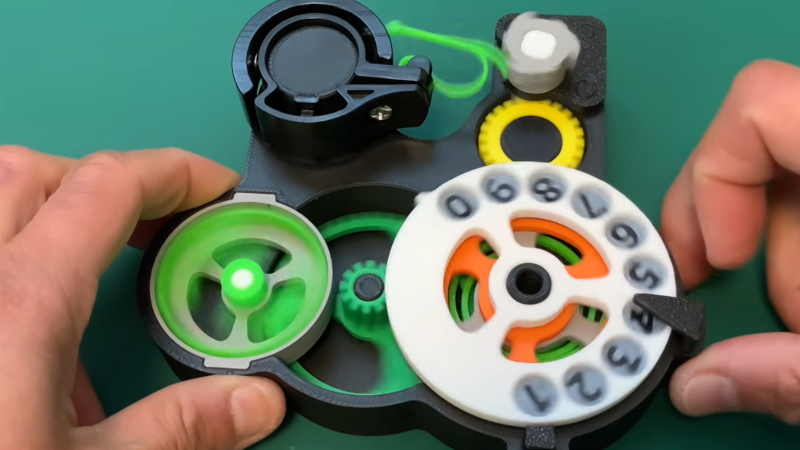
There’s a meme which may have a basis in truth, of a teenager left clueless when presented with a rotary telephone. The dial, in reality a mechanical pulse chain generator, was once ubiquitous enough that having one in your parts bin was anything but unusual. If you’re curious about their inner workings in 2026 though, you may be out of luck. Never fear though, because [Moeya 3D Designs] is here with a fully 3D printed version. It’s not as compact as the original, but it’s all there.
If you’re not put off by the anime-style Japanese voice over on the video below the break and you can enable subtitles for your language, you get the full explanation. There’s a ratchet and spring on the dial, which when released drives a gear train that ends in a cam that would operate a switch for the pulses. Another set of gears drives a very neatly designed centrifugal speed governor, and we see the effect immediately when it is removed. We’re not sure who will go for this project, but we surely like it.
There are two videos below the break, with the dial shown off in the first and the design process in the second. Meanwhile we’ve talked in the past about the networks behind the dials.
Thanks [Jan] for the tip.












To be completely fair to the hypothetical teenager, none of us knew how rotary phones worked before someone showed us, and no one is showing children how to operate rotary phones for obvious reasons.
awesome build
Rotary dials of old were compact marvels of simplicity. One can still score a decent working kind if you know where to look. IMHO, rotary dial and step relays were amazing inventions, simple, RELIABLE and darn efficient for their day (obviously, local/limited-run PBXs where inevitable EMF noise was tolerable, then again, ~100 years ago there weren’t that many sources of crazy high-power EMF noise to start wtih).
Rotate (pun intended) to present and find me thinking “with each winding of the counter-balanced spring , and subsequent letting go, one can probably charge a tiny supercapacitor providing juice for a small LED light beneath the dial”. Rotating this thought some more, “… and power attiny to do the tone-dial once the number is dialed in full” because … because one of my landline phones I am using has came full circle functionality-wise, one pre-punches the phone number one digit at a time before these are dialed once the line is connected. Perfect. I now have one of my weekend projects : – ]
https://www.youtube.com/watch?v=5r4mO7Chlz8
Can we move on from this smug “teenagers don’t know how $1980s_TECH worked”?
Teenagers aren’t stupid. Teenagers are exposed to television shows from last century. Lots of rotary dial stuff on there. They are also exposed to plenty of social media videos of the genre “LOL this is how things were in the olden times.” They’re not stupid. They know that we used to use rotary phones. They know what floppy disks are. They know what vinyl records are. They know what cassettes are. Though I grant that a bunch of them don’t realise that the venn diagram of “computer media” and “audio tape” has a big overlap :-)