
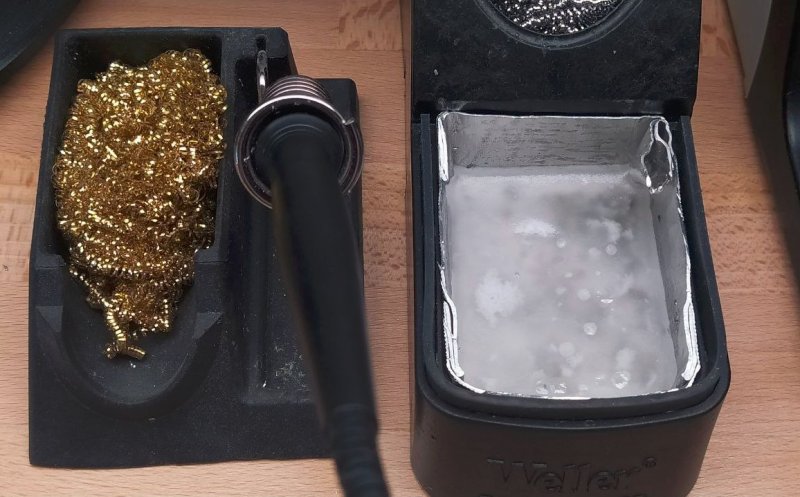
Have you ever tipped all the stray bits of solder out of your tip cleaner by mistake? [MisterHW] is here with a bit of paraffin wax to save the day.
Hand soldering can be a messy business, especially when you wipe the soldering iron tip on those common brass wool bundles that have largely come to replace moist sponges. The Weller Dry Cleaner (WDC) is one of such holders for brass wool, but the large tray in front of the opening with the brass wool has confused many as to its exact purposes. In short, it’s there so that you can slap the iron against the side to flick contaminants and excess solder off the tip.
Along with catching some of the bits of mostly solder that fly off during cleaning in the brass wool section, quite a lot of debris can be collected this way. Yet as many can attest to, it’s quite easy to flip over brass wool holders and have these bits go flying everywhere.
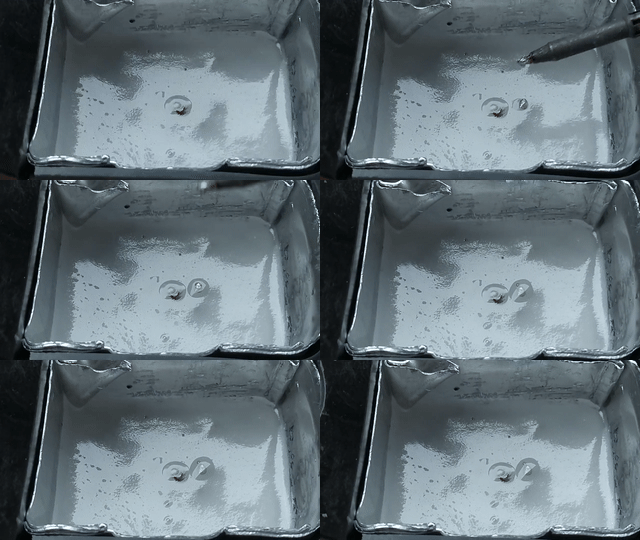
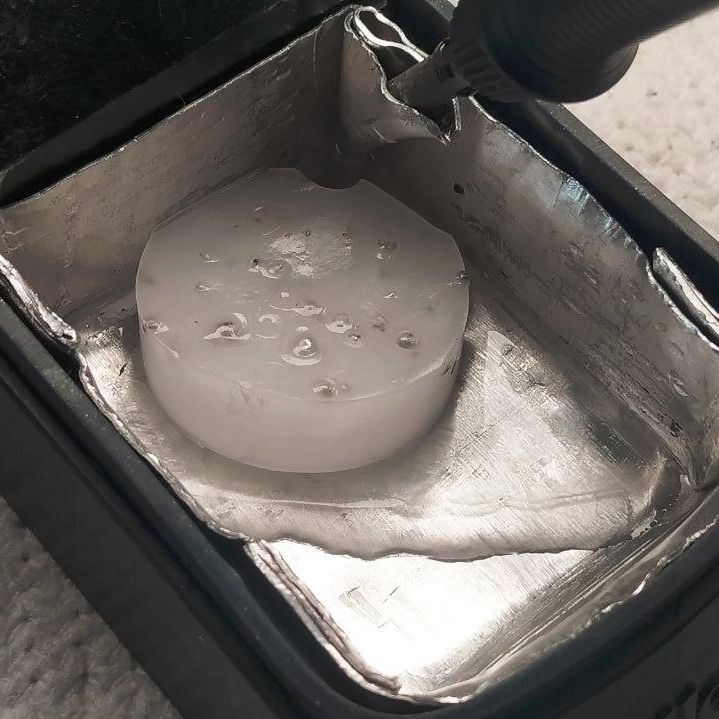
That’s where [MisterHW]’s pit of particulate holding comes into play, using folded sheet metal and some wax (e.g. paraffin) to create a trap that serves to catch any debris that enters it and smother it in the wax. To reset the trap, simply heat it up with e.g. the iron and you’ll regain a nice fresh surface to capture the next batch of crud.
As the wax is cold when in use, even if you were to tip the holder over, it should not go careening all over your ESD-safe work surface and any parts on it, and the wax can be filtered if needed to remove the particulates. When using leaded solder alloys, this setup also helps to prevent lead-contamination of the area and generally eases clean-up as bumping or tipping a soldering iron stand no longer means weeks, months or years of accumulations scooting off everywhere.











That’s extremely clever, and I can use it lube my bike chain.
For a crappy old Weller?
Sure.
Not beating my ceramic cartridge heating elements against anything though.
Yeah! Dont beat your iron and also those brass wool things are way more abrasive than a wet sponge, destroying the coating on your tips (high quality tips are less susceptible, but still i dont trust the brass)
I very much doubt it Is brass. Looks like coated steel to me
If it is coated steel, it will wear down the tip very quickly. A brass sponge doesn’t cause any excessive wear though. You can always check it with a magnet.
I use a Hakko T18-K every other day, they last me 3 years on average. No babying of any kind. I use a brass sponge
In fact I have killed only one since 2020?? The other one is still going, doesn’t look bad at all. I just prefer brass wool over anything else since it removes all the crap in the tip without effort. For removing excess solder I just hit the iron on the desk
I’m still a hobbiest so not at a professional desk per say. I like to take the small bits of solder and combine them black into a blob of solder. So far I have a few chunks to use as a paperweight.
That’s all fun and games until the Blob of Solder achieves sentience and comes rolling, Katamari-style, across civilization 🙂
(As an aside, with my “irritating pedant” hat on, the expression you intended is “per se” – https://en.wiktionary.org/wiki/per_se)
You were pedanting and didn’t catch “hobbiest”? (It’s “hobbyist”.)
That just means someone who is maximally hobby, i.e. cannot get any more hobbier.
“few chunks to use as a paperweight”
If leaded solder, you may wish to encase that paperweight in epoxy.
Lead is toxic and if handled, the hands should be thoroughly washed. Children should not be allowed to handle lead at all … We all know how children was their paws.
Even lead-free solders may be toxic if handled depending on the alloy.
In large enough quantities everything around us is toxic, but there is no reason to get paranoid. Come to think of it, this entire hobby is surrounded by dangers, soldering fumes, soldering burns, explosion hazards, fire hazards, electrocution hazards, exposure to high electric fields, exposure to high magnetic fields, ear piercing 15kHz wining sounds (mostly a thing of the past when CRT’s were common). Vapors from glues, vapors from plastics, constant emission of chemicals from plastic (like cables and other flexible stuff). Batteries might leak, spilling their guts, batteries might explode if treated badly. Then we have the virtual dangers of data leaks and being hacked but that’s for another day.
Relax… that is the key to survival.
And washing your hands of course, always, not only when handling paper weights.
Don’t be ‘that guy’.
We have enough “what about…” -ism in the world already.
Lead is bad for you.
There is no safe level of lead.
Does that mean you need to wear a level 3 hazard suit around lead? No.
Does it mean you should take the minimum effort route and wash your hands every single time you handle it? Yes.
As you said, there are enough things to worry about. But that doesn’t mean you just shrug off the things you don’t see immediate damage from.
Not washing your hands after touching lead doesn’t make you tough, it makes you stupid.
And that is meant in the most literal way, because all lead exposure leads to eventual cognitive impairment.
Humanity has known this for a LONG time.
Exaggeration is an art…
Metallic lead is hardly toxic and is not absorbed through the skin.
Inhaling lead dust is problematic, but if you’re not drilling or grinding it, having it on a desk is not a problem. It’s lead salts and organic lead compounds that are toxic.
Was wondering about that part for decades.
In my youth (grade 5 I think) me and my classroom buddies dabbled in amateur cast lead projects. We literally melted lead obtained from smashed lead acid batteries and poured into sand molds. Venting, what venting, I remember placing a discarded tin can on a gas stove in our tiny kitchen (this was in a middle of winter, so windows were closed shut), picking it up with pliers, etc. I was kind of smart to place the sand mold on a floor least it starts splattering everywhere (which it usually did – when heater air was violently escaping from the sand mold through bubbling), but otherwise I think I inhaled quite a load of lead fumes in the process.
Later on someone noticed our newly found hobby and provided us with few kilos of babbitt instead. I don’t remember which kind, likely, tin-based one, and, also, luckily, this hobby fizzled out after few notable runs, so I could be that I was simply lucky.
Forty-five-ish years ago, I stepped into my dorm room and saw my roommate talking on the phone, idly chewing a piece of my rosin core solder. I tried to get his attention, but he was so engrossed with the phone conversation he didn’t notice me gesturing. He finally hung up the phone, and I told him the bit of “wire” he was chewing was made of lead and tin. As a pre-med chemistry student, he was suitably horrified.
But of course, both of us having grown up in the 1960s and 1970s, we were exposed to lead EVERY DAY, from just about every painted surface, toothpaste tube, automobile tailpipe, etc.
It’s a surprise we’ve done as well as we have despite it.
Yet I handled leaded solder throughout my childhood, and I am fine! Curious!
The human body is more fault-tolerant than you think.
I always question the statement “I handled lead/mercury when I was young, and I’m fine”. What we don’t know is how much better you might be if you hadn’t handled the toxins. The world might be a much better place if a few billion people had IQs about 4 points higher.
I collect solder splatter and blobs from my workarea, and periodically re-melt them in a ladle style crucible, and pour into irregular “sticks”, which I use for subsequent de-soldering tasks (de-soldering a fist-sized transformer from a PCB takes some thermal mass). If I’m pressed for time while just doing cleanup, I may pour into the well of the bottom of an Aluminium beverage can
De-soldering vacuum pistol. spring loaded solder pumps. cast off from torch heated PCB (mass parts scavenging), etc. So many places some of us end up with used solder.
I have been slinging solder for 60 years and I have relied on a cheap old metal trashcan and a small brass brush to de-crud a hot tip. During soldering with my old Unger, very damp paper towel works better than a sponge, IMO.
For long periods of inactivity, I have an outlet switched to insert a 1A diode into the AC circuit; this keeps the iron hot, but at a lower temperature which helps reduce any oxidation buildup (reheating is very quick when the diode is shorted.) After unplugging the iron, the copper/steel wool works great as a final session cleanup, cooling the tip below the melting point of solder and the development of any burnt rosin.
These days, there are modern soldering stations for not very much money at all, with up to 300 watts, with integral-heater cartridge style tips, and those tips can be swapped out in about 3 seconds while the iron is still hot, and simply putting the handle back into the holder puts it in standby mode at ~100C until the next time you pick it up, at which time it goes from 100C to 350C in under 5 seconds.
I second the small brass brush and the standby diode. Now that I think of it, the only additional automation I need is some kind of sealed switch with a long flexible arm that would automagically un-shorten the diode under the weight of the iron.
Some things just need to stay simple.
i need this for my desoldering iron. it desolders fine but cleaning the nozzle kind of makes a mess. its one of those new old stock radioshack desoldering irons. the one with the red sucker ball. its leaving splatter everywhere.
Please don’t bang soldering iron on anything unless you are trying to kill the heater. Any blob that can be banged off can just as easily be wiped off on the brass wool. I believe the real purpose of the metal well is to hold a sponge or a tin of flux. The banged up edge of the well are a good indication that it is not the intended purpose.
I like the idea. I’ve knock my Hakko Fx888 over and spilled lots of solder debris out. But I am not sure this is solution for me. I could plug the hole in the bottom of the iron holder and fill it will paraffin wax, but I am not sure this is the solution for me. The auto-ignition temperature of paraffin wax is 245C to 340C, and the soldering iron is at ~350C.
Allow me to provide a little more background.
It’s fair to make assumptions based purely on the information given in this article.
However, I do quite enjoy revisiting project documentation to update it, as I’ve done this time in the third year of using this item. That and not having damaged a single heater in over 20 years should serve as a data point that it’s reasonably safe to remove solder by bumping the tip against a soft edge.
The lip inserted into the edge of the WDC is made of high temperature elastomer, probably silicone. You’re not supposed to hit the plastic.
I bought that WDC used, with all the scratches and blemishes on the plastic. It’s a hack and I was cheap.
The state of the metal insert.. I hope it’s clear that there are marks from me forming the sheet metal, both outside, and for some corrections while inserted into the plastic part.
AlMg3 is pretty soft, but not THAT soft.
None of the marks on the metal were caused by a soldering iron.
I’m not sure I understand that one. I should have mentioned though that to reset the trap, the soldering iron isn’t set to soldering temperature, but far lower, something like 150°C. Due to the limited contact of the tip and the metal, the heat is just enough to eventually melt the wax. The plastic is not affected, nor does the temperature of the wax go anywhere near its auto-ignition temperature.
I must admit I haven’t, to my knowledge, used soldering irons with Al2O3 heating elements that excessively. My daily drivers are Ersa i-CON and i-CON PICO, and lately a PTS200 USB-C iron with various integrated heater tips. The i-tool tips made by Ersa seem to be essentially a silicon carbide heater in a stainless steel tube. The PICO station came with a broken heater, which I replaced, and that heater had developed a fracture in its center. Since there were no visible marks on the outside that would indicate an external force had been at play (the metal tube is pretty thin-walled), I assume the cause of this failure was thermal shock, or thermal cycles propagating a manufacturing defect.
I promise I’ll update my write-up should I ever manage to kill a tip / heater, but don’t hold your horses.
I wipe my soldering iron on a wet sponge. When the tip wears out, I put in a new one. That’s the most I’ve ever thought about it. Not interested in optimizing soldering iron life; I’ve got better things to do.
I really don’t understand when you would need to bang the side of it like that. My regular flow is turn the iron on, scrape the tip on the brass sponge, load up some sacrificial solder, scrape it again, and then it looks amazing and is ready for soldering. And when you put it away just load more sacrificial solder on the tip.
As far as I can tell this doesn’t eliminate the need for a brass sponge (or wet sponge if that’s your thing). Why would you ever have big blobs you need to knock off like that? I don’t understand the need for this.
This is how a big blob of solder in need of removal might be accumulated: Pressing the iron against partially oxidized copper might not transfer enough heat to the copper to get good wetting, so a lot of rosin-core solder is pressed against the tip to transfer more heat and allow the rosin flux to attack the oxide. This might require a lot of solder by the time the joint is good, so there’s a lot of excess solder on the copper. Much of it can be removed with the iron, and a lot of the rosin will have burned off, so the used solder isn’t as good as fresh solder is. Flick or scrape off the solder from the tip, repeat until the excess solder is gone from the copper.
I think you’re right to say that big blobs don’t need to be knocked off, but they have to be removed somehow.
Careful with that; paraffin wax has a relatively low autoignition temperature.