
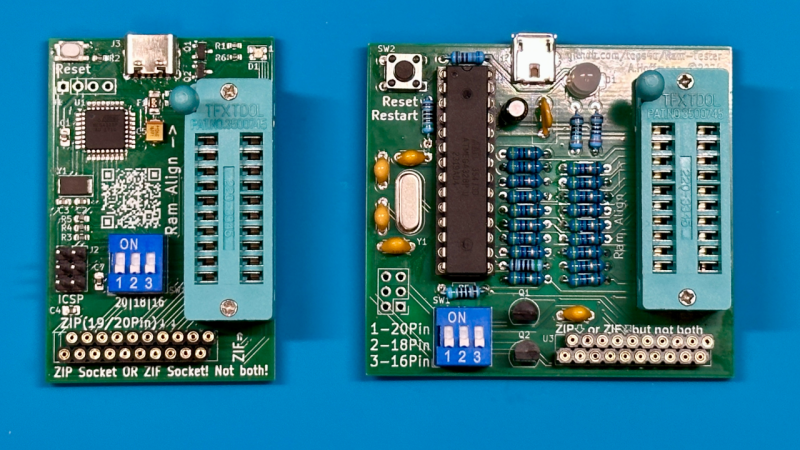
People enjoy retrocomputing for a wide variety of reasons – sometimes it’s about having a computer you could fully learn, or nostalgia for chips that played a part in your childhood. There’s definitely some credit to give for the fuzzy feeling you get booting up a computer you built out of chips. Old technology does deteriorate fast, however, and RAM chip failures are especially frustrating. What if you got a few hundred DRAM chips to go through? Here’s a DRAM chip tester by [Andreas]/[tops4u] – optimized for scanning speed, useful for computers like the ZX Spectrum or Oric, and built around an ATMega328P, which you surely still have in one of your drawers.
The tester is aimed at DIP16/18/20 and ZIP style DRAM chips – [Andreas] claims support for 4164, 41256, 6416, 6464, 514256, and 44100 series RAM chips. The tester is extremely easy to operate, cheap to build, ruthlessly optimized for testing speed, sports a low footprint, and is fully open-source. If you’re ever stuck with a heap of RAM chips you want to quickly test one by one, putting together one of these testers is definitely the path to take, instead of trying to boot up your well-aged machine with a bunch of chips that’d take a while to test or, at worst, could even fry it.
[Andreas] includes KiCad PCB and Arduino source files, all under GPL. They also provide adapter PCBs for chips like the 4116. What’s more, there are PCB files to build this tester in full DIP, in case that’s more your style! It’s far from the first chip tester in the scene, of course, there are quite a few to go around, including some seriously featureful units that even work in-circuit. Not only will they save you from chips that failed, but they’ll also alert you to fake chips that are oh so easy to accidentally buy online!












Well it seems to address a few of the concerns I have with most of the homebrew RAM testers I’ve seen, I’d still like to see a few more features and even perhaps speed characterisation (ensuring DRAM at the least meets the marked speed) at different voltages but I’m impressed with this and not least because it has a ZIP socket.
sound like you want TubeTime Pico2 based https://github.com/schlae/pico-dram-tester ‘Tests RAM at full speed’ tester
“More Fun Making It” covered it on YT https://www.youtube.com/watch?v=7orsBI78VHI
Hi I’m the creator of this project.
The Pico DRAM Tester is a very(!) interesting Project IMHO!
Yet it has some points that cloud or should be improved. I has no Fuse, no ESD/EMF Protection, when powered via USB it looses some of the supply voltage over the Picos internal Diode – to my understanding it powers the DRAMs with 4.4-4.5V. It also has some flaws in the firmware (which may of course be easily fixed). On the other hand it tests very close to the specified timings of the various RAMs but only in Full Access Mode. For some reason it does not (yet?) use Fast Page Mode and it does not support Static Column Mode. Currently it has only a sloppy check for retention times, which also has a bug. It currently does not check for individual address line Errors or shorts to ground.
As for this HW there are of course limits of the ATMEGA 328 which is used here. The minimum Cycle Time is 62.5ns which is far from possible DRAM Timings that are in the region of a few ns… However also vintage Computers were far away. The Pico needs a 300+Mhz overclocked CPU to closely test the timings. A C64 PAL has <1MHz Core Clock.
Was this the one that was seen on Retro Collective’s YouTube channel? Hollie used it to check a Spectrum I think.
“Cheap” or affordable? ;)
Back in our school days one of our teachers at my school didn’t like the word “billig” (German for “cheap”).
He always wanted us to be clear whether we meant “billig” (cheap) or “günstig” (advantageous).
Because in that context “cheap” refered to low quality,
while “günstig” refered to something being low in price or avantageous in price (fine or fair cost/benefit ratio).
Now, well since like forever you can have “Gut und Günstig” oder “Gut und Billig” depending on your choice of Martkauf oder Edeka :). The concept that cheap and affordable means two different things gets kind of lost.