
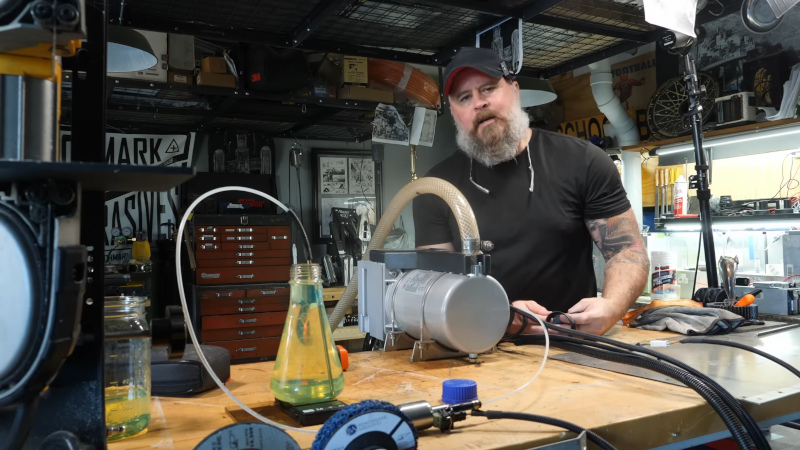
Not a huge percentage of our readers probably get their heat from diesel fuel, but it’s not uncommon in remote areas where other fuels are hard to come-by. If you’re in one of those areas, this latest hack from [Hangin with the Hursts] could save you some change, or keep you ̶2̶0̶%̶ ̶c̶o̶o̶l̶e̶r̶ 25% warmer on the same fuel burn.
It’s bog simple: he takes his off-the-shelf hydronic diesel heater, which is already 71% efficient according to a previous test, and hooks its exhaust to a heat exchanger. Now, you don’t want to restrict the exhaust on one of these units, as that can mess with the air fuel mix, but [Hurst] gets around that with a 3″ intercooler meant for automotive intake. Sure, it’s not made for exhaust gas, but this is a clean-burning heater, and it wouldn’t be a hack if some of the parts weren’t out of spec.
Since it’s a hydronic heater, he’s able to use the exhaust gas to pre-heat the water going into the burner. The intercooler does a very good job of that, sucking enough heat out of the exhaust to turn this into a condensing furnace. That’s great for efficiency — he calculates 95%, a number so good he doesn’t trust it — but not so good for the longevity of the system, since this intercooler isn’t made to deal with the slightly-acidic condensation. The efficiency numbers are combustion efficiency, to be clear. He’s only accounting for the energy in the diesel fuel, not the energy that heats the water in his test, for the record; the electrical power going into the blower is considered free. That’s fair, since that’s how the numbers are calculated in the heating industry in general — the natural gas furnace keeping this author from freezing to death, for example, is a condensing unit that is also 95% efficient.
Another thing you can do to get the most from your diesel heating fuel is add some brains to the operation. Since this is a hydronic system, the cheapest option, long-term, might be to add some solar energy to the water. Sunlight is free, and diesel sure isn’t getting any cheaper.












90+% for FULL condensation of the water in the flue gas is expected If the burn mix is dead on.
My (commercial, high efficiency condensing) hydronic system tests in at 93% or 94% as long as the return water temp is below about 55C. At that point, the flue gas is quite dry (20 to 25% of saturation). Above that, it drops a bit, to about 85% at return temp of 70C and above, where no meaningful condensation occurs until the flue gas reaches the exhaust header (coaxial to the combustion air intake for about 3m), where some gain is found preheating intake air, with some associated condensation, esp on below -20C intake temperature.
In the northeast United States oil furnaces are a common home heat source. Such furnaces can be very efficient. Heating oil is essentially diesel fuel with a dye added so that it can be detected if people try to evade road taxes.
+1. Gas furnaces with built-in condensing behavior, via a counter flow coil to heat the water, are also fairly common in this area; I have one, rated at 93% efficiency. (Though these days it is mostly providing hot water and running as backup to my mini split system, which is far more efficient in terms of ergs used.)
Interesting. Here in Canada oil furnaces are slowly going extinct, so I have no personal experience with them, but I was under the impression the oil they used was just a bit heavier than diesel, to the point of in-interoperability.
Maybe a different hack would be more suitable …
What if you sent some or all of the exhaust through an Energy Recovery Ventilator?
This would let you move both sensible heat and latent heat into the fresh air you are bringing into your house.
That would be basically the old Volkswagen van heater: the motor was air cooled, so the cabin air heater manifold wraps around the exhaust pipe instead.
The main hazard: air leaks between the exhaust and the intake.
There’s another similar consideration, and that is getting your exhaust gas to leave the premises. If you cool it down too much, it will not have the lift after leaving the smoke stack, and all the exhaust gas will just hang around in a cloud around the house. You want it to have enough energy left, so it rises up where the wind can carry it away.
An ERV has enough intermixing between incoming air and outgoing air that it’s fundamentally unsafe.
Anything other than complete isolation of the exhaust carries a risk of CO poisoning.
I have a 9kw JP parking heater I use for hot water window cleaning. I hooked up an egr from a 3 litre Jaguar to the exhaust and circulate pure water through that to to extract heat from the exhaust. It’s mounted on an incline so condensation drains out easily.
Been working for two years now with no issues with soot build up.
You aren’t using brains by adding solar to the system. Most cases living off grid this time of year, solar isn’t producing enough for our daily needs let alone for heating water….
Well it’s just as well that’s not what they were suggesting then, isn’t it? The “brains” part links to an article about adding a controller to a diesel heater.
This is blatant advertising for that brand of oil heater. I wonder if HaD will be promoting Ginsu knife videos next. Is it a hack when they cut through a metal can?
Just as an FYI – the linked Afterburner project went closed-source in 2020
Still a pretty good product if you have a compatible heater, but it’s now fully commercial.
I never heard of this type of diesel heater before. My workshop at home is heated with an air diesel heater because of the gas prices here in the Netherlands. I turned off the radiator in my workshop and use the diesel heater instead, because it saves me a lot of money. I’m going to look into setting this up using a secondary radiator so I can do something similar to this, to make it more efficient.