
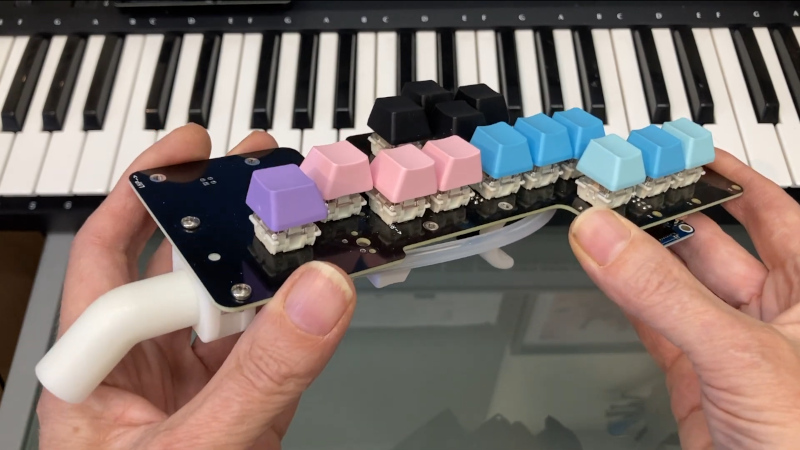
The Haxophone is an open source MIDI saxophone project that has achieved some popularity. It’s caught the attention of [Shieladixon] not because she is a saxophonist but because she plays the recorder and is dissatisfied with existing MIDI recorder peripherals. She’s set about modifying the device to produce the Haxocorder, a better MIDI recorder.
The video below the break is the third of a series, of which part one and part two deal with the Haxophone and the shortcomings of her existing recorder peripheral. She’s replacing the Pi Zero of the Haxophone with a Pi Pico in a Zero form factor, and simplifying its design significantly to remove unnecessary features. The result is a versatile instrument capable at a touch of becoming the full range of recorders, which she demonstrates with some nifty duet work.
The upstream Haxophone project can be found here if you are interested, and we hope she follows this up with a release of her mods to make the Haxocorder. Meanwhile if you feel you might have seen her work before, she’s the brains behind the MIDISID.












Wonderful project! Now just need an Ocarina version. :)
I want open source midi bagpipes…
i’d love to know what was unsatisfactory about the many similar commercial offerings
Something described at length in the first 2 minutes of the part one video linked in the article.
i wouldn’t love to know it badly enough to watch 2 minutes of self-promotiional video sorry
This looks like a fantastic breath controller! Another thing for the to-build list, perhaps once she shares the refined design.
If you file the key caps on the back buttons you can make them right close together.
The closeness can even be enhanced by filing the switch body to male them perfect.
I’ve been looking at exactly that issue, since outside of the minimum center to center distance key switches look like they would be a good, versatile, cheap choice for my project. I haven’t seen a clear statement of just how small people have been able to file / Dremel the cases…
I find the choice of tactile feedback keys interesting, since that’s also one of the issues I have been looking at. Obviously, I want silent or as close to it as I can get, but I’m not sure whether tactile would improve playability, or just distract since the instrument I am basing this on does not require that the keys be fully depressed.
And I really need to look at how spring force and travel play into this.
I think I need to start ordering some of the keyswitch sampler kits… And may need to think about either hot – swappable keys or building several key boards and trying them out.
And then I still have to figure out how to mount the bidirectional load cell(s?) between the two halves of the instrument. If anybody happens to have a good practical prototype-mechanical-design-for-mounting-load-cells reference, I’d greatly appreciate a pointer.
Assuming I ever complete enough of my other projects to actually start building this one. Too many interests, not enough focus.
I wonder whether using IR LEDs and a photodetector in each hole wouldn’t be a better way of detecting the finger. That would allow for analog control (degree of reflection from the finger back to the detector) which would solve the problem with the back hole requiring two keys.
Alternatively, a Hall effect sensor underneath a tiny magnet which gets pressed closer to the sensor might also give that good analog feedback mechanism, but could easily then be made binary by means of thresholds.
On a flex PCB, it could even be fitted entirely into a tube, making it even more true to the real thing.