

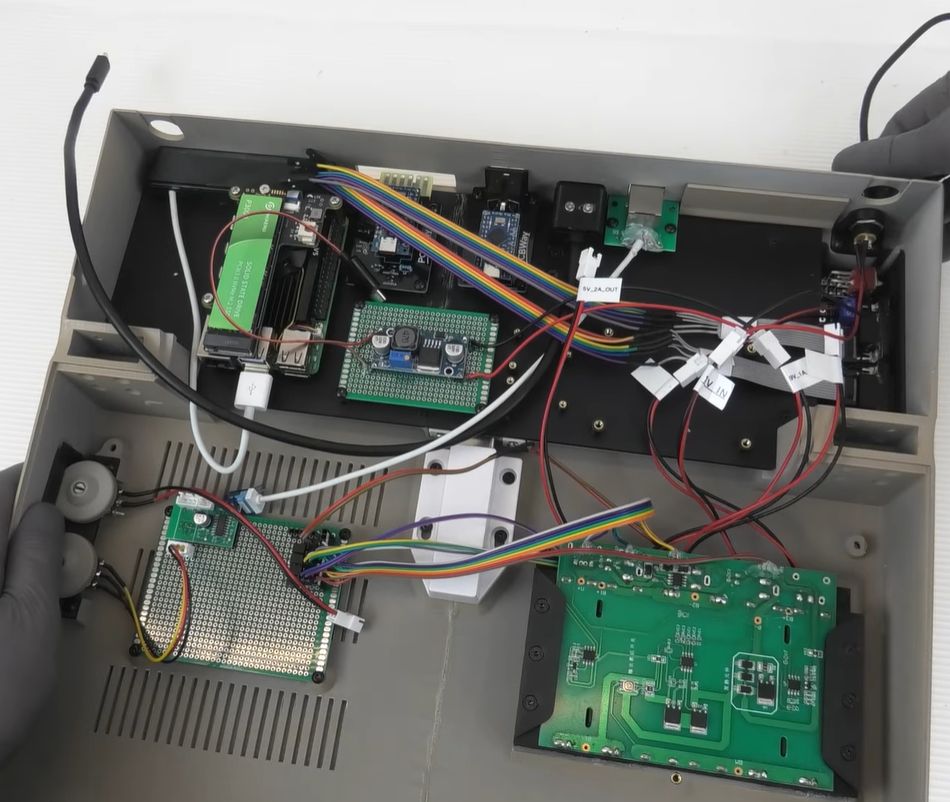
 What might a laptop version of the Commodore 64 have looked like if one had been released by the late 1980s? This is the question that [Kevin Noki] tried to recently answer with a custom C64 laptop build.
While technically you could argue that Commodore’s SX-64 could be construed as a ‘portable’ system, its bulky format ensured that it was only portable in the sense that a 1980s CRT-based oscilloscope is also portable. Sadly, this turned out to be the last real attempt by Commodore to make a portable non-PC compatible system, with the ill-fated Commodore LCD project never making it out of development. We can, however, glean from this some design hints of what Commodore’s designers had in mind.
Interestingly, [Kevin] decided to instead use the Macintosh Portable as inspiration, with adaptations to make it look more like a breadbin C64. One could have argued that the C64C’s design would have worked better. Regardless, an enclosure was 3D printed, with parts glued together and metal dowels added for support.
For the guts, a custom keyboard with a new PCB and FDM printed keycaps was used, with a Raspberry Pi Pico as keyboard controller. We would here cue the jokes about how the keyboard controller is more powerful than a C64, but the real brains of this laptop come in the form of a Raspberry Pi 5 SBC for running the Vice C64 emulator, which blows a C64 even further out of the water.
This choice also means there’s no direct compatibility with genuine C64 peripherals, but a workaround involving many adaptors and more MCUs was implemented. Sadly, cartridge compatibility was sacrificed due to these complications. The resulting innards can be glimpsed in the above screenshot to give some idea of what the end result looks like.
Of course, this isn’t the first time a Commodore 64 laptop has been created; [Ben Heck] used a C64C mainboard and an original keyboard back in 2009. This meant direct compatibility with all peripherals, including cartridges. Hopefully, now that Commodore as a company has been revived, it will pick up on ideas like these, as an FPGA-based C64 or C128 laptop would be pretty rad.
Thanks to [fluffy] for the tip.












Emulator, meh.
The warning seems necessary, obviously…
Feel free to take the design and modify it to incorporate a real C64 PCB. Should be rather straightforward…
Okay, despite what’s inside, this build is very neat. It really looks stunning and it doens’t really matter what’s inside, does it? I doesn’t have a CRT either, but do you really want one, nope. It might have been cheaper/easier to put a “The C64” mini inside, since these are relatively cheap now and are good enough for what they need to be, then again the pi make it very easy to do other things too when the owner get’s tired of the C64 and just wants a simple portable computer with modern functions for whatever reason that needs to look cool.
Anyway, the look and feel are spot on or to be more precise “are perfectly in style”. An awesome build and a nice impression for a prop in a “what if” or “what could have been” universe movie.
Yeah, it’s fine. The color is “wrong”, though, I think.
It looks unnecessary dated or too “retro style”, just to fit design of old breadbin C64, I suppose.
Because, by the late 80s, Commodore had used a more light beige color as design language.
Just think of Commodore 128, the 1541C, the C64-II or Amiga 1000.
Something similar in apparence to the Compaq SLT 286 laptop would have been more realistic to happen at the time, I think.
Papa’s built a small laptop using a color crt .
Let’s pretend it’s an piece of art, that way it can be endured more easily.
Have you looked at john pspas laptops he is the leader in all different designs and uses a breadbin model which looks period correct .
A C64 laptop existed. it was called the SX64. Is this guy just chasing internet points?
The SX64 even had a colour CRT monitor, none of this LCD crap.
Did you even get to the second paragraph of the article before needing to blurt?
The SX-64 isn’t to be considered a laptop.
Think of it, a laptop is a computer that is usable on your lap. The SX-64 is not usable in that position, it needs to sit on a desk, making it a portable computer. The SX-64 weighs 10Kg and has a detachable keyboard and it’s tiny screen and 5 1/4 diskdrive touch your belly when it all is resting on top of your lap, not very practical is it, therefore it is not a laptop? Believe me I know, I tried, it is not a laptop.
Pi-top kit + Amiga emulator = 68060 Amiga
So, yeah, recognizably a Commodore 64, with all the horrible ergonomics of that keyboard.
If you’re going to go through that trouble to make a portable ’64, a SX-64 style with a truncated tail (no CRT neck) would be sweet.
This one keeps trying to insert itself in my life on the side panel of youtube for weeks now lol. It is a cool build and aesthetic. I have the same sighs as others.
I really like this build. It contains some really nice 3D printing tips and tricks.
Same. I’ve been working on a mechanical keyboard with closer-than-normal key spacing (16 mm vs. the standard 19 mm), and the main problem is keycaps, because ALL the ones I could just buy are designed for standard spacing, and even the ones that are smaller don’t specify their dimensions in their descriptions. So I have a set of low-profile caps that I am milling down to 15.5 mm (they are 16.5 mm square, and plenty of material to remove). But if I had known that using a 0.2 mm nozzle allows keycaps to be PRINTED and still look great, I probably would have gone that way. I kind of wonder how many iterations it took to get caps that fit properly. I’m not sure I would be happy doing a full set of water-slide decals for every key, though. What the kids appear to be doing these days is having dye-sublimation prints made, then heat transferring to the keys.
Cool thing – and here is the Amstrad CPC 464 Portable Laptop, which uses authentic CPC hardware:
https://youtu.be/G0GfkJjZaNU
https://hackaday.com/blog/?s=amstrad+cpc+portable
It seems that the CPC Portable also inspired the PortaCoCo: https://portacoco.com/
Cheers!
Commodore LCD was under-budgeted and rumor has it, it was one of the Commodore’s competitors who suggested the bean counters should pull the plug.
Have Commodore been at it since then, by now they’ll be selling some kind of holographic projection screen and not just tri-fold LCD. Actually, it is kind of sad that back then Cray Computers couldn’t make joint venture with Commodore and properly pursue computer of the future. I bet they’d spin Plan 9 fork and invent cloud computing before widespread internet, too.
Opportunities lost, IMHO. Engineers who could have made it happen were busy elsewhere, redesigning the angle of car handles, or the subtle shape of the USB port on the dashboard. I see it that way, talent wasted on things of no particular importance, regardless how much profit it brings.
Why?
Why not?
You’re not from around here, are you?
Awesome build, no matter what people are saying.. you should forward the design to commodore.net. Maybe they will make an official one. :)
I don’t know why people are so negative about this. I think it’s a beautiful build.
Oh well, it has so many reasons I guess. 🤷♂️
I agree that it looks well or fits well the original breadbin C64 (made from recycled VIC 20 parts).
On other hand, some people might feel a bit tired of seing their beloved C64 being used to make a quick buck.
They’re tired of another remake or emulator box over and over again.
Because that’s what had happened for 40 years now.
And that hurts them, watching how their “baby” is being misstreated all the time.
They’ve seen classic-themed modern computers being used to sell through the retro or nostalgia fad.
What they longing for is a real, authentic C64 being created.
Not just visually, but also under the hood.
If this C64 laptop had used an 80s monochome screen (such as that of the Amstrad PPC512)
or an 90s LCD monitor with a CCFL backlight (lile with the GameGear),
then the responses might have been different, maybe.
The use of a real C64 motherboard or the innards of a C64DTV might have been received as more positive, too.
That’s why I wrote that people should think of this C64 laptop as an art piece.
Something that’s a hommage to the C64, rather than being an actual C64.
And if you’re wondering why all the drama..
The C64 isn’t just an old computer. To a whole generation it’s an identity.
Just like the Amiga A500, maybe (to a much lesser extent, though).
The ZX Spectrum (its clones) was another generation shaping computer,
it was beloved in former eastern block.
Generation C64:
https://de-wikipedia-org.translate.goog/wiki/Generation_C64?_x_tr_sl=de&_x_tr_tl=en&_x_tr_hl=en&_x_tr_pto=wapp
Everybody has their preferences, which seem to be closely correlated with their dates of birth. For every birth year there is a year where things were just right, before everything went to hell. So for the Amiga fans, the colors look dated, but if he had used the Amiga “design language”, the “C64 originalists” would be here with their torches and pitchforks. This IS a beautiful build, and I don’t even mind that it’s emulated, because building from scratch does NOT mean the you have to first mine the copper before you can refine it and draw it into wire. He is focused on look and feel, and he certainly got the look right. I doubt that modern mechanical keyswitches feel anything like the originals, but this is a situation where I could definitely pretend not to notice, even though I definitely WOULD notice.
That makes sense.
Though on a side note, I remember the Commodore 1702..
https://en.wikipedia.org/wiki/File:Commodore_1702_Video_Monitor.jpg
Along with the 1701 that was the original video monitor of the early C64 era, before 1084S got popular.
And it was defintely not yellowed/brown like the way most breadbin C64 are now.
I WAS a little concerned that he may have color-matched to a yellowed original. Although he seems savvy enough to match to a surface that hadn’t been exposed to sunlight. Anyway, it’s really hard to judge based on a video, since there’s all that color temperature stuff to mess it up.
I fully agree, the lighting makes a big difference.
It’s hard to tell how it looks in real life judging by the pictures.
Perhaps my criticism was entirely unfounded.
Thank you for mentioning this! 🙂
“small torque hinges”, I did not know they existed, good to know.
There are a hundred gems like this in the video. “Huh – good to know.”
Yes, but the hinge was near the end, with a low learning curve or investment…. unlike:
White color inkjet printing.
Matching colors for custom rattle can spray paints.
Custom Firmware for LCD Monitor driver boards.
… and more….
Sorry, “White Toner”, no low rez inkjet here. This guy might do this for a living….