
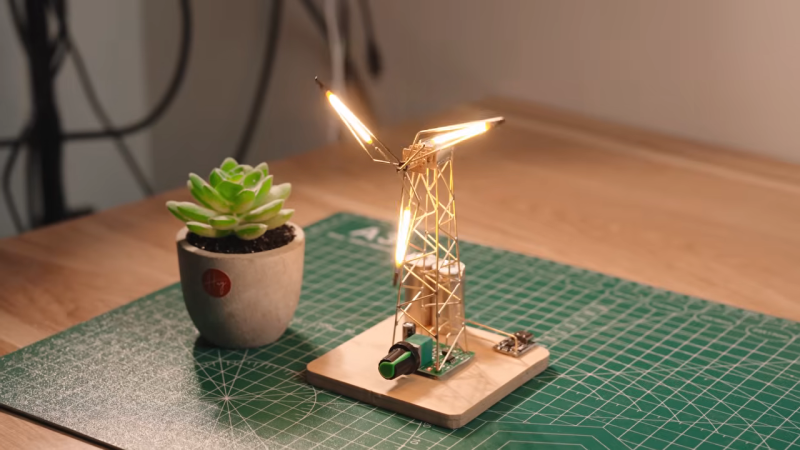
Typically, lamps provide a stationary source of light to illuminate a given area and help us see what we’re doing. However, they can also be a little more artistic and eye-catching, like this windmill lamp from [Huy Vector].
It’s somewhat of a charming desk toy, constructed out of copper wire soldered into the form of a traditional windmill. At its base, lives a simple motor speed controller, while up top, a brushed DC gearmotor is responsible for turning the blades. As you might imagine, it’s a little tricky to get power to flow to the LED filaments installed on those blades while they happen to be rotating. That’s where the build gets tricky, using the output shaft of the motor’s gear drive and a custom slip ring to pass power to the LEDs. That power comes courtesy of a pair of 16340 lithium-ion cells, which can be juiced up with the aid of a USB-C charger board.
It’s an elegant build, and rather charming to watch in motion to boot. We love a good lamp build here at Hackaday, particularly when they’re aesthetically beautiful.












It’s kinda brave to build an uninsulated circuit sculpture with non-protected li-ion cells.
Otherwise looks very nice!
You could put some lacquer on the feed lines, the charging module has protection so it’s only the lines from the batteries to the module that are a theoretical risk if something metal falls on it.
Or maybe put the charging module right next to the batteries, in a nice way, and maybe an extra current limiter for extra safety if so inclined, then do all the brass and copper to the rest of the design.
I mean if that is your worry.
Lacquer is made from BUGS!
You’re thinking of shellac. Traditional lacquer is made from urushiol, derived from tree sap.
Urushiol comes from poison ivy
I’m not worried about something falling on the model, i’m worried about something falling off the model, given that it’s got moving parts :)
What about direct soldering to battery contacts?
What about hot gluing a linear charger pcb that gets hotter than the melting temperature of hot glue?
What about the annoying motor sound which is heavily reduced in the video?
Yes, all of this.
Don´t worry it is only made for youtube. “ASMR” video, AI enhanced to look “soothing”
It’ll be fine. Remember these lamps: https://www.jessar.ca/product/desk-lamp-halogen-telescopic-arm-20w-black/?
They run power thru the bare metal arms. Dunno about the modern LED ones, but they old halogen ones were handy as if you needed about 12v AC you could just clip some alligator leads to the arms.
Apparently the old ones are retro now, and rather expensive.
It’s absolutely beautiful and I think I might recreate it.
I’ve spend too much time in real windmills (17th – 18th century). The design doesn’t look like a modern electrical wind”mill” but a traditional windmill for moving water or oil (grain versions are different). But those have 4/8/12 blades, depending on the goal (more blades, more torque, less blades, more RPM). Most grain and old water and grain windmills have 4 blades that are very large to reach the torque needed (almost hit the ground), the modern electrical ones are usually used for low torque and high rpm goals, like producing electricity. But those are on a single pole, not a construction like this. So the design of the base is more of a more 20th century water/oil moving wind”mill” and the blade construction of a 21st century electrical higher RPM version.
Absolutely not trying to be rude, it’s a very very beautiful project, of which the maker should be very proud. It’s a work of art. I think I might recreate his beautiful work to put in my living room.
Looks beautiful! I love it!
Any ideas for a slow, smooth and low power consumption motor to use here?
Follow the first link in the article, it has a link to aliexpress.
The one they used seems a little too noisy, and probably a little power hungry for the task. I wonder if better options exist.
The generic “N20” motors seem to be a little quieter. They’ll all be a bit noisy, as they’re a high speed motor geared down to get torque.
A small stepper motor might be a better choice.
This is a fine craft-style video, but for more soothing windmill projects look into SimpleFOC project. With an esp32 or rp2040 plus minimal MOSFET driver boards you can make a brushless motor spin as slow as you want, consuming as little as you dictate.
What about cannibalizing a quartz analog clock module? Low but enough torque, quiet, outstandingly low power consumption. With some 3D print tinkering, you could even procure a more compact gearbox.
The other possible option would be an ultrasonic motor. Or a vibra motor from a cellphone – they’re dirt cheap.
However, the soldering iron seems incredibly noisy
Yeah, I noticed that too. I guess what’s used here is a low grade solder intended to be used for highspeed trains or dumpster trucks. Instead of the slightly more expensive high end low noise solder as used in sound cancelling headphones and the special gas filled super duper audio cables, but that’s a trade secret not many people are aware of.
I can tell by the sound that he failed to use low-oxygen, 100% pure flux solder that costs roughly $1,000.00 USD / pound.
If you want real quality you’ll have no choice but to use pure gold for everything, so you can cold-weld everything. You can try to get away with less pure gold by welding it in a chamber flushed with argon, but that’s still a huge trade-off. You can always tell.
For some reasons this inspires listening to “The Windmills Of Your Mind” : – ]
I like it too! I think I will flatter Lewin by imitating it. Bare connections and all!
I just seen someone selling these on TikTok today. I actually took a screenshot. I wish I could post it. Looks identical to this.