
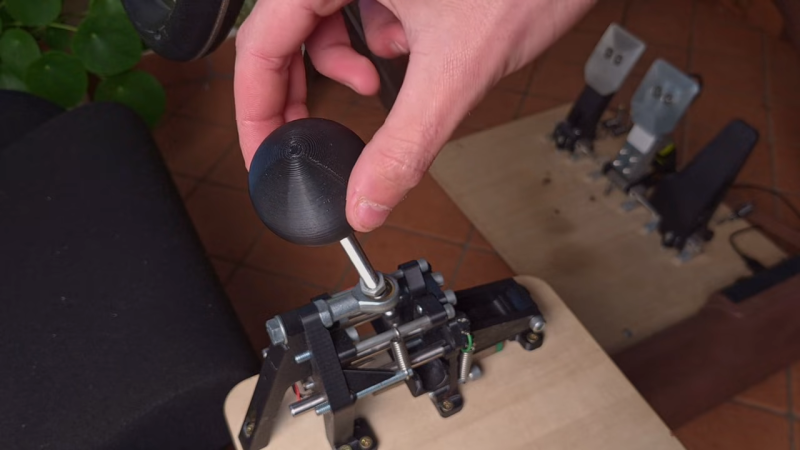
These days, sim racing is more realistic than ever. There are better screens, better headsets, and better steering wheels with better force-feedback, all of which help make you feel like you’re driving the real thing. If you’re looking for a stick shifter to complete such a setup, [DAZ Projects] might have just what you’re looking for.
To create a robust shifter with great feel, the build relies on 3D printed parts as well as lots of quality metal hardware. At the heart of the build is a linear rail for the front-to-back movement, with a printed slider on top with a carefully-profiled indexer to ensure the stick properly ca-chunks into the right gear. A ball joint locates the shift lever itself, while allowing for smooth movement left-to-right. Centering is via simple extension springs. The H-pattern shift is enforced with machined steel rods. Detecting the position of the stick is handled via microswitches, with an Arduino Leonardo reading the switches and reporting itself as a USB device that should work with any modern sim.
It’s funny to think that such a mechanism would once have been a very serious machining job. These days, you can just squirt all this stuff out on a printer in a few hours. For the parts that can’t be extruded, [DAZ Projects] has provided a parts list on Google Docs.
We’ve featured some great racing sim builds over the years, from button pads to pedal boxes.












I’m not watching it unless it’s sponsored by NordVPN.
The excessive advertising of NordVPN by every youtuber pushed me to find alternative VPNs providers and install SponsorBlock and adblock in my browser.
I can tolerate reasonable amounts of advertising but too much is too much.
It is difficult to take a design first approach for these kinds of builds with many mechanical parts. I’m the kind of person who likes to design something perfectly in theory first and then only ordering the parts to do the actual building process.
This process simply does not work for complex mechanical builds because there are just too many variables, tolerances for dozens of individual parts. Its worse when you’re 3D printing parts (which is often). The only way forward with complex mechanical builds is to have all the parts in front of you, and a decent set of calipers. Then you just measure as you go, and model stuff in CAD
Amazing
Now we need a clutch pedal that acts like a real clutch pedal. Might be harder than the shifter, like it’d be a feat to pull it off without software being involved and playing along.
Clutch cylinders are dirt cheap, and much simpler. Also if you ever had the luxury of a cable shifter you can feel the clutch disc bite through the pedal (My first car had an unusual backwards clutch, the oressure plate was bolted to the crankshaft and operated by a rod through the mainshaft). Sadly as a mildly Autistic individual my firat car was a 1983 VW Rabbit. Just an amazing machine from a feedback perspective. Haven’t been able to go near a sim rig without it making my skin crawl.
Every “feedback” is so incredibly fake to me.
To clarify, I remain fascinated by the concept, the implementation is where it falls down.
Well it would wouldn’t it…. For the Vast Majority of us we don’t feel feedback in our daily passenger cars through the wheel. You actually only feel a very very Small amount through the wheel or our hands. The majority of the Feedback we feel is in the G Forces we receive on our body … Hips butt legs. . Especially with Electric Power Assisted Steering we feel even less than before. So now the wheel manufacturers have to come up with Manufacturing Software for the Wheel that helps Replace those feelings and then some as we ask it to Replace Several Different Ways that we Measure Feedback IRL by just transmitting it through our hands. The Company’s that do it the Best are the Company’s that have Figured out the Algorithm the best!
The clutch pedal is really easy. It’s literally a glorified multi-stage spring along the travel. The brake pedal is extremely difficult, and software controlled force feedback is required to correctly simulate brake fade and boiling brakes. Even car manufacturers has trouble making brake-by-wire feel correct, and would simply resort to temperature sensors and a warning light on the dash.
This guy has all kinds of stuff designed and it looks impressive! I found it last night and woke up this morning to HAD showing it! The trick for the brakes is apparently a load cell, plus some other stuff. I haven’t been into gaming since my PS2 got stolen with 50% of GT completed 22 years ago. My kids just got a PS5 and my wife bought me GT7.
Now I want to build something and I’ve seen some really cool/impressive builds! One I saw actually had the tip-in for brakes and had geometry to make it feel right—though I watched so many videos last night I can’t remember which it was.