
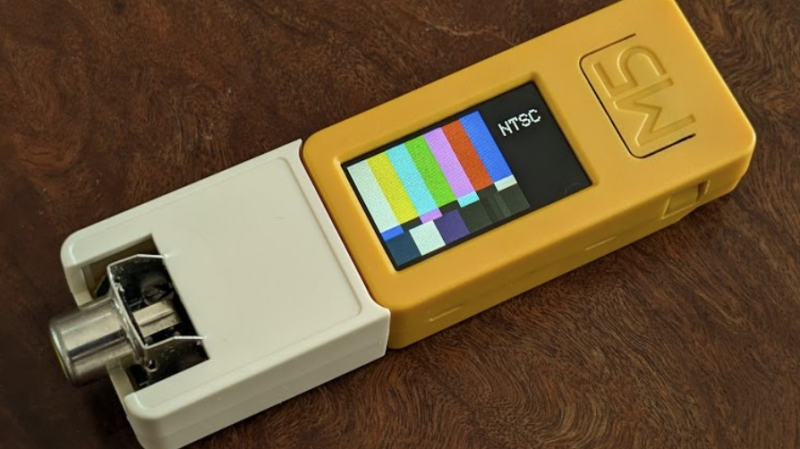
[Nicholas Murray]’s Composite Test Pattern Generator is a beautifully-made, palm-sized tool that uses an ESP32-based development board to output different test patterns in PAL/NTSC. If one is checking out old televisions or CRTs, firing up a test pattern can be a pretty handy way to see if the hardware is healthy or not.
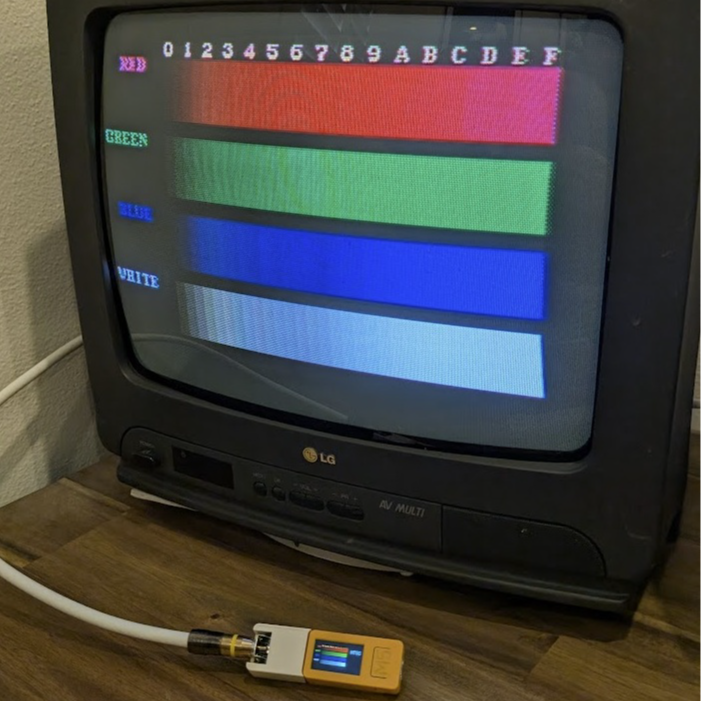 The little white add-on you see attached to the yellow portion is a simple circuit (two resistors and an RCA jack) that allows the microcontroller to output a composite video signal. All one needs to do is power on the device, then press the large button to cycle through test patterns. A small switch on the side toggles between NTSC and PAL video formats. It’s adorable, and makes good use of the enclosures that came with the dev board and proto board.
In a pinch a hacker could use an original Raspberry Pi, because the original Pi notably included a composite video output. That feature made it trivial to output NTSC or PAL video to a compatible display. But [Nicholas]’s device has a number of significant advantages: it’s small, it’s fast, it has its own battery and integrated charger, and the little color screen mirroring the chosen test pattern is a great confirmation feature.
This is a slick little device, and it’s not [Nicholas]’s first test pattern generator. He also created a RP2040-based unit with a VGA connector, the code of which inspired a hacker’s home-grown test pattern generator that was used to service a vintage arcade machine.









Following the NTSC colour article a while back I’ve a new appreciation for generating the Signals on an ESP32.
I don’t understand why US used NTSC when much superior SECAM was available. Probably had something to do with EM emissions from the TV that helped FBI/NSA track what channels people watched.
NTSC was carefully designed not to obsolete older monochrome sets. The same signal could be received by both B&W and newer color sets.
Regarding your second point, I’m sure you could make a FOIA request to get that data, since the people who gathered it are now out of jobs, thanks to DOGE (and the lack of NTSC broadcasts)
PAL was also usable on older sets. It’s better than NTSC, which we used to call (in the UK) Never Twice the Same Colour (sorry, color!)
Yes, tracking people was the reason. Ok, maybe in the UK where it was a thing (to make sure people paid their TV tax). It the US the government knew everyone was watch the Mod Squad anyway, no need to spy.
Seriously, you could extend the question to the rest of Europe, who used PAL. Or Japan, South Korea or Taiwan, that also used NTSC.
Both PAL & SECAM were 60;s developments, but the US TV stations had already invested in color broadcast equipment.
Note NTSC was developed in 1953 in the US, and was designed (as pointed out by Antron) to be backwards compatible with B&W. Sales of color TVs didn’t surpass B&W until 1972.
My parental units gave me a B&W TV as a “enlisting in the USAF” gift in 1980 (it became my first computer monitor as well!)
this is not much different than FM stereo signal being received on cheap mono receivers, as the L-R signal was ignored. While the signal quality was not a good as systems developed a decade later, it was good enough on smaller screens (20 inch or below) and lasted until digital took over.
Besides all written by others – SECAM has one major drawback
Both PAL and NTSC can be mixed by simple analog mixer if in sync – SECAM can’t.
NTSC is dramatically older than both SECAM and PAL.
SECAM and PAL are both workarounds for the patents on NTSC.
But even without that, NTSC is also dramatically cheaper to decode than SECAM. That delay line wasn’t cheap in 1950s technology.
+1
Yup Nailed it….
and another brain dead comment hijacking my nickname
The color system used has nothing to do with tracking what you are watching – even monochrome was trackable. It all had to with sensing the LO leakage, easily detected at a distance.
Also consider the fact that when color was being productized by RCA and others, there were already 5 million B&W sets in use. At the price that customers bought them $200-$800 then ($2100-$8600 adjusted for inflation), the thought of obsoleting the B&W sets with an incompatible system was a non-starter. The NTSC system pure genius!
As to PAL or SECAM being superior: well yeah, given 2MHz more bandwidth, you can do better!
” Helps Check Those CRTs ” Because so many of us have them lying around.
We do.
19″ flat face Viewsonic in storage here.
https://i.imgur.com/I7Twuw2.jpeg
Once in a while I still find CRT TV for sale. This picture was a few weeks ago at Goodwill, I’m guessing nursing homes recently cleaned out their closet and dumped all these CRTs since no one uses it without DTV converter and LCD TV are so cheap no one is buying old DTV converter anymore.
All of the TV had RF only except for one that wouldn’t power on at all.
One is my secondary monitor at work lol.
I can currently go to my local hotel and pick up a flatscreen CRT TV for free right now, they’re literally giving them away at the front desk.
There’s no proof that people don’t need CRTs anymore because in many aspects it’s still one of the best display technologies in terms of color reproduction for production-quality materials. For example Dell P1130 will produce better colors than any LCD when used in Photoshop, Illustrator or even LaTeX.
I have 6, but only 3 are TV, the other 2 are arcade machine screens and a computer CRT.
Reminds me of Newtek’s Calibar from 1997 — 24 test signals in a penlight-shaped case.
Great idea. I toted around my GameCube running 240p Test Suite to seller’s homes when I was looking for a good 32″ monster Trinitron (Wasn’t going to drag a 150lb TV back to my house to find it has wonky geometry or something). This would have been much more convenient!
The color tv test pattern generator was one of my first electronic projects back in early 80s. Sure, all analog. It was really existing to see the result on TV screen. Then later in 80s I used ZX Spectrum fot TV tuning.
Here in the US, we’re currently being told the remaining broadcast stations will soon(?) be transitioning to a newer, incompatible 3.0 version of ATSC. Some of the TV manufacturers are refusing to support it because [business reasons]. None of the TVs available now support it (yes, this means the one you got for Christmas two days ago). Of course, it has the capability for encryption because [more profit].
10 years ago, I got a tour of a major market TV station on the cusp of converting to ATSC 1.0. The tour leader pointed to a fiber connection in their transmitter room. “That’s the connection to [cable provider]”, he said, “and 90% of our audience.” The huge tower, antenna and megawatt RF generator was for 10% of their audience (and dropping, I suspect). I’m wondering how they will be able to financially justify the transition to the new broadcast standard..
There are some religious communities who don’t approve cable TV so I guess it’s justified if it allows people to watch the news.
The problem with cable is lack of privacy. The cable company always had +(in the US markets) the ability to tell what you were watching. It was harder in the analogue days when a late friend of mine was busted for a converted cable box… He didn’t have it behind an isolation amplifier. That worked for the days of one way cable, now the cable company always knows what you are watching, and when.
I like over the air TV, and when I want someone to talk to, there is Ham Radio.
It’s a shame this doesn’t have an RF output for those really old school TVs with only RF. I suppose you could squeeze it into a thrift store RF modulator though.
PAL system in Australia was superior to SECAM and NTSC PAL did not interfere with Monochrome B&W TV’s they worked fine and still do to this day