
There’s folk wisdom in just about every culture that teaches about renewable energy — things like “make hay while the sun shines”. But as an industrial culture, we want to make hay 24/7 and not be at the whims of some capricious weather god! Alas, renewable energy puts a crimp in that. Once again, energy supplies are slowly becoming tied to the sun and the wind.
Since “Make compute while the wind blows” doesn’t have a great ring to it, clearly our civilization needs to come up with some grid-scale storage. Over in Sardinia they’re testing an idea that sounds like hot air, but isn’t — because the working gas is CO2.
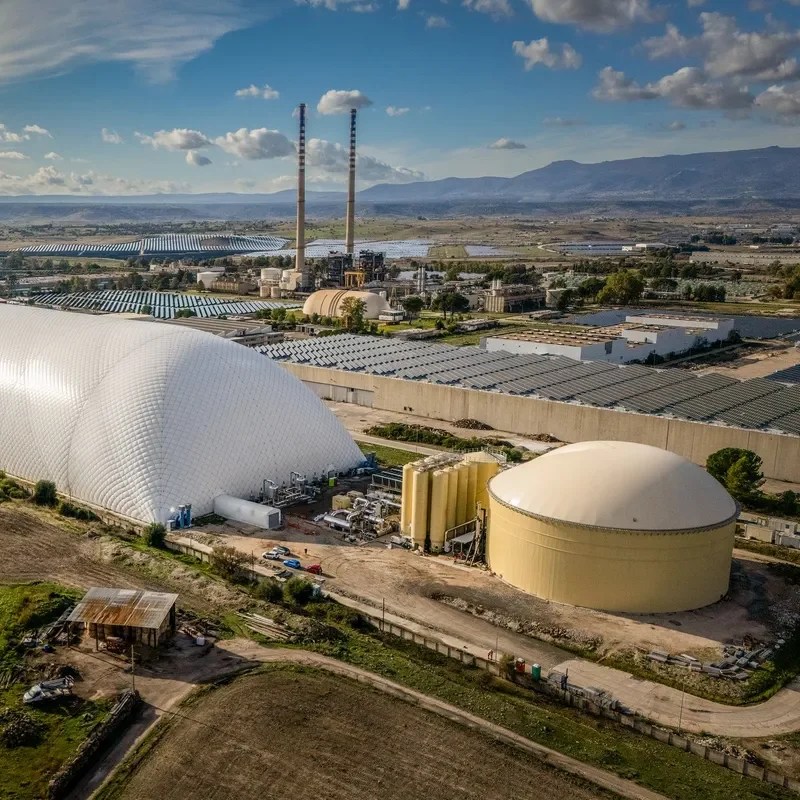
The principle is simple: when power is available, carbon dioxide is compressed, cooled, and liquefied into pressure vessels as happens at millions of industrial facilities worldwide every day. When power is required, the compressed CO2 can be run through a turbine to generate sweet, sweet electricity. Since venting tonnes of CO2 into the atmosphere is kind of the thing we’re trying to avoid with this whole rigmarole, the greenhouse gas slash working fluid is stored in a giant bag. It sits, waiting for the next charge cycle, like the world’s heaviest and saddest dirigible. In the test project in Sardinia — backed by Google, amongst others — the gas bag holds 2000 tonnes and can produce 20 megawatts of power for up-to 10 hours.
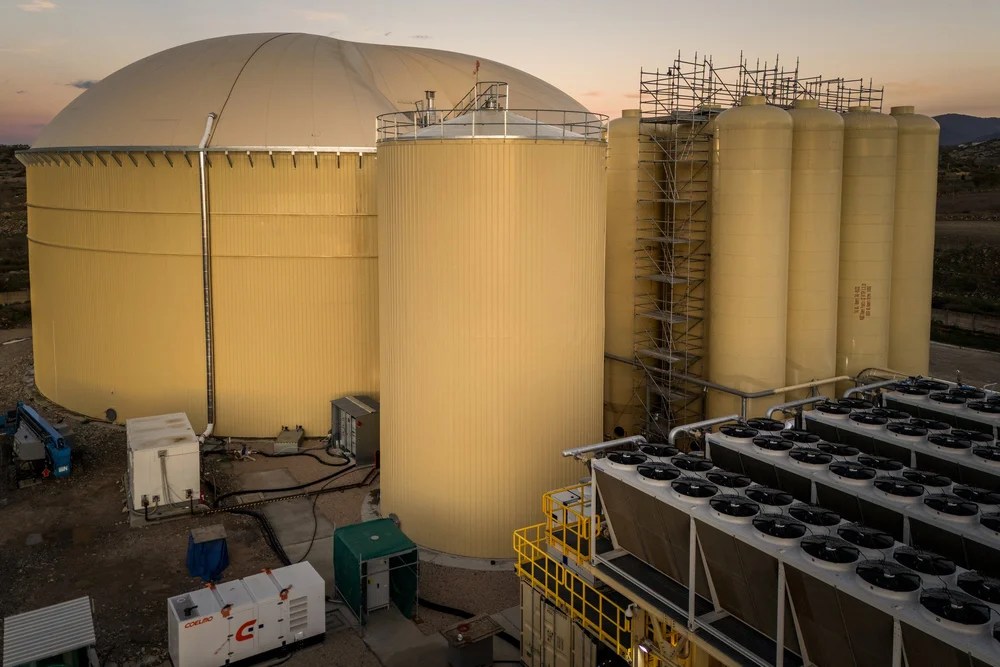
That’s not exactly astounding. It gets you through the night, but leaves you hanging if the next day is cloudy. But it’s scalable. The turbine is 20 megawatts, sure, but all you need is land to add extra energy capacity. The 200 MWh pilot plant is a five hectare facility, which is only about 12.3 acres, or roughly 1/10th the size of the Mall of America. It seems like increasing capacity would be fairly trivial; unlike, say, pumped hydro storage, no special topography is required. Ten hours of storage is also notably longer than the six to eight hours grid-scale battery farms usually aim for.
As of this writing, there’s only one of these plants in operation, but expect that to change rapidly. In 2026 the company behind the Sardinia project, Energy Dome, plans on putting in grid-scale storage based on its technology in India and Wisconsin, and that’s before Google gets into it. They’re hoping to roll this technology out at a number of data centers worldwide, though the exact details of the deal aren’t public.
We’ve talked about grid-scale energy storage before, using everything from liquid tin to electric car batteries and big piles of gravel. This methodology has a lot to recommend it over those others in comparison, and should worst come to worst, at least it won’t burn for days like certain batteries we could name. Releasing 2000 tonnes of CO2 might not be as benign as a failure from a liquid air battery, but storing liquid CO2 under pressure is a lot easier holding onto cryogenic air.
All images credited to Luigi Avantaggiato.










The advantage of using liquid CO2 is that it liquifies at room temperatures above 6 bar/atm. No cryogenics needed for massive volume reduction.
The disadvantage (aside from the greenhouse gas problematics) is that parts of it solidify when boiling off, potentially blocking pipes and vents.
Nitrogen does neither.
I worked for a company here in SanDiego CA. We used CO2 in liquid form by the tanker truck every other week. Sure it sits at 6 Bar at room temp…
As soon as you start using that CO2 for anything it will turn to snow and block your plumbing… You need a tank (or in this case a bag) heater to bring the pressure up a couple more bar in order to stop it from going right to solid phase.
Someone is being paid eo prop up a bad idea.
What if you didn’t expand the liquid in the tank itself, but pumped the liquid out to a heat exchanger, where it can expand by the ambient heat from the environment.
Like, a pipe running through a large pool of water.
So you want a large pool of solid ice?
Would come handy in the summer.
It all depends on what the energy would have been used for otherwise. If the grid shuts off wind on a sunny day then that’s effectively energy lost. If the wind can be left on with excess going here then whilst not free (as usually the wind contracts specify a minimum rate for their energy) in which case then it’s using otherwise lost energy for a cost, but if the wind or solar contracts could be modified to some sort of fair-deal (unlikely) then it could be charged cheaply.
Perhaps if the wind farm owners own these then they can better spread their costs though as they would be charged ‘free’ and only energy coming out would be at the wind minimum tarriff.
This is the lie of renewable energy.
Besides at room temp. liquid CO2 rests at 300PSI.
That must be some bag they are holding that CO2 in.
Re-thinking the Space Elevator again I see…..
The bag is for the non-compressed CO2.
The small yellow cylinders next to it are for the liquid CO2, and the domed building next to that is the generator and compressor hall.
the domed building has an indentation in the dome that kind of makes it look like a butt at certain angles. as if the installation is telling us to bend over and take it.
I feel you must be purposely trying to misrepresent the concept, as I refuse to believe you are so dumb as to believe your own statement
Don’t feed the trolls.
On a quick search, the typical correlation factor between wind power and grid demand is about 0.1–0.2. The correlation factor goes from -1 to +1 where 0 means no correlation or random co-occurrence.
This happens mainly because wind power is to the cube of wind speed, so when it’s windy enough to make significant power, you get an excess of it, and when the wind speed drops you get almost no power. The grid demand varies much less, so the wind power you do get is rarely proportional to the demand, and why integrating significant amounts of wind power into the grid leads to trouble – and results in having to sell the power for export at very low prices. With no reliable correlation between supply and demand, the prices remain low and the only way to make money out of it is by state subsidies (the minimum contract rate).
Instead of subsidizing the producers directly, it would make rather more sense to subsidize the storage system, which would stabilize the price of electricity on the grid by providing reliable demand.
However, that only works if we assume there are no cheaper options like combined cycle gas turbines or nuclear on the grid, because if there are then solar/wind + storage can’t compete with price and would still demand government subsidies to exist, or the political choice to ban the alternatives.
Thank you for that. Clear, concise, and informative.
Apropos the article, note that Verdox (Massachusetts company) has developed a way to extract CO2 from the atmosphere using electrolysis. It’s similar in form to those oxygen concentrators that people wheel around (but using electrolysis), it’s much more efficient at extracting CO2 from air, and it works at low concentrations such as found in air.
Getting CO2 out of the atmosphere efficiently was one of the missing steps towards carbon capture, which is now solved.
https://www.verdox.com/
We could quite easily extract CO2 from the atmosphere for these sorts of installations, and grid scale storage to even out bumps in the supply will probably be the next boom technology.
each wind turbine has a tall empty pylon under it, it only contains a service ladder and some cables. we should stick a big stack of lead weights in there, or some water tanks, and use all that vertical space for some gravity storage. not a lot mind you, but it multiplies with the size of your wind farm and takes up no additional space. for future designs we can widen the pylon for additional capacity. using liquid based systems you can take advantage of a subterranean tank and get additional head (stop laughing pervert).
What do you do with the access ladder that some turbines have in there?
A single 12 Volt car battery can hold more energy than a ton of lead hoisted 150 meters up. It would be far easier to add the equivalent amount of supercapacitors in the turbine’s grid tie inverter than mess around with the pulleys and weights.
If car battery explodes it will spray sulfuric acid everywhere and the clean up operation will involve tossing equally toxic sodium hydroxide to neutralize it. Otoh lead weight on a pulley is not going to harm anyone unless their stupid enought to stand directly under it.
You mean, laundry soap or the ashes from burning a bunch of wood for a barbecue?
Here in the U.K. they get paid for the electricity they might have produced even when the wind turbines are turned off because there’s no demand (or because they can’t get the electricity from Scotland down to England). So might as well produce it and store it even if inefficiently.
However I’m kinda nervous about a huge storage of a heavier-than-air suffocating gas… that seems like an industrial disaster in the making. And would be very vulnerable to can’t-prove-it’s-Russian attacks.
I was thinking the same thing; I wouldn’t want to live near it, if that giant balloon fails, there is going to be a ground-hugging cloud of deadly gas. It doesn’t even need to replace the oxygen all that much, a high concentration of CO2 is deadly even when there is sufficient oxygen left
Indeed, but how near do you have to be for it to actually be a problem?
Worst case big catastrophic failure with no wind to disperse and mix the gas rapidly the area of threat to life might be large eventually but the danger pretty low for most of it – its going to take a fairly long time for the gas to get out to that radius folks can be evacuated I’d think. But I suppose such rapid deflation with geography and wind direction that wants to rapidly spread and funnel it could be a problem for a large area quite quickly.
Either way though no way something like this should exist in the UK – land is just too valuable a commodity for such consumed like this. When much more power dense options exist, even if they cost a bit more to build its going to be worth it.
co2 hugs the ground and can flow like a river into lower areas. i think there was some issue with some co2 lines here in the states that was causing all kinds of mayhem. lets hope you didnt build your home in a low spot.
That’s ok all the rich people live on top of mountains, the highest hills and high rise condos /s
If EU Comission tells you to grab a baseball bat and smash your genitals to prevent CO² because of Russian agression on Ukraine, will you do it? Or will you take your bat and smash Ursula’s head to a bloody pulp instead?
I would, but that’s because fake Dudes don’t have any balls to smash.
(Note to reader: the genuine Dude doesn’t advocate for violence.)
He abides
I condone if the ultimate harm is to themself.
This is indeed a real concern. In 1986, 1700 people died when suddenly a lot of CO2 was released from Lake Nyos in Africa.
https://en.wikipedia.org/wiki/Limnic_eruption
was just going to post this!
land is a finite non renewable resource.
Compressed gas energy storage is almost as bad as a sand battery. You lose compressing the gas. You can’t recover the heat energy from the compression, and you lose on the expansion. Then you are using co2 which is far from the best choice.
I recently saw a documentary from the 70’s where a fellow who had been a farmer before and after both world wars recounted the difference. Before the wars they were making hay by hand and the limit of how much field they could cultivate was by how fast they could cut it down and transport out before the winter ruined it. He said they would hope for enough sunny days to get it all done, and leave the rest to rot.
After the war, when the horses were all used up and eaten for meat during the rationing, the surplus tractors built for the war effort went to working the farms instead, and all the work could be done in a week.
What place both ate their horses and had ‘surplus tractors built for the war effort’?
Tanks make lousy tractors.
Even the engines are far too big.
Perhaps not for a 2025 model tractor, but a 1950 model?
UK apparently, and they were American tractors sent overseas through the lend-lease program.
The USA had a million tractors in 1935.
Was England that backward before the war?
The interwar years were a period of farm consolidation in the USA.
Many people leaving country, average farm size greatly increasing.
But still just the beginning.
Commies called it ‘end of capitalism’, wrote books.
Just like now.
Yes. Before WW1 the UK had almost no mechanized agriculture to speak of, and after WW1 they started importing food instead.
Then come WW2 and the German U-boat problem on shipping, they suddenly ran out of food and had to start rationing everything – while desperately scrambling to re-start agriculture.
Germany was also hugely reliant on horses. Up to 80% of German transport in the war was horse-drawn. They didn’t have anywhere as many trucks as they needed.
On the other hand they didn’t have the fuel for the trucks either.
Welcome to trolling.
The more immediate cause was the shock therapy by US economic consultants applied after the collapse in 1993, which enabled the oligarchs to amass power and property very quickly and set the course of the Russian economy for the next 20 years.
The idea of privatize everything at once meant that the people had to sell their shares of public ownership for bags of potatoes just to survive, and the few criminal lords who had any money could buy everything for a song, resulting in far greater wealth and income disparity than any western capitalist nation has ever accomplished. Great job!
“should worst come to worst, at least it won’t burn for days”
Is anyone here mathy enough to calculate, in the event of a catastrophic pressure bag failure of the sizes being described here, how far the (now decompressed) CO2 would travel at ground level at hazardous levels before dissipating? Ignoring factors like wind, and assuming level ground. Let’s assume below 1000ppm is the ‘safe’ concentration, given a proximate community that includes kids, old people, pets, etc.
How far away from the nearest habitated area would this need to be built?
I’m sure nothing bad will happen when scaling up the storage by another factor of 100 and putting it near population centers.
https://en.wikipedia.org/wiki/Lake_Nyos_disaster#Eruption_and_gas_release
Yeah that’s exactly what was on my mind…the earlier threads about whether grid storage is valuable even if it’s lossy really had me scratching my head….and the people pretending the temperature question is unsolvable, likewise. But a giant bag of CO2 seems dangerous to me. CO2 is at a very low concentration in our atmosphere, it seems like it wouldn’t take a very big release to make a massive localized effect.
What heat source are they using to re-vaporize the liquid CO2?
Now that is a really Good Question.
PT Barnum would be proud if he were still alive…
He is laughing in his grave at us.
Probably natural gas.
The idea is that you would use the ambient heat to boil the liquid, but that’s not fast enough to generate megawatts at the turbine, so these kind of systems typically use some additional heat source like geothermal heat or burning gas to get the peak power output.
4290 tons of water, 20 Kelvin temperature drop (if my back-of-the-envelope calculations are correct). That’s a reasonably compact heat storage tank, considering we’re now building systems with 45000 tons and more for city-scale heat storage. No need to over-complicate it.
It’ll also act as cooling waters for the compressors and condensers.
“What heat source are they using to re-vaporize the liquid CO2?”
The energy required for heating could be supplied by Solar Roadways, surely.
It is an interesting idea, seems like it would be reasonably safe and cost effective enough. Though I have to wonder if it really does scale sensibly at all, and if you wouldn’t be better off just putting solar and perhaps a few comparatively tiny battery on that land area instead – the hectare is only about 1MW for solar, so the output for the same land area is on paper about 1/4 of the turbine’s potential, and exactly where on the output curve of solar a day will be is a little less predictable. But they always produce something during the day, so even if you are making the assumption its 1/8th or even only 1/16th the turbines potential reliably on the same land area at this scale when you scale up that 1/16th ‘reliable’ daytime output will turn into 1/2 the turbines potential pretty quick land area wise, and end up exceeding it in the end, even though we are assuming much worse than sticker performance from the panels – yes the gasbags now last more than a day, but the solar and small battery/flywheel is actively generating rather than just storing similar amounts reliably every day (and thanks to the assumption the generation wasn’t near the actual peak potential output of the panels with gluts of excess power available if you can find users for it fairly often). And as solar is much easier to co-habituate with other structures, perhaps including a version of this concept for the medium term energy storage underneath…
So sizing your arrays expected minimum to the local daily demand with a few small batteries placed on top of whatever other building/warehouse/farm etc land use is underneath them to have power daily and get you through the night may be a far more efficient use of land and resources than scaling this project up.
Obviously if you have lots of low value land (which isn’t true around here, but globally isn’t so uncommon) and need that rainy day storage this idea isn’t unworkable, could even be ideal in a few places, but much as I hate to sound like the frequent commenter “Dude” I think for that rainy day energy store in most cases synthetic fuel actually makes more sense – stable, portable, energy dense and flexible in use energy source that you can build deep bunkers of rather cheaply and then easily take on the road/rails/air for energy supplied directly where you need it. Unless the round trip efficiency of this (and so far I can’t find any information on its round trip efficiency, which suggests its probably not that good – if it was surely that really positive advertising data would be made really easy to find) is getting up to the 60-90% sort of ballpark batteries have depending on chemistry I can’t see it making a strong enough economic argument to look better than the more flexible and directly compatible with existing infrastructure synthetic fuels.
It’s a misconception that the grid needs energy storage “for the rainy day” – i.e. rare events when no power is available otherwise.
That’s not the problem. What it needs is the capacity to absorb very large amounts of energy over the sunny day and the windy day and then release it slowly over the average day. Also, the average week, and the average month, as the availability of renewable energy chances on multiple time scales from weeks to seasons to years (i.e. dry/wet years for hydro).
The need to steady the output over months and even years is what demands large storage capacities that vastly exceed the potential of batteries or pumped hydro etc., which can only realistically be attained by turning the energy into synthetic hydrocarbon fuels.
The argument is not about stockpiling a couple barrels of synthetic oil or gas for an emergency. It’s about effectively plugging the renewable power inputs to the gas and oil grids of the nations by running the whole thing through synthesis plants. Sure it’s inefficient, but that’s the only viable way it can be done to expand the use of renewable power beyond the 20-30% share that can be directly integrated into the power grids using the pitiful amount of storage capacity we can build with batteries and the like.
Though to be precise, wind and solar cannot exceed 20-30% by much. Total renewables including hydro, can.
The EU is currently at the limits of how much wind and solar can contribute to the grid at 29% load share, but at the same time the high electricity prices and the surcharges used to pay the subsidies are keeping people from using electric appliances and heating, including electric heat pumps.
https://www.cleanenergywire.org/news/three-four-homes-germany-still-heated-fossil-fuels
Oh, and the German solution to the problem? Introduce a gradually rising penalty on gas and oil heating, and use taxpayer money to pay 50% off on electric heat pumps.
So basically, take money out of people’s pockets to force them to buy more expensive clean energy. Sounds like nothing could go wrong.
https://deutschlandinenglish.com/p/millions-in-germany-face-energy-poverty-amid-rising-heating-costs
You forgot that Germans pass that to French Tax payers that have to subsidizedTHEIR nuclear energy so that Germans can use large amount of it for basically free. That and misusing interconnexion.
You are missing the point – you can be 100% solar powered really really easily if you scale up the generation enough – if your the baseline minimum output of that bad weather day are at or around demand you will never really need more than overnight energy storage levels (and of course the sliding scale of anything in-between that extreme and the other of wanting ‘infinite’ energy storage so no potential generation can ever be wasted.).
And both practically and economically that very oversized solar generation on the same location and land area might well be cheaper and more efficient than this huge CO2 bladder land hog as you scale up – even if the peak potential generation of the solar is largely wasted much of the time as you don’t have those rapidly scalable demands/energy storage solutions its a cheap to build system that reliably meets the actually requirements. The only challenge there is keeping your baseline energy demands inline with the actual baseline generation rather than people being the short sighted fools they usually are filling the generation capacity of something to near the peak potential all the time…
Scale up generation? Panels lose conversion over time. The need replacement. On an industrial scale the amount of pollution you’re creating versus the amount of energy produced needs to be understood. They don’t last forever, how do you safely dispose of them? How much greenhouse gas is generated to mine for the materials to replace the now useless cell? How much energy is consumed in the manufacture of the originals and replacements?
I’m not saying solar doesn’t have a place in the energy future, it does. In places underserved by a grid and remote so the grid isn’t even available, please feel free to install it. But as a long term energy solution that can provide for a growing energy consumer like the human race? The landfills will tell the folly of that kind of thinking.
Why new nuclear plants aren’t being pursued and built with the goal of co-generation using heat for any number of processes that need a heat source (from residential to chemical synthesis) is a mystery to me.
Too many people are making a buck trying to sell the idea of solar and wind as good ideas when they are inefficient. Solar at least has some use as I stated above, but wind and wave power generation? The maintenance alone make them ill-suited for large scale use. The amount of land needed for a wind farm is prohibitive.
Given the existing huge demand for extraction of dirty raw unprocessed materials to make the stuff that goes into solar their lifespan really won’t be a big burden – its like mining the slag heaps as often done now to get the minerals left in them – as it is a rather more concentrated source than the natural world provides! So in theory at least as cells age out in quantity (which hasn’t really really started to happen yet as solar is still in that early growth phase with most of them having lots of life left in them) they will become the cheapest and best source of raw materials to make new silicon wafer etc.
Also this big gas bladder doesn’t last forever either, probably from the article at least a shorter lifespan than the solar would have, but that is rather beside the point, as nothing lasts forever. The big point no matter what you are doing is land area is finite, and by far the limiting factor in many places so anything that consumes so much of it to be a really low energy density and probably really inefficient battery just doesn’t work out well – Cover the same area with Solar and a tiny battery and the batteries will need replacement once maybe twice in the lifespan the bladder expects but they have likely cycled vastly more useful power through them as the efficiency is good, and the solar cells are still 80% of brand new and almost certainly better (seriously modern panels if they don’t get physically damaged are getting towards 20+ years in the 90-95% of new sort of range – age is so often less impactful than how recently they were cleaned and the weather!). And for good measure its not just an energy store its actually generating it.
Not really, as that land can still be fully productive farms etc – Wind and Solar can share the space they occupy quite a lot better than this giant bladder for instance – You are not grazing sheep or growing leafy greens under the giant bladder, but you can do that with low level solar, and big wind installations are no different to the farmer than the telegraph pole or electric pylon that happen to cross so many fields – minor inconvenience, perhaps a small fraction of that single percent yield loss for the field.
The concept is called “embodied energy” (the energy required for mining, transportation, refining, processing, manufacturing the solar panels). it is typically expressed in units of kWh (of embodied energy) per kW of installed capacity (“standard sun”). The highest values (which I trust more than the lower ones) come up to about 4200 kWh / kW; so 4200 hours orthogonal in full sun energetically repays the panel. Depending on how arid or cloudy the sky is, at what angle it is installed, … it will take longer. This is an industry estimate (unknown date). Wikipedia, Australian government, and other sources typically mention lower values. It will depend on who is making it where and when (energy efficiencies of processes improve).
I think you over-estimate how giant the bladder is: 12.3 acres is just 0.0497 square kilometers.
That’s for ~200 MWh of storage capacity. If we scale that up to roughly 1 Terawatt-hours, which is about 1/600th of the yearly electricity consumption of Germany, it would only occupy less than 16×16 kilometers of land.
In other words, if you build kilometer by kilometer farms of gas bladders, and repeated that 250 times, you could get enough grid storage capacity for 14-15 hours of average demand on the German grid. That shouldn’t be too difficult, or costly. That’s just perfect for overnight backup of renewable energy.
The same amount in lithium-ion batteries would cost around $150 billion. That may not sound like too much, until you consider that it needs replacement every 15 years regardless of use, while a gas bladder at atmospheric pressure is basically just a big plastic tarp with a relative cost of nothing.
A good rule of thumb for solar panels is that the effective average output over a year is 1/8th of the peak wattage. To account for different locations, In Dubai it’s double and in Halifax is half. Could be better, could be worse, but the local weather, upkeep and maintenance, play a big role so it’s hard to predict.
Anyways, adjusted by the average, your number would suggest just under 4 years. Sounds plausible. However, it doesn’t “repay the panel” until you consider the losses of going from electricity back to the materials that made the panel – or “closing the loop”. That’s because refining and depositing the silicon for the panel actually uses carbon from natural gas and coke made from coal in a direct chemical reaction that can’t be replaced 1:1 with electricity. To do that, you run a conversion loss that multiplies the amount of years the panel would actually need to operate in order to make the materials needed for its own construction.
That is something that nobody has solved yet. The conversion loss from solar PV back to new solar panels is technically a net negative, with all the glass and refined silicon and mining operations etc. that cannot run directly on solar PV. It other words, it’s not a net energy source, it’s a net energy sink that only exists by the use of slightly more fossil fuels.
Mind: I’m not saying that each solar panel consumes more fossil fuels than it makes in electricity – that’s not the case. I’m saying it would take more energy than the solar panel produces to make the solar panel using the electricity it produces, because electricity is not directly useful for making solar panels.
That is why solar panels are not truly the answer to de-carbonizing the energy system. They help reduce CO2 emission, but do not eliminate the use of fossil fuels yet.
How many times do you need to scale up to operate through December and January, somewhere around northern Germany where you have 8 hours of daylight with the sun hanging low and 60-70% average cloud coverage?
https://aleasoft.com/wp-content/uploads/2022/11/20221107-AleaSoft-Monthly-solar-photovoltaic-thermosolar-energy-production-electricity-Europe.png
I.e. basically no solar output for 2-3 months.
Also, what do you do while the sun isn’t up? How many solar panels does it take to power you through the long nights? Answer: infinite, because there’s no sun. That means for 2-3 months a year, for more than 16 hours a day, you have to run other generators – and the fuel for those other generators comes from… any ideas?
Also, to make matters worse, the demand curve for Germany is completely inverse of the solar output curve, so for the 2-3 months where you have minimum solar output, you also have maximum grid demand.
We’re not talking about doubling up on the solar panels, we’re talking about building 20 times as many, and still not having enough. Surely at that cost, it would be more sensible to just make synthetic fuels and burn those instead.
If climate of germany is not valid for life then why not put people on boats during winter and move them to Kenya for good weather? When it gets warm then can return.
Also note that Germany is already hitting negative net loads in the summer, thanks to solar, while solar is actually only contributing around 15% to the total electricity consumption. Scaling up from here will have sharply diminishing returns because the added capacity mainly adds to the peak summer capacity, which is already too much to be used and needs to be sold for export.
https://www.gridx.ai/blog/germanys-duck-curve-integrating-renewables-into-smart-grids
In the winter, you don’t have enough sunlight to charge your “overnight” batteries even if you scale the system up by a ridiculous factor. Yet in the summer you’ve already got more power than you can use.
The only serious solution for going up is to start shifting power from summer to winter over a 6 month window, but building it with electric batteries would be a humongous waste of money, energy, and materials, because the ESOEI of a battery that gets charged and discharged basically once per year is piss poor. Accounting for the energy required to build it, and the energy it would store over its service life, would put the system efficiency well below 10%.
That is why, even if we were to turn the excess electricity into chemical fuels and back into electricity at a low efficiency, it would still easily beat the battery by energy and much more by cost.
Kenya is on the equator, which is very good for solar power all-year-round. I think you’re onto something. The Kenyans could all move to Germany for the wealthy stable society and good social benefits etc., and then the Germans could all move to Kenya for the good cheap energy resources, and both would be happy in their new homes.
I mean, it would be a far better idea than the DESERTEC plan, which was to build superconducting power lines all the way to Africa and the Middle East, so the Germans could have access to solar power all through the year without ever leaving home. It kinda smacks of Neo-colonialism a little bit.
I did say with battery/flywheel for the overnight – but that is the point if you size generation up so you get enough even in winter during a bad day, which is plausible enough even if its not that sensible then you don’t need the deeper energy store at all – its clearly not an optimal option for a nation, especially those furthest from the equator with really big seasonal shifts as on those good days even in winter you are going to have more potential power than you can possible ship or use, and by the summer that potential is even more wasted. But it is very possible. And might actually compare rather well in price over time and land area use compared to this rather land hogging bladder and tiny turbine that still needs there to be a power generator somewhere else…
Except you can scale it up that far and you don’t actually have to do anything with it at all – that cheap solar panel can just be disconnected and ignored when its potential isn’t required. Obviously if you can ship your excess to somewhere else usefully and earn a little in the process you should but having excess solar panel that could be generating power but aren’t in use at the moment is no different to the practically countless backup generators etc that sit there doing nothing much of the time… The investment was made to have energy, if you don’t need it right now you don’t HAVE to actually use that potential generation and find somewhere to use it.
And the point is this gas bladder appears like if anything you need to scale up and cover even more land to have sufficient storage capacity than that ridiculous scale solar – to have enough runtime on that turbine you likely need too many bladders covering enough land that the reliable solar GENERATION on that land might well be getting ahead of the turbine output from this energy STORAGE plant – the sun effectively has infinite capacity and that giant land area taps into it, this storage plant can’t output more than the turbine spec, and needs all that land area to last a very finite length of time, while also needing somewhere else a heap of power generation – that to make this concept worth building at all must be more uncontrollable renewable.
Maybe this is a solution to peoples needs somewhere, it certainly seems like it should be very affordable reasonably on demand storage but it really doesn’t look like the tech in the article actually scales sensibly, it is just too big a land hog, and the larger it gets the greater the safety exclusion zone around it must be, making it an even bigger land hog than its already giant footprint. Where you could if you wished build every not transparent part of your home out of solar panels and some structural frame perfectly safely, though it would be stupid with the only reason to do so being you have an excess of solar panels with nowhere better to put them, but you could.
There is no such cheap solar panel, and never will be.
The cost structure of solar is 2/3rds other than panel cost, so even if the panels cost zero you could not afford to scale the system up enough to get solar in the winter.
To put things into perspective, having our current energy infrastructure costs around 5% of GDP today. A fully renewable system that produces the same amount of energy would cost much more, but let’s say it cost exactly the same for the sake of the argument: now try and over-provision that up by a factor of 20x to get your solar power in the winter.
Now you’re paying 40% of your GDP and people are walking around in rags because they literally have to spend all their disposable income just for keeping the lights on. It is not plausible even if it was technically possible to produce so many solar panels for everyone.
Really not true, or at least it doesn’t have to be – a fully renewable system puts nearly all the cost into maintaining a larger and more resilient grid which will be more expensive than the current stuff, but comes with the advantage that a wider web of connections are made so resiliency to a downed power line gets better etc – it would be nice to have that anyway. But as the generators themselves are so so cheap, and getting cheaper to build, maintain and run the cost of actually generating the electric is so so much cheaper…
Really not true or just as true of every power plant if you include all the external infrastructure – oil wells, refinery, shipping the crude and refined products around, you still need a beefy grid connection, and all the Enviromental protection studies and labour building the place…
Plus how you build solar will make a big difference to its costs too – Battery (or alternatives) are the single biggest cost item but you don’t in a system loading up on really excessive panels count actually need many of them, so while they could easily eat 3/4 of the budget on their own if you wanted to it isn’t a requirement when focused on shoving as many panels around as possible to bring that reliable baseline generated up. The MPPT/Inverter brain electronics tends to be the next biggest cost per item and this one you can’t skimp on but you generally only need one of them for even pretty darn giant panel counts, so assuming you are going for maxing out your control electronics rated capacity it won’t actually be that big a share of the cost compared to the huge count of panels and mounts..
The kind of article that falls victim to hype. The original article doesn’t mention it either, and that’s probably because the efficiency is very poor.
Why invest in it though? Because the system is simple enough and cheap enough to build and the efficiency doesn’t matter if the input energy is free (surplus renewables subsidized by the taxpayer).
I was about to agree with you, until you ruined it at the very end. There is overwhelming evidence we are the main cause of the warning, anyone who denies that either makes money by prolonging the status quo, or is just trying to avoid having to change their behaviour.
Got any proof? Humans are emitting less than 2% of all global emissions worldwide. Most of the CO2 is actually produced by bacteria in oceans. The whole green energy thing is a scam run by far-left activists who hate white people.
Bacteria in the oceans will have been doing that for millions of years. It would have been part of the global equilibrium, balanced by carbon sinks.
It doesn’t explain the sudden increase in CO2 that just happens to have occurred since industrialization and the use of fossil fuels.
I’m sure you have Opinions on why Einstein was wrong, too.
Once again, where is the proof? If you are a leftist it’s easy to talk out of your ass but it won’t grant you a Nobel Prize or even a McDonalds coupon.
I’d check your citations on that 2% number… Unless you are talking about absorbable/cyclable carbon outputs the I guess that’s close? But the big thing is we mostly produce CO2 that’s unable to be cycled back into the environment and thus we get an excess in our atmosphere leading to an average increase of our global temperature year over year. Most reliable sources say humans have contributed about a 50% increase of CO2 to our atmosphere since the industrial revolution (literally one of the tldrs in the summary of this article: https://www.climate.gov/news-features/understanding-climate/climate-change-atmospheric-carbon-dioxide#:~:text=Highlights,was%20before%20the%20Industrial%20Revolution.)
This isn’t a political thing, this is a “I want my grandkids to live on this planet, and now it’s humid in Seattle b/c global warming and I moved here to NOT live in a humid butt-sweat hellhole…” thing…
There’s tons of proof Derp. Do you have any proof of your ridiculous claim? Of course not.
Plankton in the ocean are the main CO2 sink on the planet. Much moreso than trees or all of the biomass on dry land.
That’s why ocean acidification is so much more of a threat that no one is talking about. If the ocean gets too acidic for plankton we may actually turn this planet into another Venus.
The fact that you don’t wanna believe that changes nothing.
Exxon studied it decades ago and changes are matching their predictions.
See https://archive.org/details/ExxonClimateDocs/03_1982 Exxon Primer on CO2 Greenhouse Effect/ and other documents in that collection.
Are they far-left tree-huggers? roll-eyes
yes.
What you’re trying to argue is the cynical point where, if someone doesn’t agree with your beliefs then they’re not merely in disagreement but categorically evil.
In reality the issue is twofold: the first question is whether the problem exists, and the second question is what should be done about it? Suppose we all believe in climate change. What kind of a climate change? Some would predict catastrophe tomorrow and say we have to change everything now at any expense. Give up all your money (to me) and go live in a cave. By the same argument, “anyone who denies action now is just trying to avoid having to change their behavior”.
But, doing something doesn’t by itself necessarily achieve the right thing, or anything, which also points to the second part of the problem: when some political faction has hijacked the solution part of the question to themselves and are aligning it with their own agenda, talking in terms like “climate justice” to avoid saying “wealth redistribution” etc., people start to feel suspicious and compelled to reject the problem. That’s because the problem seems necessary to the solution, and not the other way around.
If the definition of the problem, the proof of the problem, and the solution to the problem all come from the same side, it all starts to sound like they’re just taking you for a spin – and you would react just the same if the roles were reversed.
If you want to convince people, you have to involve them in the process, but that may mean the other person can disagree with your solution. For example, the other person may conclude that climate changes, and so what?
For that person, the outcome may actually be positive. For someone else, negative. Are you in a position to dictate that A should not have it better because B will have it worse? Or that A should have it worse just so B wouldn’t? Does the situation differ if one is rich and the other poor? One is white, the other is black? Who is categorically more deserving, or less deserving, and why?
Turn the lever and decide, who should the trolleybus run over.
Throw the switch between the front and rear wheels on the trolley passing, derailing it.
Kill the driver and all the riders.
It’s an unknown number, but highest potential.
Basically what the greens are doing.
Either progress will sufficiently de-carbon the future, or we’ll run out.
Greenies say ‘progress bad’, eat some bark.
Terrorist snot rag wearing Swedish troll, still mental child, says so!
1 degree C is, more or less, 250km north/south.
Is the earth unlivable 500km south of where you are?
Southern hemisphere people, shut your C holes, you’re not funny.
Yes environment is non-linear, some places will get better, some worse.
Buy your ticket, take your chances.
Imagine an unoptimized bicycle with some problems (friction).
One might investigate the chains, the spokes, the tension, the tire pressures, the ball bearings on each wheel etc.
Upon inspection the front wheel ball bearings turned out to cause the most friction. So the ball bearing friction is reduced (replacement with a marginally better ball bearing of the right dimensions one might have laying around, or perhaps just lubing it a bit).
Now the bicycle still has friction, so one inspects again, this time the dominant friction was the chain, so you increase/decrease tension, clean, lube, etc. until it is no longer the dominant friction source.
Now the bicycle still has friction, so one inspects the tire pressure and tests on representative niche of terrain it will be used on: if flat enough there is less need for the damping properties of the tube and you can reduce friction by increasing pressure, etc.
Imagine the improvements feasible were nearly infinitesimal, so as you fixed the chain a bit so it is no longer the dominant term, the front wheel bearings may return as the dominant term, and they need to be optimized in concert until a third, new friction term appears (insufficient tire pressure, the rear wheel bearings, … the bearings for the pedals,…).
When a system has been optimized (by nature: ecosystems adapting for peak fitness in local niches; by humans: workflows like where we plant which types of food, where we build what kind of shelters from the elements, …) some kind of reward function was climbed until one arrives at some local optimum, both by natural selection and human ingenuity.
What happens in the neighborhood of a peak if you change coordinates away from those of the peak?
No place on earth will be unaffected, and everywhere a large number of problems will appear, nobody will have a net benefit in absolute terms (but some will rise in status to rule an empire of dirt).
It was always changing backwards and forwards. Some were simply aligned more with the long term trend than the immediate one.
what really happens is the rich people with private jets tell everyone to be good to the environment, use less, recycle, and wipe your ass with seashells. meanwhile the working class gets strangled with regulations, poor countries are kept poor to keep them from advancing and using carbon, poor americans are ignored as usual. id rather the world burn than live in that reality. its quite unfortunate that we do. at least building nuclear reactors faces the reality that our insatiable wants comes with some risks.
Rome wasn’t burnt in a day!
But it was destroyed in a day. If solving curent climate madness means killing children of democrat politicians then me and my AR are up for it.
You missed one.
I deny it because it’s a money sink that doesn’t accomplish anything.
Most of the money spent on climate change goes to advocacy, and I don’t want my government money going to specific political candidates. (Their money should come from donations, not the government).
All of the remediation efforts I’ve seen – all of them – have ended in dismal failure and released more CO2 than not doing the experiment. It’s as if no one in that arena can do basic math to see if something might work.
Research is good, let’s do more research. I’ve noted in a post above about Verdox, their breakthrough was only as couple of years ago, and we need more breakthroughs like that. It’s looking like fusion will be a thing in the next year or so, so that’s another piece of the puzzle.
Grid scale storage, like in the article, will be another important piece of the puzzle. One that’s sorely needed before we can even start to think about correcting the problem.
most of the money goes to companies selling snake oil. and the left is really drunk on “snake oil”. but were a “science denier” if we mention it.
Making energy cleaner, cheaper and more accessible always makes sense regardless of whether climate change is true. One could say we can even ignore the whole thing, because we’re getting there anyways, whether we choose to panic about it or not.
Although, you could argue that we’re in such a hurry that we can’t wait for progress to progress, so instead we have to start limiting, rationing, and redistributing, and putting our trust in our rulers to manage all of this with absolute power to keep everyone in line – otherwise it just won’t work.
The optimist could go either way depending on their political leaning. For the pessimist, the choice between the two options is about whether you want your disaster later, or to make sure it happens now.
green tech is one thing, and it has useful applications in some cases. but policies that hurt the poor in developing countries or even our own or start wars over it is something else entirely.
also should have pointed out that when the cost of living is artificially inflated with taxes to combat climate change and the working class are stifled with regulations, and when nations are kept down because of some high western ideal, you get more wars. wars are very bad for the environment. ever tanker sunk every oil well detonated by a missile, every gas guzzling military vehicle and fighter jet, that’s a lot of co2.
Look on the bright side.
All those deaders stop producing CO2.
Could be a net win for the planet, if it’s bloody enough.
There’s no need to apologise to climate deniers. Even if every scientist were lying (they aren’t, the deniers are) what’s so bad about clean air, a protected environment and the satisfaction that we all sacrificed to do our part?
You can clean air, protect the environment, and have the satisfaction that we all sacrificed to do our part, by killing everybody.
Except for you of course. There must be somebody left to feel the satisfaction that something was accomplished. Otherwise the last part wouldn’t hold. It could also be a small elite group of people who decide that everyone else must die, so the can enjoy a clean and protected earth that provides all the resources they need without having to compete with billions of other people for the wealth.
“make hay while the sun shines” is about taking an opportunity while you have it,not renewable energy.
When CO2 is compressed, work is done, releasing heat. That heat must be withdrawn from the system, i.e., thrown away, to liquefy the CO2. When vented to the turbine, heat must be added to convert the liquid to gas. At each stage, energy is wasted.
As others have mentioned, WHAT is the efficiency in total, and how does that compare with current technology, such as vanadium flow battery (~75-90%, per https://en.wikipedia.org/wiki/Vanadium_redox_battery), or Na-ion battery (~90%, per https://en.wikipedia.org/wiki/Sodium-ion_battery)?
aside from this:
https://en.wikipedia.org/wiki/Lake_Nyos_disaster
There’s the real estate problem to think about.
If you’re going to bother with this, what’s the tradeoff if you went with hydro storage or gravity storage? I can drink or use water, and gravity is only a problem if a safety system fails and I’m next to it when the blocks fall down.
Why in the world would you use the poisonous gas you’re vilifying as a storage medium? We need to find a way to convert it to a useful form, not store it. This goes for the underground storage baloney as well!
Perhaps creating synthetic petroleum? Carbon fiber?
“Faulty idea based on a faluty assumption that man is warming up the planet.”
One for /r/ConfidentlyWrong. You could a star there.
right now i cant even warm up my living room.
Judging by your comments I’d say that’s because you don’t believe in electricity.
no its because i live in alaska. were on hydro power. but the landlords put in a small heat pump that was meant for a space about a third of the size. its actually an interesting story that kind of proves my point. they did all these environmental upgrades, got all the subsidies had the inspector come by in summer and signed off on it. they picked spring to reduce the heat loss delta so they could past the weatherization tests (just a once over with a thermo camera). did they seal up the crawlspace under the building (there are gaping holes rusted into it) or install any weather sealing at all? no. and they put the water heater in an uninsulated shed and didnt re-insulate the pipes so the pipe tape heaters are always on. so last electric bill was $200+. we have a heating assistance program, but because of a string of dei hires, they are four months behind in their processing. all these wishy washy dreams of saving the planet are snake oil and hurt poor people. they just dont work.
i mean you guys wont build nuclear reactors for the people but bill gates will build it for datacenters. not worry in 3 years the msm will be singing bill’s praises because he paid off the right people and your anti nuclear brainwashing will be reversed. in the mean time, we spew carbon. california burned trying to protect the environment, neglecting their forests, and all that space age green material the city was built out of is now in the atmosphere. im not denying science, its just nothing were doing means a damn because everyone does the convenient thing no matter the cost, blow green smoke, drive gas cars because elon bad, upgrade your phone every year. the reality is that humans want it all and they dont care how and any virtue signaling is social credit and nothing more. these are not the actions of smart people. i never once claimed that climate change is fake.
“no its because i live in alaska”
Sounds like a you problem. Move. Get a better job so you don’t have to live in a slum.
See, we can give glib responses to real problems too.
“we have a heating assistance program, but because of a string of dei hires”
Ah, your predicament isn’t because of your failures, after all you’re a superior intellect. (That’s what your mom said, after all.) It’s the non-whites.
why is it that so called renewable energy solutions tend to have underwhelming output and consume an egregious amount of land.
Yep… And ugly too. While a nice nuclear energy plant could almost be unnoticed on a comparably postage stamp of area.
>nice
>nuclear
Pick one.
Chernobyl and Fukushima should’ve been lesson learned enough that this is not safe nor sustainable way to produce electricity. All the money spent on building the New Safe Confinement over Reactor #4 could’ve provided free electricity to the entire Ipswitch and surroundings for 38 years – which is longer than average lifetime of a nuclear reactor. What’s worse, despite all the fake promises by Novarka Corporation, with current technology it’s impossible to dismantle Chernobyl reactors, and it won’t happen for another 100-200 years until all the radiation dissipates.
the lessons i learned are:
dont let communists design and run nuclear reactors
dont build your powerplant in a tsunami zone.
nuclear sounds a lot better than bulldozing ecosystems to put up solar panels and wind farms. let alone all the co2 we pump into the air because all this renewable technology sucks and we got to make up the slack by burning fossil fuels.
besides these two are old designs that had deficiencies. there are newer safer designs now. safety rules are written in blood.
How about social democrats?
Case in point: the first two nuclear reactors in Finland were built in collaboration between the Soviet Union and General Electric. You know, to remain politically neutral through the cold war. The Finnish politicians hated both in equal amounts by the anti-capitalist sentiments from the left and the fear of Soviet invasion by the right.
So they put both through the wringer and demanded each to justify every design choice and feature, run the construction through validations and double triple checks, explain every detail until they both were in agreement over how it should be done. It is said that this elevated the level of nuclear power design in both countries, because the Finns would accept no less than perfect, and that is what they got. The old reactors are still pulling world records in uptime and reliability, and they’re probably the most closely monitored nuclear power plants in the world.
Fast forward a few decades, and the French AREVA wants to enter the market with a design of a brand new EPR power plant. Which country do they pick for the trial?
Oh… Finland. Well, it took them 18 years to get it done to satisfaction. The other unit built in Taishan, China? That took only 10 years and went online before the Finnish unit did, but then suffered from cracks in welds and fuel rods, and radioactive gas release in 2021…
So I guess the moral of the story is, safety rules aren’t written in blood. They’re written in regular ink. It’s up to you to maintain the standards. And also, don’t buy nuclear power plants from the French.
They still cant get it right…………
Diablo Canyon was bu-ilt next t a fault line, so was the decommissioned reactor at San Onofre.
The problem with nuclear power is two fold…
The environmentalists have driven the cost of building said reactors to the point of making them not profitable….
The second issue binds to the first; the operators of these plants literally run they until they fall apart like they did with San Onofre. They ran this one well past it service life.
There is one more problem with Nuke Electricity Boxes….
Nobody wants to dispose of the waste from these plants.
Not to mention the reactors take a decade or six….
Not only that the vessels this radioactive trash is stored in break down over time and have to be replaced…
So in the end. Nuclear power is not a bad idea; it’s a fatally stupid idea, poisoning the environment for tens of millions of years.
Burning dead dynos until we establish ourselves in space is a wise idea.
Nuclear power is not clean compared to coal or natural gas.
The effects of coal and natural gas only last a short time compared to the byproducts of playing with element 92.
Nuclear is the way. Everything else is window dressing.
“Chernobyl and Fukushima should’ve been lesson learned enough that this is not safe nor sustainable way to produce electricity. ”
Neither Fukushima nor Chernobyl killed nearly as many people as coal and oil have done, and will continue to do.
Agrivoltaics, nothing says you are committed to one use with solar.
” consume an egregious amount of land.”
Solar can coexist with farming. The panels provide shade that some crops love. I’m sure there’s some modifications to how high the panels are mounted, or spacing of the panels, but you still get multiple uses of the land.
Also, solar is something that can be placed on otherwise unusable land. Former trash dumps; sites that were contaminated then cleaned up but still not seen as desirable locations for building; sites near noisy facilities like, say, data centers with gas turbine power generators.
Just like the Space Elevator.
:D
is the volume of that big bag really ~ 1 million cubic meters? quick estimate of 2000 tons of CO2 at STP gives about a million cubic meters. I can’t see how long the thing is.
Of all possible gases, why did it have to be specifically CO2 though?
This. Engineered for marketing to the solar roadways/space elevator/”crysals” audiences
What happens when the ambient temperature exceeds the critical point of carbon dioxide?
Why not turn atmospheric CO2 to dry ice when you have power (there is already a lot of tech around this), and then you don’t have to worry about pressure, and just insulting it well. When you need power you “melt” it to get the CO2 gas again, and you have a high temperature difference which could also generate energy.
I guess maybe it’s more complicated or inefficient than liquefying CO2, but that giant bag just seems so impractical.
I think we’re suppose to bust out our spreadsheets and show work, or something.
“The turbine is 20 megawatts, sure, but all you need is land to add extra energy capacity.”
Land just happens to be one of the most expensive commodities in places/countries with a high density of people. While those are exactly those places where something like this is necessary.
That “all you need” is about the hardest and most expensive thing in population-dense areas.
And guess what…..
It may take as much as 50MW to get all that warm air back in those little steel bottles.
Ridiculous. Neither cost effective, economically nor ecologically sustainable. The Sun shines 24 hours a day. Bits are portable. Electrons are not. Make compute where the Sun is shining. Duh
Right, all it needs is 3x the number of data centers, each run for 8h/d.
I know it’s you, Jensen. Quit hiding behind such nicknames to sell more GPUs.
Right now Jensen couldn’t sell more if they wanted to….
And @The Mad Programmer does have a point a large amount of our cloud/internet/compute demands could be met by moving the loads to where the sun is shining across the day – plenty of data centres out there not at 100% utilisation much of the time. But actually making that all work seamless and securely…
That’s actually what bitcoin mining DOES, shifting around the world based on electricity prices. I know it’s “wasted” compute but it’s also a BTC/renewable power arbitrage. Power needed? stop BTC mining and sell power. Power revenue drops below BTC returns? Back to mining….worldwide balance in milliseconds.
Honestly I would be surprised if they hit 40% efficiency.
Forgot this one.
Q: Link to studies that show that reductions in particulate emissions have produced resulted in some global warming.
Several scientific studies demonstrate that reductions in anthropogenic particulate emissions (particularly sulfate aerosols) have reduced their cooling effect—by reflecting sunlight and brightening clouds—leading to “unmasking” of underlying greenhouse gas-driven warming.
This effect is well-established, though the exact magnitude varies across studies due to uncertainties in aerosol-cloud interactions.
[big snip]
These reductions provide major health benefits by lowering PM2.5 exposure but highlight the need for rapid greenhouse gas cuts to offset the lost aerosol cooling. The IPCC and reviews consistently note aerosols have masked ~0.5°C (0.9°F) of warming historically.
Nothing happens in a vacuum, my friend.
Hackaday editors – for the love of God, please add a voting up / down system to your response system so that we don’t have to keep wading through so many garbage responses from science denying idiots
Your dogma ate your credibility when you wrote “Since venting tonnes of CO2 into the atmosphere is kind of the thing we’re trying to avoid with this whole rigmarole, the greenhouse gas slash working fluid is stored in a giant bag.” because the physics based truth is simply that the gas is collected and stored purely as a matter of energy efficiency due to what it would take to seperate it from all of the other gasses in air. 🙄