
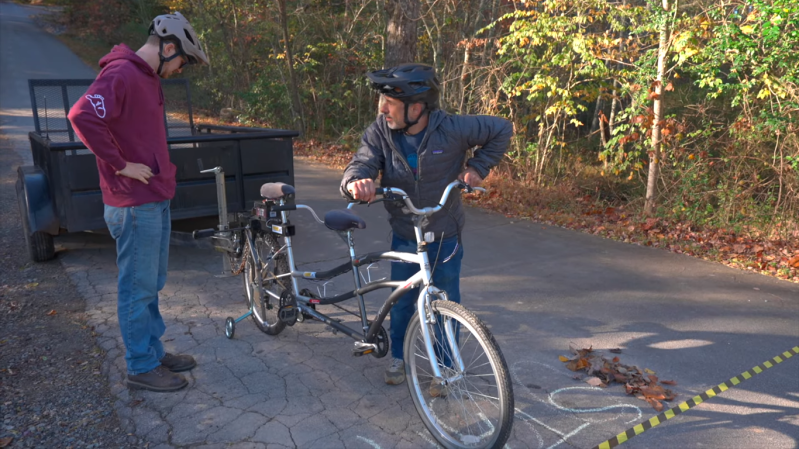
An old joke in physics is that of the “spherical cow”, poking fun at some of the assumptions physicists make when tackling a new problem. Making the problem simple like this can help make its fundamentals easier to understand, but when applying these assumptions to real-world problems these assumptions are quickly challenged. Which is what happened when [Seth] from Berm Peak attempted to tow a huge trailer with a bicycle — while in theory the bike just needs a big enough gear ratio he quickly found other problems with this setup that had to be solved.
[Seth] decided on a tandem bike for this build. Not only does the second rider add power, but the longer wheelbase makes it less likely that the tongue weight of the trailer will lift the front wheel off the ground. It was modified with a Class 3 trailer hitch, as well as a battery to activate the electric trailer brakes in case of an emergency. But after hooking the trailer up the first time the problems started cropping up. At such a high gear ratio the bike is very slow and hard to keep on a straight line. Some large, custom training wheels were added between the riders to keep it stable, but even then the huge weight still caused problems with the chain and even damaged the bike’s freehub at one point.
Eventually, though, [Berm Peak] was able to flat tow a Ford F-150 Lightning pulling a trailer a few yards up a hill, at least demonstrating this proof of concept. It might be the absolute most a bicycle can tow without help from an electric motor, although real-world applications for something like this are likely a bit limited. He’s been doing some other bicycle-based projects with more utility lately, including a few where he brings abandoned rental e-bikes back to life by removing proprietary components.












Yow! I’m always wanting something like this. But practically, my upper limit is 300lbs (eg, 3 bags of concrete). Like, you need to be able to man-handle your trailer when you get off (or break) your bike. And even at 300lbs, I keep thinking about zeroing out the tongue weight with an extra wheel or two. I mean, duh. And fwiw i put the hook between the seat/chainstays right in front of the rear axle…i would never want to put it so far back, and i learned not to mount it to the seat post years ago.
300lbs is also about the same that I was able to haul with my biped trailer (mechanically, imagine a grocery cart with a leash).
FWIW, to max out trailer capacity on a bike, just buy “carla cargo”. Very expensive but it has zero tongue weight and tongue-activated independent brakes. These are all solved problems. They even have models with a tongue-activated electric motor for zero tongue in-line force too.
The thing is, no matter what your gear ratio is, you’re still putting all this weight and inertia through the frame and wheels of a bike designed for a rider up to 250lbs. I’m still dreaming about the real human-powered heavy transport, but it would need a much beefier drivetrain than a bike, and it would need 4 wheels with the weight between them instead of on a separate trailer…it would basically be a car with pedals. You can cut some weight but fundamentally if it’s going to haul around like a ton, you need a frame and wheels more like a car than like a pedal bike+trailer. I think unlike this youtube gambit, that idea is possible, but dang it would be slow.
You’re not wrong about repositioning the tongue weight over the frame to spread the load over the wheels and other frame bits, but don’t forget about traction! Without normal force pressing the drive wheel down, you end up doing a tethered burnout at the first incline.
Laying down nome math with mostly-remembered constants: basic/cheap/long-wearing rubber is good for “about” as much lateral force as normal force on a surfare. Figure 250lb of bike+rider, and we have about 250lb of lateral force available. I’ll round up to 300 for laziness. (I’m not converting between lbf and lbm because I can’t be arsed and because the USCS is a pile of “good enough” kludges. Also ignoring rolling resistance because I’m only going for ballparks here.)
So if my physics and trigonometry are all being remembered correctly, we have capability up to a 45° slop for a unicyclist, up to around an 18.5° slope for a bike arrangement which has 1/3 of trailer weight on tow vehicle, and up to around 1.5° slope for a situation with zero tongue weight (just bike and rider). Give or take actual tire/surface friction coefficient, actual rolling resistance, actual dynamics of the rider’s pedaling, etc.
Recommend reinforcing the bike for sure, and definitely wire up those trailer brakes as mentioned in the fine article / content!
They have three problems: 1. the front wheel lifts, losing direction, 2. the bicycle tilts, 3. the bicycle self dissasembles due to forces applied to it.
They need a double tandem bike (like a car), thus becoming much heavier and likely less to flex and the chain to jump (due to interconnecting rods and perhaps a better chain drive). Having 4 humans on it will also increase weight and power, and being on 4 wheels it wont tilt.
The other “ideea” is to tie the bicycle on a tree uphill, and use it as a capstan for a chain dragging the trailer. The only issue is that you have to be on the side of the bike that stays attached to the tree when it is ripped in half by the strain.
hahahaha…
+42
And they called Mumen Rider a wimp
The Vietnamese won the Vietnam War in part by using bicycles to transport up to 600 lbs of supplies through the jungle, as recorded in the book “The Bicycle in Wartime” – well worth the read.
This kind of sounds like, in reverse, when people put a really powerful engine in a car without doing the legwork on the rest of the powertrain…. the first time the give it a good rev, it twists the frame, burns up clutches, breaks U-joints, and shreds differential teeth.
I’ve seen it happen. It’s both kinda funny and tragically sad. Sometimes, even if you can manage to shoehorn a 427 into a 1984 Chevette, the rest of the car just wasn’t built for that kind of power. [vrooom crack crack screech pop smoke donk]
This will sound rather pedestrian but still a pretty good story. In high school a friends mom gave him her old beater car, an early 1990s Ford Festiva. Strange little car.. Kia made unibody chassis, Mazda drivetrain, Blue Oval badges. Great commuter car if you’re trying to save monies with a wheezy fuel sipping 1.3 liters of fury and a 5 speed manual gearbox, but at 16 year…. you get made fun of a lot and it wasn’t very exciting to drive (when we were 16…. Today, decades later, I’d rather enjoy ripping around town in a stock 1.3L Festiva) so we set out to change that.
After some extensive research and a few trips to the salvage yards, we scored enough used parts off various cars to swap in a Mazda 1.6L turbo engine/trans into this little go-kart along with a really nice brake/wheel/tire upgrade. Stock 0-60 time of a 1.3L Festiva was darn near 14 seconds and a full 1320 foot quarter mile pass took almost 20… with drag slicks and a limited slip differential on the turbo 1.6 swap, we managed to click off numerous low 12-second quarter mile runs in this absolute unit…….
This was absolutely GREAT, until about the 7th or 8th pass down the track the car started to drive strange and the gear shifter moved quite a lot when applying power. We ended up tearing two of the motor mounts straight off the chassis of the car from the significant amount of extra stress no engineer ever imagined that poor econobox would experience. “Simple” fix, of course.. Added a few extra pounds of steel gussets in various places until the next weak link showed its face, which were the axles.
Making something dumb go fast is fun, but it’ll almost always be the same song and dance.
lol – that’s great! I would have never suspected a Festiva would have been capable of 14 seconds, much less 12!
First principle analysis: 7 tons up a hill takes about 70 kJ per meter of elevation. A single person can sustain 250 Watts. The maximum climb rate is therefore 1 meters per 280 seconds. If you’re pedaling up a 5% grade, you’re going 20 meters sideways for ever 1 meters up, so your maximum towing speed is 20 m / 280 s = 0.07 m/s or about 260 meters per hour per person.
The same 5% grade gives a leverage factor of 20, so lifting 7 tons turns into 350 kg pulling at the wheels. Bicycle tires have a coefficient of friction up to 1.0 so you need at least 350 kg on the bike to keep it from slipping. Two adult men plus the bike itself is probably only around 200 kg.
Prediction:
The bike is going to be too slow to keep upright – needs extra wheels.
The bike is too light to have traction – needs more people on top.
Bicycle parts are engineered for moving masses around 100 kg or less. Pulling 350 kg is probably going to break stuff.
Most of their problems would be obvious and foreseeable if you bothered to actually do the theory.
If you have a bunch of people whose job is not growing food or producing materials and energy, nor is it making and refining stuff, or transportation and distribution, or facilitating any of the things mentioned by teaching or organizing and planning etc., then they’re very likely to be on the value consuming instead of the value producing side of the economic equation.
Now, what is economic activity that does not increase or replace its own value? That’s a luxury, an indulgence of waste, or worse it’s social parasitism – cheating yourself a living. It may seem like hard work, but in reality the more people work like that, the quicker we all become poor in all the real senses of wealth, like food and housing or energy, or the economic power to do anything about the state of our society or environment. Every bit of economic waste drives up cost and price, so it’s not actually true to say you pay nothing for it.
In times when many people are struggling to make basic income, it seems rather disgusting that some people would make theirs by producing clickbait slop and junk.
That’s true, said the fentanyl salesman.
An economy where people make their living on luxuries, or “services” and “content” as they’re called these days, is a closed loop. If the losses within that loop are greater than the inputs, or the inputs are missing entirely, the system will run down and eventually stop.
Superfluous activities that do not replace their own value even indirectly, like writing clickbait articles, increase the system losses, but it’s hard to tell the difference because it still looks like work. You’re working hard to put food on the table, doing whatever gets you paid – even if that thing was literally just setting piles of money on fire. More economic activity means the GDP goes up, which by definition means that “productivity” is increasing, so the socioeconomic metrics show that we should all be getting richer and more prosperous. Why then are the wages stagnating, why is inflation running rampant, why aren’t we getting paid?
Because more and more people every day are working nothing for nothing and simply adding their weight to the system. To add insult to injury, the fact that we’re getting worse is taken by people to argue for redistribution and “economic justice” rather than addressing the input side of the problem. It’s selling people socialism in half-measure: every job should pay a living, or even no job, but nobody should have any duty or responsibility to actually produce the value they’re paid with, because that wouldn’t win any votes.
“Wait- what? You mean the society that feeds me should also decide what I do for a living and where I live to do it? That’s pure slavery, fascism and feudalism!”
Well, if you don’t want that, you better start minding your own business and making sure it doesn’t come to that. Beggars can’t be choosers.
Taking this joke a little seriously for only a moment, adding extra people/making it bigger and stronger is sort of a version of the rocket equation. Needs to be bigger to tow more then needs more power (people) so needs to be bigger yet. Etc.
For what it’s worth my mates and I had a good time pedaling around a 12 person bike car at like 5 mph tops and it was only powered by clean brining ethanol. Half of them probably weren’t pedaling at all but those of us that were wore t shirts in 40F weather so it was definitely real work being laid down.