
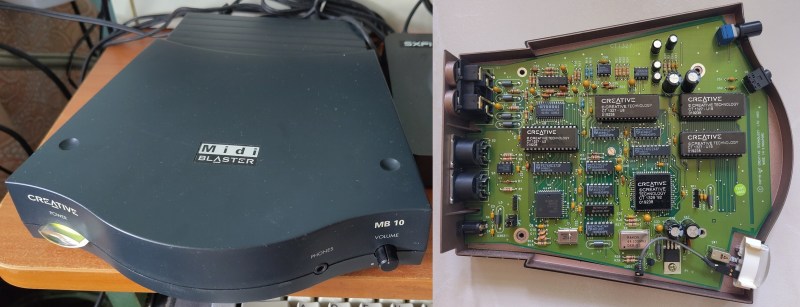
Before it became viable to distribute and play music tracks on home computers, the use of FM and Wavetable synthesis was very common, with MIDI Wavetable-based devices like the Roland MT-32 and SC-55 still highly sought after today. The Creative Midi Blaster MB-10 that [Yeo Kheng Meng] reviewed and tore down for an analysis isn’t quite as famous or sought after, but it provides a good example of what Creative Labs was doing at the time in this space.
Released in 1993, it definitely has more of a popular style vibe to it than the utilitarian Roland devices, even if this means highly impractical curves. In the list of features it claims Roland MT-32 emulation, which would have made it quite a bit more useful to the average user, including gamers of the era. Games like DOOM supported these MIDI devices for audio, for example.
In terms of price only the Roland SC-55ST comes close to the MB-10, similarly dropping a screen and a host of features. In terms of features the MB-10 claims far fewer instruments than the SC-55 variants, with even with the slightly higher priced SC-55ST massively outgunning it in raw specs. So would you ever buy the MB-10 back then and consider it a ‘good deal’? If $100 in 1990s money was worth losing full MIDI compatibility for, then it seems the answer was ‘yes’.
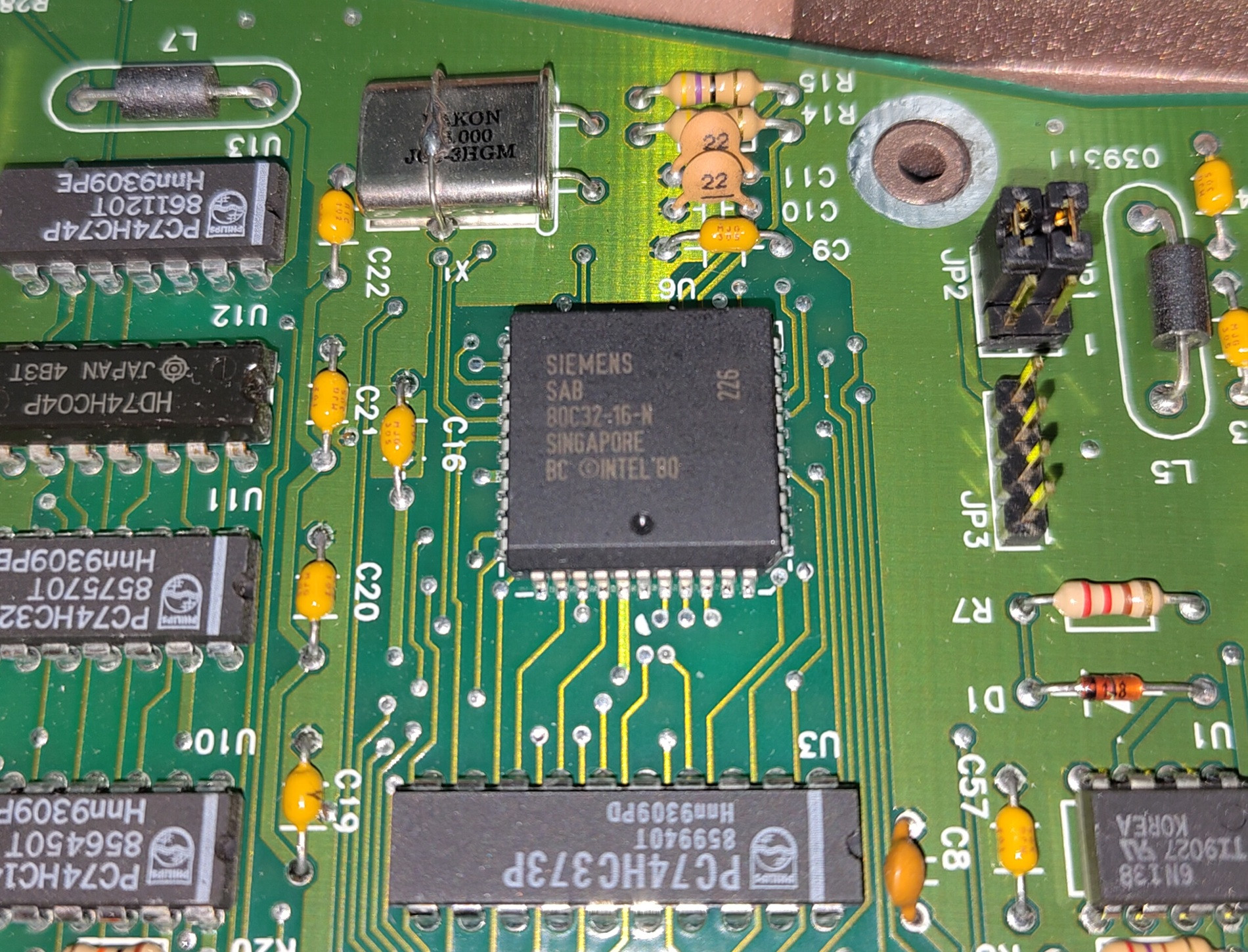
During the teardown of the MB-10 we can find an 8051-based Siemens processor that handles the MIDI interfaces and a Dream SAM8905 effects processor. Most of the remaining ICs are ROM chips that contain the firmware and MIDI banks, with the ROM dumps found in this GitHub repository.
The analog output stage includes the venerable TL074CN opamp and TDA1545 DAC, as well as a TDA2822M power amplifier IC. All of which is typical off-the-shelf for the era and also not something where Creative spent big bucks. It also appears that the 20-note polyphony claims on the box are false, as the Dream processor can only do 16 notes, which a quick test confirmed.
Despite being the cheaper option, it seems that most people with the spare cash to splurge on an external MIDI Wavetable device opted for a Roland one. These days it’s correspondingly quite hard to find an MB-10 for sale, unlike Roland MT-32 and SC-55 variants, yet considering software compatibility you really want to just stick with MT-32 and SC-55 compatibility anyway.












If someone can figure out how to get one of these into MT-32 mode, DOS gamers won’t care about the missing upper-half of the instrument table.
Were the curves impractical? Unquestionably. But at the same time, nobody was looking to rack mount one of these, and the slightly wasteful internal dimensions meant they were able to spread everything out enough to build these single-board without any sort of cooling, and still not have to worry about overheating.
There was a style trend in electronics then. Even in graphic arts, building design etc. I remember fads and styles that come and go. Some VCR’s had the bulge look even though the tape door was flat.
Remember that brief period circa ’98 when, prompted by the first-gen iMac, every single thing – from Zip drives to vacuum cleaners & clothes irons – was translucent teal plastic?
I assume it was intended for you to put your (CRT) monitor on top, rather than using the traditional pile of books/bits of wood that many of us used as a monitor stand.
I think a lot of graphic and mechanical design trends from the mid-90s to early 2000s was driven by design software gaining new capabilities, and the users just going nuts.
A CRT monitor would’ve instantly cracked that case, if you set it on top of it. Fair chance it would’ve broken the PCB as well, in the process of squashing the thing flat. Desktop CRTs weighed 40-50 pounds!
I’m also just now realizing that I have NO IDEA what those two holes in the top of the case are for. They don’t correspond to any of the holes in the lower body, and a teardown at another site confirms that the thing screws together from the BOTTOM, not the top. So, those holes are just… holes. Maybe they were meant as mounting points for something that would sit atop the Blaster. Perhaps even another (stackable?) MB-10.
I always preferred FM synth. Early wavetable and other synthesizers were right in that ‘uncanny valley’ – while undoubtedly closer to sounding like real instruments, they were also unmistakably synthetic. The overall impression does not sound good to my ears. (similar to auto-tune in pop music these days. Makes voices sound just enough ‘un-real’ to seem cheap and plastic-y)
Hi, if you like FM, please have a look at Adlib Tracker for some OPL2/OPL3 fun! :D
Then there’s ESFM, too. While it sounds a bit different to an genuine YMF262 (OPL3),
it has an awesome native mode that just recently had been better understood.
There’s a demo that makes use of it: https://www.pouet.net/prod.php?which=96920
I’m shocked that I discovered this device today. I was active in midi and DOS games during this time. I had Sound Blaster 32 and Gravis Ultrasound during this era. Still hanging onto a Sound Blaster 64, though I have no computer to put it in.
I am still hanging on to my Gravis Ultrasound Max (big red)
Btw, the SB32 and AWEs featured the fine EMU8000 chip (by EMU systems).
Besides doing MIDI it was very useful as astand-alone, high-quality MOD player.
There were a couple of MOD player programs for DOS and Windows 3.1/9x that uploaded samples into soundcard RAM.
Such as Impulse Tracker (IT), AWE32 modplayer v1.51, AWEPplay 0.430, AMP v2.01 etc
This allowed somewhat high-quality mixing that exceeded raw PC computing power of the 90s.
Still today, the EMU8k is still quite capable here.
The popular MOD4WIN supported same thing for GUS, OPL4 (AudioTrix Pro) and EWS64.
In case of OPL4, though, sample RAM had to be wired to the OPL4 (instead of a General MIDI ROM chip).
Personally, I think that building an Sound Blaster with EMU 8000 chip is still worth it in 2026!
You can listening and composing music on that thing.
There’s also Adlib Tracker that uses OPL3 (YMF262) FM synthesis.
It’s really mindblowing how much great music there is!
Even hybrid sample+FM songs that use both technologied.
Impluse Tracker supports that, I think. For MODs in Scream Tracker 3 (S3M) format.
Impulse Tracker also can utilize MMX for its drivers.
I still have a fine collection of .mod and .med (and OctaMED) files from my Amiga days; still play them occasionally, although looking at the file creation dates on them makes me sad & wistful.
I remember using MOD4WIN and being amazed that my Windows 3.1-based 486 could just about match the playback performance of my 7MHz, Workbench-based A500.
Thanks for the impromptu walk down memory lane. Nostalgia’s not as good as it used to be.
Wavetables are a synthesis technique used in e.g. Korg’s Wavestation, the PPG Wave, and Waldorf Microwave synthesizers. Saying that the MT-32, SC-55, or any of the Creative Labs products used wave tables is just incorrect. For some reason CL decided to co-opt the term for their cards with on-board sample memory, but they all used basic PCM playback.
Another term that could be used to describe soundcards with sample RAM might be Rampler (as opposed to Rompler), maybe.
https://en.wikipedia.org/wiki/Rompler
The MT-32 and CM32L (and LAPC-I) also are real, programmable synthesizers.
Unlike GM/GS/XG devices, their various waveforms can be altered and they support uploading new instruments.
https://en.wikipedia.org/wiki/Linear_arithmetic_synthesis
That’s why many games sounded off via MT-32 emulation, they’ve relied on custom instruments.
SOMI was one of the few games that used stock instruments, most notably.
That being said, there were few soundcards that offered more sophisticated MT-32 emulation than, say, AWEUTIL on AW32/64/SB32 or SETWF on Turtle Beach MAUI.
Besides the missing support for custom patches,
their physical MPU-401 often didn’t feature intelligent mode that was needed by many games from the 80s and early 90s.
Which caused trouble when trying to use external MIDI synths
either daughterboards attached waveblaster header or via DIN cable).
The intelligent mode differed from dumb mode (UART mode) that it offered features such as a metronome.
That intelligence was helpful in the days of slow 4,77 MHz PCs.
The dumb mode merely was providing a plain serial port, basically.
Interestingly, many games demanded for intelligent mode even though they didn’t use these features.
Implementing a simple “ACK” (acknowledge) response on the PC side made them run.
Programmable soundcards such as the Ensoniq Soundscape S-2000 provided that.
Nowadays, SoftMPU driver does provide this, too.
It can be run as a TSR and creates a virtual MPU-401 (intelligent-mode) that re-directs MIDI data to the real MPU-401 or a serial port.
Unfortunately, it will work with Real-Mode software on a 386+ only.
PC/XT users or PC/AT users (286 CPU) have to use a hardware solution, such as the MIDI Quest card or a clone.