
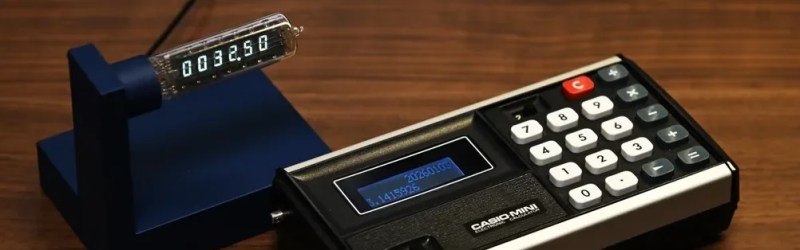
Have you heard the saying “the problem is the solution”? It seems to originate in the permaculture movement, but it can apply equally well to electronics. Take the problem [shiura] had: a Casio Mini CM-602 that had let out the magic smoke. The solution was a twofer: rebuild the Casio into a modern number cruncher with Reverse Polish Notation (RPN), and save the Vacuum Fluorescent Display (VFD) for a gorgeous WiFi clock.
[shiura]’s write-up includes a helpful guide for reverse engineering the pins on this sort of VFD, if you don’t happen to have the same model calculator (or VFD tube) they’re working with. If you’ve done this sort of thing, you know what to expect: power it up and kill power to the pins, one by one, to map out which segments or characters go out, thereby identifying the anodes and grid electrodes. The cathodes had already been ID’d from looking at the PCB. After that it’s just a matter of wiring the VFD to an ESP32 via a transistor array to get the voltages right, and voila! Clock. The code and case design files for this clock — including an editable .blend — are available via GitHub.
The calculator half of the project is an incredibly elegant hack that relies on the fact that the Casio’s CPU has the same pin pitch as modern micros: 2.54 mm, or 0.1″, so an RP2040 zero can sit in the footprint of the original CPU, scanning the keypads with its GPIO. Then an I2C display is separately wired up to replace the clockified VFD. Perhaps some driver circuitry for the VFD died, or [shiura] salvaged the display before deciding to save the calculator, because otherwise we see no reason why this brain transplant couldn’t be done while keeping the original display. Admittedly having two lines on the display instead of one make the “new” calculator a tad more usable. The code for that is also available on GitHub, and while the readme is in Japanese, machine translations have gotten pretty good and the code is quite readable on its own.
Longtime readers will likely be familiar with [shiura]’s work, with a number of finely crafted clocks having been featured from the Japanese maker, along with vintage pocket computer repairs. Bringing both together makes this twin hack particularly on-brand.











Was that supposed to be a joke that my humor detector failed to register?
Sounds like AI fail to me
Those em dashes tho
The HaD style guide (yes, we have one) wants dashes for asides instead of parentheses. Besides, they tuned ChatGPT to use fewer of them after everyone caught on; now what you want to look for are the incessant use of sentence fragments for emphasis, and the use of the word and: LLMs almost prefer to start a sentence with “and” than use it as a proper conjunction.
They’re also only an em-dash thanks to our page renderer autocorrecting the double-dashes I write with, because that was deemed more professional when the site was set up.
“ChatGPT, please write a blog post about this website https://www.instructables.com/A-Modern-Calculator-and-Clock-From-a-Broken-50-Yea/ in the style of a http://www.hackaday.com blog post”
Harsh and uncalled for.
Did you get an LLM to write that? XD
It’s pure hallucination: I haven’t been with HaD for two years, nor do I have a Twitter account. I haven’t since about 2010, and even then it wasn’t under my real name.
Regarding: Variable Frequency Drive (VFD)
that’s really sad… it makes you wonder how much effort is put into writing these “articles”.
Regarding the project cool. But it’s kind of daring leaving the edge of the tube so unprotected.
Fun fact! The I submitted to HaD didn’t bother defining VFD; I assumed you lot would all know what it was from context. I can’t speak to what happened after that, I’m afraid. It’s fixed now of course.
Was that a Freudian slip?
Thanks for your honesty and the small peek behind the curtain. I’m happy to have read it in case The Man removes it. It does confirm some of the suspicions I’m sure many of us have.
Unusual to see a Japanese lefty.
Ironic it’s such a strongly right-handed calculator.
The original Casio Mini was a watershed calculator in its day, setting the new low watermark for price for a four function electronic calculator. It sold like hotcakes, so vintage calculator preservationists don’t worry too much about seeing one repurposed in such an imaginative way. The only thing cooler would be to make the clock out of a repurposed Pandicon display rather than VF, though, as far as I am aware, Pandicon displays had connections at both ends, meaning that the tube would be supported at both ends instead of one end hanging in the air.
I have a NIB Pandicon tube sitting around for a project some day …. Just need some motivation to build something cool.
My parents bought a Casio Mini for me (new) when I was in middle school for the princely sum of $60. Still, that was just a quarter of the Bowmar Brain and other calculators available at the time. I still keep my Casio in my roll-top desk and use it from time to time.