
If you’ve wiring up a microcontroller and need some kind of storage, it’s likely you’ll reach for an SD card. Compared to other ways of holding data on your project, SD cards are just so much cheaper, resilient to physical and magnetic shocks, and simpler to work with from both a hardware and software perspective. On the other hand, it might seem silly to put a SD card slot on a board that’s never going to see a replacement card. [DIY GUY Chris] wants to advertise a solution for that: a cardless SD card chip by XTX that can act as a drop-in replacement for your projects.
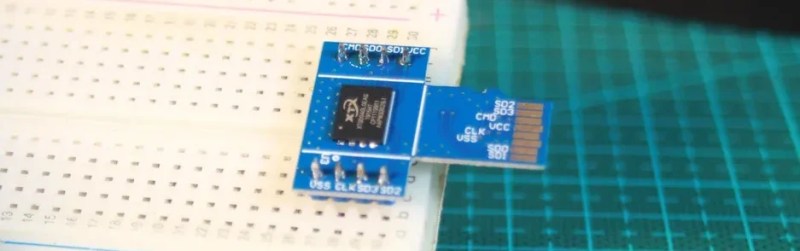
The XTXD0*G series are NAND flash chips of precisely the sort you’d find in an SD card, except without the SD card. That means you can use your usual SD card access libraries to speed prototyping, but skip the BOM cost of an actual card reader. In his Instructable and the video embedded below [Chris] shows how he used the 4 Gbit version, the XTSD04GLGEAG to make a custom SD-compatible breakout board that is equally happy in your laptop’s card reader or on a breadboard.
To get it plugged into the breadboard, [Chris] is using the standard 2.54 mm headers you can get anywhere; to get it plugged into a card reader, he’s just relying on the PCB being cut to shape. [Chris] notes that you’ll want to have the board built at 0.6 mm thickness if you’re going to plug it in like a micro SD card.
Of course once you’ve gotten used to the little NAND chips, there’s no need to put them on breakouts but this looks like a fun way to test ’em out. You don’t need to keep your flash chip on an SD-card sized PCB, either; we saw something similar used to make modern game cartridges. If you insist on using a standard SD card and don’t want to buy a slot, you can certainly DIY that instead.












So basically an SD version of eMMC. Neat!
Speaking of MMC… and around the cycle goes.
https://en.wikipedia.org/wiki/MultiMediaCard
I’m not sure about this eMMC module but many have much better longevity and data endurance than SDcards.
Perhaps more useful than you’d imagine to replace SD cads with them!
This is an SD interface, not eMMC.
The LGA8 parts (XTSDxx) have an extremely sparse datasheet, but the more recent guys (XTSDGxx) specify 100k P/E and 10 year retention. So pretty good from a NAND perspective.
I’m kinda wary about flash cards in everything.
They wear out.
I wish there was an actual truly permanent media that one could produce as an individual maker or small business. Mask ROM seems expensive and unavailable now.
I’ve considered the idea of making a super tiny circuit board of diodes, but the site is just unrealistic for today’s data requirements.
There’s a ludicrous gap in longevity/endurance between a mask ROM and NAND flash. NOR flash is good enough for most cases.
I guess one issue with SD cards is that the erase region size is larger than the typical logical block size of a file system. You want to write a block, an entire erase region of the SD card gets loaded into an internal buffer (where the block gets overwritten), the complete erase region gets erased and then the content of the internal buffer gets written back to NAND.
Haha, just kidding. What really happens is that there is a power supply glitch after the region has been erased and before the buffer has been written back. Even journaling CoW filesystem can’t cope with that — it’s not just one block which got lost but a pretty large region of the card.
I guess if you add a storage capacitor which can keep the card’s controller alive long enough, this problem might be solved.
Cheap Chinese NAND factory reject chips are a different problem, of course.
I think I might like this better than an SD for some scenarios where I do want to keep the memory removable. For example.. a 3d printer controller board. It would be kind of like plugging in a Pololu. That just seems more durable, harder to lose, just more appropriate for the sort of project.
Like Pololu though, it would need to become a standardize pinout, placement and spacing.
Only difference is the micro SD is basically a cob already
Can someone let mw know if this can be used to emulate the initial SD standard (capacity up tp 2 GB)? Got myself a 3D printer that can read only those cards, serial not working, and the tiny supply of such cards as second hand is exhausted by old equipment (usually for updates).
Thanks.
No, it’s SD 2.0 which is when they introduced SDHC (so SD_SPEC is 2).
Thanks.
4Gb (512kB) not 4GB
4Gib
4G is 1000
4Gi is 1024
https://en.wikipedia.org/wiki/Binary_prefix
Good catch. I’ll call it Gbit in case that was autocorrupt and not a purely human typo.
I’m seeing 8Gbit chips on LCSC for about $4.20 in qty 100. I can get a micro SD card and SMD socket for half that price, or less. It does take up a bit more space on the PCB, but I could put any size card in there I want.
I use a 3d printers, laser etc. and have trouble with sd card. I have data on normal usb flash reader but must using sd card. Please make converter (live) for puting usb everywhere I can use sd card, raspberry pi, printers etc.
No.
If someone did the near impossible (impossible to do w decent speed) for you, you couldn’t handle it.
As demonstrated by your inability to handle USB sd card readers.
Hint: Format the card in the printer.
Adafruit’s had something like this in their catalogue for a year or two now. Seems like a neat idea but I haven’t yet found a use-case where it seemed a better fit than an SD card as such.
You just Apple’d the SD card. Good job. /s
This seems kinda silly to me. There are SPI flash chips that are far, far easier to use than an SD card. I’ve done this for FAT file systems full of audio samples being read by FatFs. You set them up at manufacture time with flashrom. Very easy.
Writing is a little harder, but not much.
They don’t make SPI flash anywhere near this large.